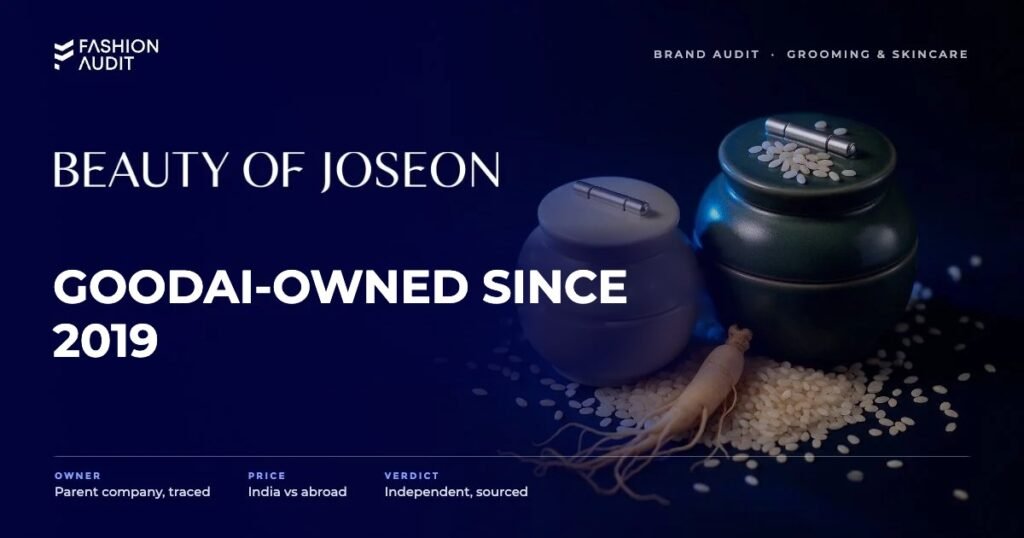
Beauty of Joseon is often described as an independent Korean indie brand. Since 2019 it has been owned by Goodai Global Inc. of Seoul. Goodai now holds about a dozen K-beauty brands — TIRTIR, SKIN1004, Round Lab and Skinfood among them — and in 2025 five Korean private-equity houses put ₩800 billion of convertible bonds into it. The sunscreen is made by neither of them.
Beauty of Joseon is owned by Goodai Global Inc., a Seoul group that acquired it in 2019 and now holds about a dozen K-beauty brands. Its Relief Sun sunscreen carried Indian MRPs of ₹1,500 to ₹1,570 on 3 September 2026, about 20% to 25% above the Korean list price of ₩18,000, and sold at ₹1,425 on Tira. The brand publishes two laboratory SPF results with standard deviations; its page does not name the laboratories or the test standard.
Snapshot
- Brand
- Beauty of Joseon, Korean 조선미녀 (Joseon Minyeo)
- Owner
- Goodai Global Inc., 541 Eonju-ro, Gangnam-gu, Seoul; Korean business registration 151-87-00589; acquired the brand in 2019
- Chief executive
- Cheon Joo-hyuk
- Declared manufacturer on Indian packs
- Kolmar Korea Co. Ltd, Sejong-si — a contract manufacturer
- Declared Indian importer
- Beauty Barn, Dimapur, Nagaland — on the one Indian listing that carries the declaration
- Price band in India
- ₹298 for a 10 ml mini to ₹1,570 for the 50 ml sunscreen, checked 3 September 2026
How it started
Goodai Global did not begin as a brand owner. It began as BRAND2C, a beauty wholesale and distribution platform, and became a brand owner by buying one. Beauty of Joseon was its first acquisition, in 2019 — the year the Korea Herald describes as the point at which Goodai formally entered beauty. Who founded the brand before that, and what Goodai paid for it, are not on the record; every account calls the price undisclosed.
What happened afterwards is easier to trace, because it happened in public and at speed.
- 2019Buys Beauty of Joseon; price never disclosed
- 2024Buys TIRTIR
- 2025Buys SKIN1004, Skinfood at about ₩150 billion, Round Lab at about ₩600 billion
- July 2025Five private-equity houses subscribe ₩800 billion of convertible bonds
- Early 2026Buys Hansung USA at about ₩100 billion; IPO preparation reported in February 2026
Roughly ₩1 trillion spent on four cosmetics companies in a single year.
The money deserves precision, because it is reported loosely. IMM Private Equity put in ₩280 billion, JKL Partners ₩120 billion and Premier Partners ₩120 billion, with Kiwoom Private Equity and Company K Partners taking the rest, at an enterprise value of ₩4 trillion. Those are convertible bonds — loans that can later turn into shares, and until they do, not a shareholding. No cap table has been published, so nobody outside the company can say what percentage of the parent anyone owns.
Goodai’s own 2024 revenue was ₩323.7 billion, up 132%. A figure of ₩1 trillion circulates as its revenue and is not: that is the combined retail sales of every brand it owns. Goodai is private and none of this comes from an audited filing, so treat the figures as press-reported.
What they actually make
One product carries the house. Beauty of Joseon is a sunscreen brand with a skincare range attached, and its own June 2026 announcement claims to be the “Global No.1 K-Beauty Suncare Brand in Online Sales”. The footnote sets the basis: online retail value only, at brand level, among brands of Korean origin, on 2025 data. The brand publishes that footnote alongside the claim.
It does not make the sunscreen. The Indian pack names Kolmar Korea Co. Ltd of Sejong-si as both manufacturer and packer, on both Relief Sun products whose declarations could be read. Kolmar is one of the two large Korean contract manufacturers. Neither Goodai Global nor Beauty of Joseon appears on the pack as maker — a distinction a reader also meets with Bata, where the name on the shoe and the company behind it are separate things, and the opposite of Campus, which runs its own plants and says so.
- Beauty of JoseonThe brand; acquired in 2019
- Goodai Global Inc., SeoulIts owner; about a dozen K-beauty brands
- Kolmar Korea Co. Ltd, Sejong-siDeclared manufacturer and packer on the Indian pack
- Beauty Barn, DimapurDeclared importer on the only Indian listing carrying one
Four names, four companies: the brand on the bottle, its owner, its maker and its importer.
Under a heading reading “Lab-Tested SPF Protection”, the brand’s own product page gives numbers rather than a badge: SPF 52.5±5.8 from a laboratory in Korea and 63.1±0.6 from one in Spain, with UVA protection factors of 16.1±2.4 and 19. Standard deviations from two laboratories in two jurisdictions, printed where anyone can read them, is more than most sunscreen sold in India offers.
The page gives the laboratories as “Lab 1 (Korea)” and “Lab 2 (Spain)” without naming them, and does not cite a test standard, panel size or date, or link a report. Korea caps the printed figure at SPF50+ and PA++++, which is why the measured 63.1 appears on no pack, and the brand does not use the higher number to claim anything. The Indian listings carry the same claim as the Korean pack.
| Claim on the brand’s own page | What is published behind it |
|---|---|
| “SPF50+ PA++++” on Relief Sun | SPF 52.5±5.8 (Korea) and 63.1±0.6 (Spain); UVA-PF 16.1±2.4 and 19. Laboratories, standard, panel size and date not stated |
| “Rice Extract (30%)” on the same product | The percentage is printed inside the ingredient list itself, at position two — consistent with the stated concentration |
| “23.31% improvement in skin glossiness”, Glow Serum | A three-week study on 21 subjects; institute, date and protocol not stated |
| “51.42% improvement in sebum”, Glow Serum | A three-day study on 33 subjects; institute, date and protocol not stated |
| “Global No.1 K-Beauty Suncare Brand in Online Sales” | A Euromonitor footnote: online retail value, brand level, Korean-origin brands, 2025 data |
| “All our products are cruelty-free” | The brand’s own statement, carrying no date. PETA’s directory does not list the brand |
Two of those rows deserve a second look. The rice percentage sitting inside the ingredient list rather than only on the front of the bottle is unusual and worth crediting. And the serum footnotes give both the study length and the panel size, so a reader can weigh them.
What Beauty of Joseon costs in India
Korea is the comparison that matters. Converted at the European Central Bank reference rates dated 2 September 2026 — ₩1 at ₹0.0697 and $1 at ₹94.97, read on 3 September 2026 — the Indian price lands well above the Korean one.
- Korea, brand’s own store
- ₩18,000 for 50 ml = ₹1,255 (₹25.09/ml)
- India, MRP on Nykaa
- ₹1,570 for 50 ml (₹31.40/ml)
- Gap
- +25.1%
- Checked on
- 3 September 2026
Tira prints a lower MRP for the same bottle, ₹1,500, and sells it at ₹1,425 — which is still 13.6% above Korean list. That is two Indian MRPs for one 50 ml sunscreen on one day, ₹70 apart. Against America the direction reverses: the brand charges $18 on its own global site, or ₹1,709, so India is roughly 8% to 12% cheaper than the United States.
The mini costs more per millilitre. kindlife sells a 10 ml Relief Sun at ₹350 MRP, discounted to ₹298 — ₹35.00 and ₹29.80 per millilitre against ₹28.50 for the 50 ml bottle at Tira’s selling price. The small pack costs more per millilitre than the large one, which is the ordinary shape of travel sizes and the reason to divide before you pay. That gap between printed and paid prices is the one documented on Metro — compare the price paid, not the strike-through.
Beauty of Joseon names seven authorised Indian sellers on its own retailer page.
Who Beauty of Joseon is actually for
At ₹1,425 to ₹1,570 for the 50 ml sunscreen at the prices actually charged on 3 September 2026, this is mid-range skincare in India — dearer than a domestic drugstore sunscreen, well below a prestige counter. It suits someone buying a daily sunscreen and a serum or two, because the sunscreen is what the brand is for and the rest is built around it.
For buyers choosing it on the SPF figure, the page gives two laboratory results with standard deviations but no named laboratory or linked report. If a published report from a named laboratory is your threshold, the page does not provide one; if two sets of numbers with standard deviations beats a bare badge, it clears that.
Reputation and controversies
One Indian matter has been decided, and it went the brand’s way. The Delhi High Court ordered the cancellation of a trade mark registered in October 2022 by a third party on a proposed-to-use basis, combining Korean characters with the English words “Beauty of Joseon”. The court held the mark “is likely to cause confusion and deception among the consumers who are ordinary persons of average intelligence”, and found no proper reason to adopt a mark so deceptively similar other than to ride on the goodwill and reputation of Goodai’s business. The ruling was reported on 6 February 2025 and is cited as 2025 LiveLaw (Del) 142. Goodai had been distributing in India since August 2022.
The advertising council’s public complaint-outcomes database holds no entry under the term “Beauty of Joseon”, searched on 3 September 2026. That council files under the advertiser’s name, and for an imported brand the advertiser is the Indian seller or importer rather than the Korean owner. Read the empty result as one term checked, not as a settled record.
On animal testing the brand and the directory disagree. Beauty of Joseon states that “all our products are cruelty-free, and we do not test on animals”, on an undated page. PETA’s Beauty Without Bunnies entry says the brand “may not be cruelty-free” because the company has not signed PETA’s statement of assurance. Not being in a directory is not evidence of animal testing; it is evidence that nobody has signed the paperwork. Animal testing of cosmetics has been illegal in India since 21 May 2014 in any case, so this is the legal floor rather than a distinction.
As at 3 September 2026, the brand’s FAQ said its QR authentication application had been suspended and its coded seals were being phased out. Until something replaces them, the checks left are the printed manufacturing date, a three-year window and the brand’s own list of authorised sellers.
Buying it in India
Every cosmetic imported into India must be registered before it lands — Rule 12(1) of the Cosmetics Rules 2020, notified by GSR 426(E). The application is form COS-1 and the certificate form COS-2, with COS-4 for an additional import number and COS-12 for a new cosmetic. The certificate carries an RC/COS number and is held by the Indian importer or authorised agent, never by the Korean brand. The public cannot search that register, which leaves a buyer one question and it costs nothing to ask.
Beauty of Joseon publishes an authorised-retailer page, and India is listed with seven names: Amazon, Maccaron, Foxy, Beauty Barn, Care & Class, kindlife and Nykaa. Among the Indian listings checked on 3 September 2026, Beauty Barn of Dimapur displayed a full statutory declaration, importer included, on both products checked.
Beauty Barn also prints what almost nobody else does: the expiry date on the listing, 8 May 2028 on one Relief Sun and 17 March 2028 on the other. The brand states a shelf life of three years unopened from the manufacturing date and twelve months once opened. That arithmetic gives a buyer a simple freshness check.
Ask the seller for the registration number
The certificate carries an RC/COS number and the Indian importer holds it. Ask for it before you buy.
Check the seller against the brand’s own list
Beauty of Joseon publishes seven authorised Indian retailers by name. Check the brand’s page for the current list before you buy.
Read the manufacturing date and count three years
The date is printed on the pack and the unopened shelf life is three years. A bottle within twelve months of that limit is not a bargain at any discount.
Look for the importer line
An Indian listing should name the manufacturer, packer and importer. Where the listing does not show them, check the pack.
Divide by the millilitre
The 50 ml sunscreen runs ₹28.50 to ₹31.40 per millilitre in India. The 10 ml mini runs ₹29.80 to ₹35.00. The small bottle is the expensive one.
Common questions
Is Beauty of Joseon an independent brand?
No. Goodai Global Inc. of Seoul acquired it in 2019 and now owns about a dozen K-beauty brands, including TIRTIR, SKIN1004, Round Lab and Skinfood. Five Korean private-equity firms hold ₩800 billion of convertible bonds over the parent, and press reports in February 2026 said it was preparing an IPO.
Do private-equity firms own Beauty of Joseon?
They hold convertible bonds over its parent, which are instruments that can later turn into shares rather than shares themselves. No cap table has been published, so no percentage held by anyone can be stated.
Is it cheaper in India than in Korea?
No. The 50 ml Relief Sun is ₩18,000, or about ₹1,255, on the brand’s Korean store against ₹1,500 to ₹1,570 at Indian MRP on 3 September 2026 — roughly 20% to 25% dearer here. Against the American price of $18 it is 8% to 12% cheaper here.
Does Beauty of Joseon publish its SPF testing?
It publishes results: SPF 52.5±5.8 from a Korean laboratory and 63.1±0.6 from a Spanish one, with UVA protection factors. It does not name either laboratory, cite a test standard, give a panel size or a date, or link a report.
Who makes it, and who imports it into India?
The Indian pack names Kolmar Korea Co. Ltd of Sejong-si as manufacturer and packer. On the one Indian listing that carries a full declaration, the importer is Beauty Barn of Dimapur, Nagaland.
Can I still scan a code to check my bottle is genuine?
Not reliably, as at 3 September 2026. The brand’s FAQ said then that its QR authentication application was suspended and the coded seals are being phased out. What remains is the printed manufacturing date, the three-year unopened shelf life and its published list of authorised sellers.
How we research and verify brand audits: our methodology.
References
- The Korea Herald, 4 September 2025 — the 2019 acquisition, the distributor origin, 2024 revenue of ₩323.7 billion and the separate ₩1 trillion brand-portfolio figure
- KED Global, 27 July 2025 — the ₩800 billion convertible bonds, the five investors and the ₩4 trillion enterprise value
- KED Global, 1 June 2025 — roughly ₩1 trillion spent on four cosmetics companies in a year
- BeautyMatter, 1 December 2025 — the investor list and the 2019 acquisition year
- KoreaTechDesk, 10 February 2026 — the brand count, the Hansung USA purchase and the IPO preparation
- Beauty of Joseon Korean official store, 3 September 2026 — the ₩18,000 Korean price, the company name, registration number and Seoul address
- Beauty of Joseon, Relief Sun product page, 3 September 2026 — the two laboratory results, the UVA figures, the 30% rice extract inside the ingredient list and the $18 price
- Beauty of Joseon, Glow Serum product page, 3 September 2026 — the 21-subject and 33-subject study footnotes
- Beauty of Joseon, authorised online retailers, 3 September 2026 — the seven Indian sellers named by the brand
- Beauty of Joseon, product FAQ, 3 September 2026 — shelf life, the suspended authentication application, the phased-out seals and the cruelty-free statement
- Company announcement, 9 June 2026 — the Euromonitor claim and the footnote quoted here
- Beauty Barn, Relief Sun Rice + Probiotics 50 ml, 3 September 2026 — the full statutory declaration and the printed expiry date
- Beauty Barn, Relief Sun Aqua-Fresh 50 ml, 3 September 2026 — the second declaration naming Kolmar Korea and the Dimapur importer
- Nykaa, Relief Sun listing, 3 September 2026 — the ₹1,570 Indian price
- Tira, Beauty of Joseon brand page, 3 September 2026 — 36 products, the ₹1,500 MRP and the ₹1,425 selling price
- kindlife, Beauty of Joseon brand page, 3 September 2026 — the 10 ml mini at ₹350 and ₹298
- LiveLaw, 6 February 2025, 2025 LiveLaw (Del) 142 — the Delhi High Court cancellation order and the quoted reasoning
- Marks & Clerk, 13 May 2025 — a second account of the same cancellation and the August 2022 Indian distribution date
- PETA, Beauty Without Bunnies, 3 September 2026 — the “may not be cruelty-free” entry
- CDSCO, guidance on registration and import of cosmetics, 19 January 2021 — Rule 12(1), the COS forms and who holds the certificate
- European Central Bank reference rates, 2 September 2026 — the won and dollar rates behind every conversion here
- Advertising Standards Council of India, complaint outcomes, 3 September 2026 — the search on the brand name
On evidence, Beauty of Joseon is one of the better-behaved sunscreen brands an Indian buyer can reach. Two laboratory results with standard deviations, a rice percentage printed inside the ingredient list, panel sizes on its serum claims and a published Euromonitor footnote add up to more disclosure than most of the shelf offers. At ₹1,425 on Tira it is not an unreasonable price for a daily sunscreen.
The questions are price and paperwork. Indian MRPs ran 20% to 25% over the Korean list price on 3 September 2026, the 10 ml mini costs more per millilitre than the 50 ml bottle, and the SPF results are published without the laboratories’ names.
Worth the ₹1,425 as a daily sunscreen, bought from one of the seven sellers the brand names; skip the 10 ml mini, which costs more per millilitre.