

Khadi is cloth that is both hand-spun and hand-woven; handloom is any cloth woven by hand on a loom, usually from mill-spun yarn. Both are part of India’s story, from the Swadeshi movement to today’s weaver clusters, and both are among the most comfortable fabrics for Indian weather. They are also widely imitated. This guide explains the difference, the famous weaves, the marks to look for, and how to buy and care for genuine handmade cloth.
Fabric Check is Fashion Audit’s series on the fabrics in your wardrobe. Prices checked 11 November 2026.
The short answer
For breathable, characterful clothes that also support weavers, buy khadi or handloom from sources you can check: weaver cooperatives, state emporiums, Khadi India outlets, or products with the Handloom Mark, India Handloom Brand or a GI tag. Expect to pay more than for mill fabric, expect small irregularities, and wash new khadi in cold water the first time.
Khadi, handloom or powerloom?
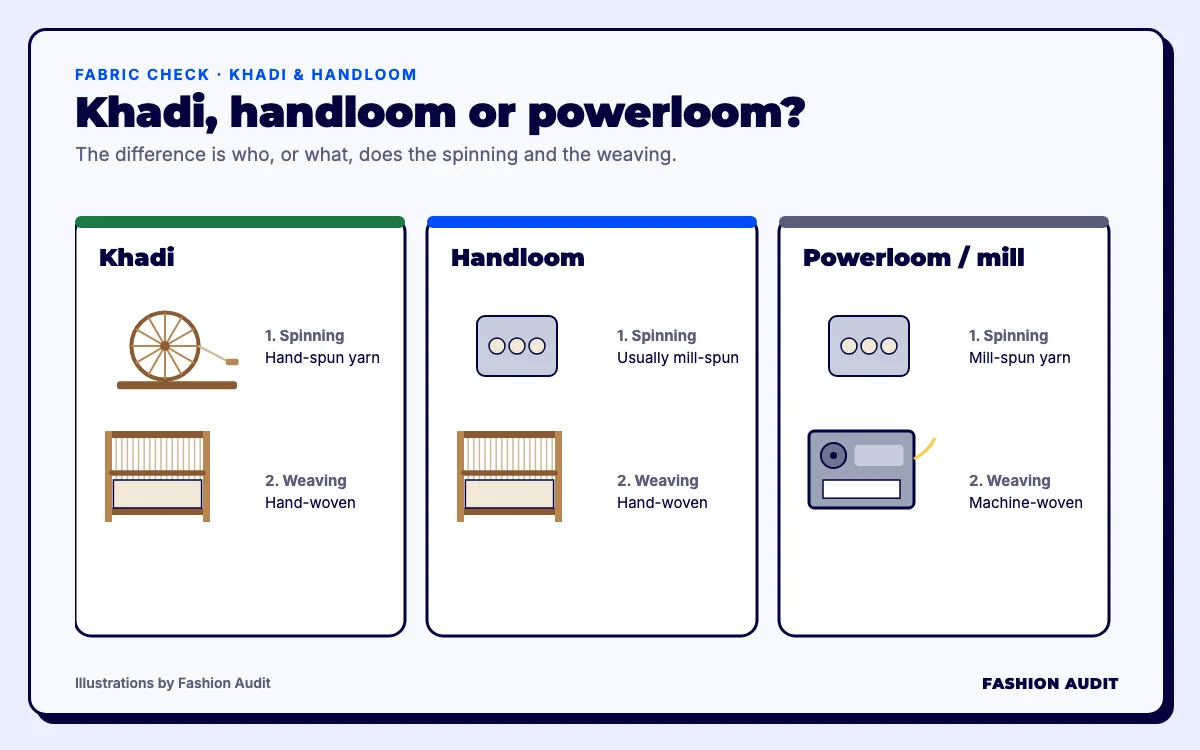
- Khadi: the yarn is spun by hand on a charkha and the cloth is woven by hand (New India Samachar, PIB).
- Handloom: the cloth is woven by hand on a loom, but the yarn is usually spun in a mill.
- Powerloom or mill cloth: both spinning and weaving are done by machine. Much “handloom-look” fabric is made this way.
Khadi can be cotton, silk or wool, as long as it is hand-spun and hand-woven.
From charkha to kurta
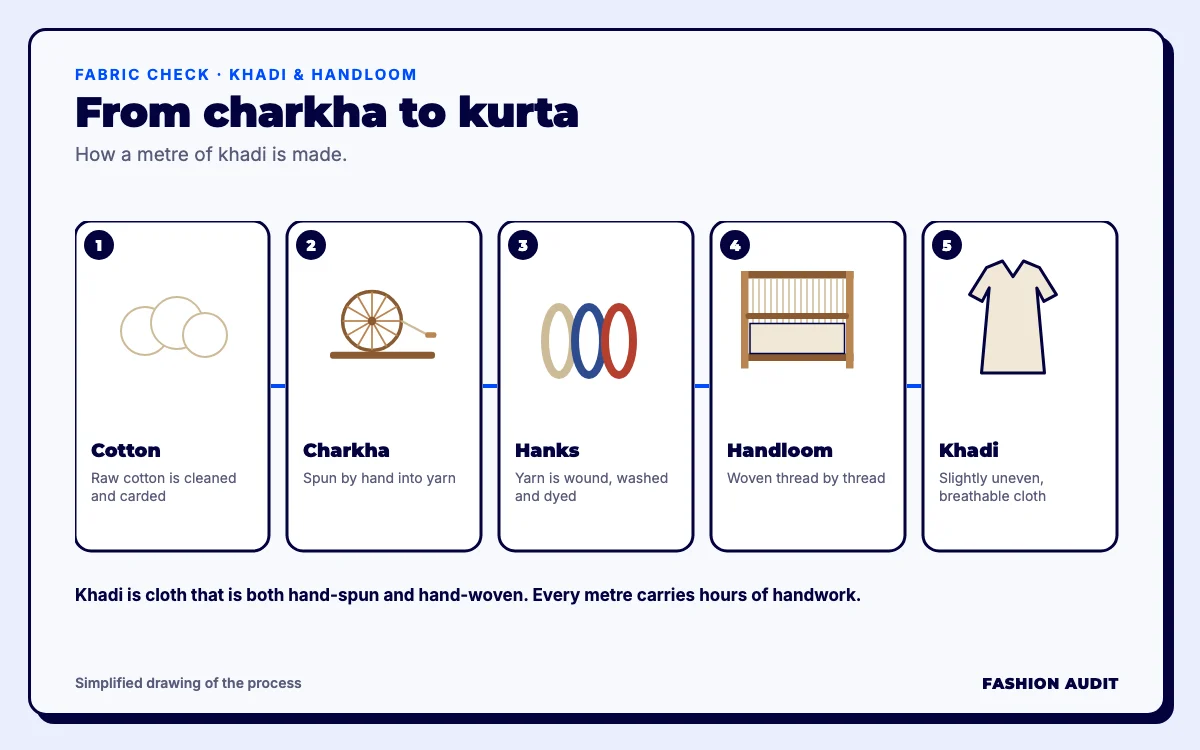
Cotton is cleaned and carded, spun into yarn on a charkha, wound into hanks, washed and dyed, then woven on a handloom. Because both steps are done by hand, khadi has a slightly uneven, textured surface. That texture is not a defect: it lets air through and gives each piece its own character.
A short history
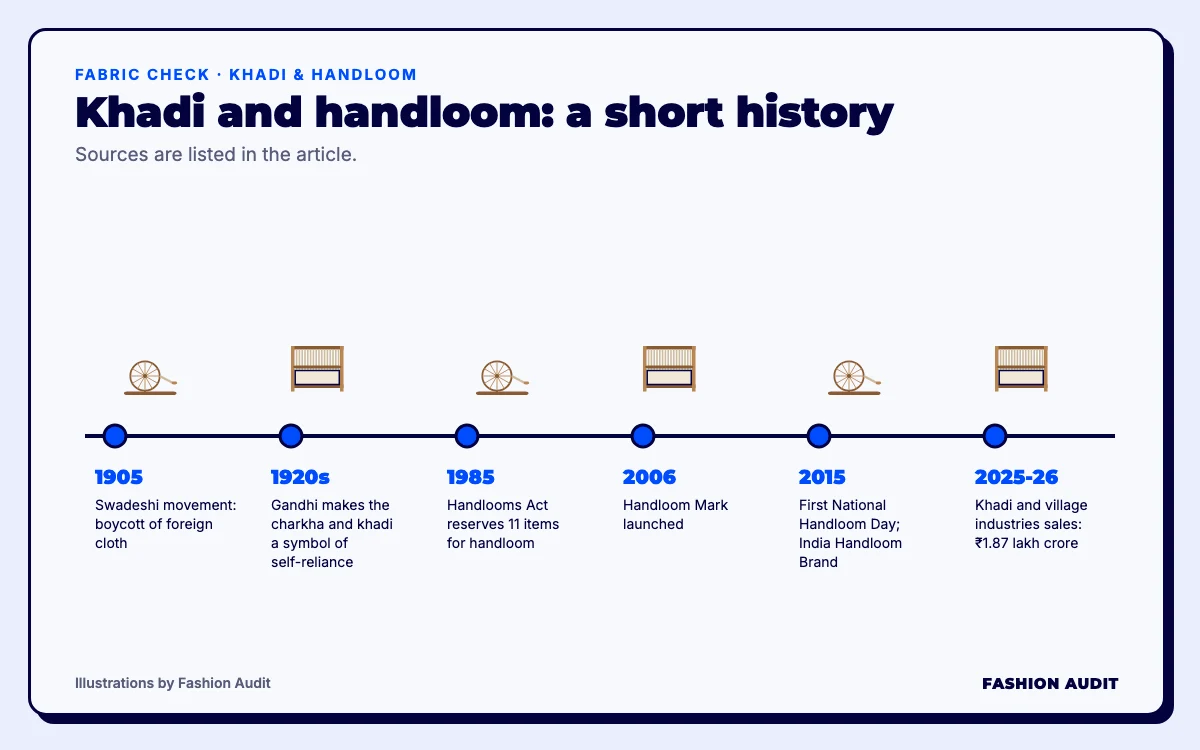
The Swadeshi movement, launched in 1905, urged Indians to use home-made goods. In the 1920s Gandhi made the charkha and khadi symbols of self-reliance. Today National Handloom Day is observed on 7 August, chosen to mark the launch of the Swadeshi movement, and was instituted in 2015 (PIB, National Handloom Day 2026). The Handlooms Act, 1985 reserves 11 textile articles for handloom production to protect weavers from powerloom competition (PIB).
Khadi has also grown into a large business. Sales of Khadi and Village Industries products, which include items like honey and soap as well as cloth, reached ₹1.87 lakh crore in 2025-26, according to the government (PIB).
India’s handloom, in numbers
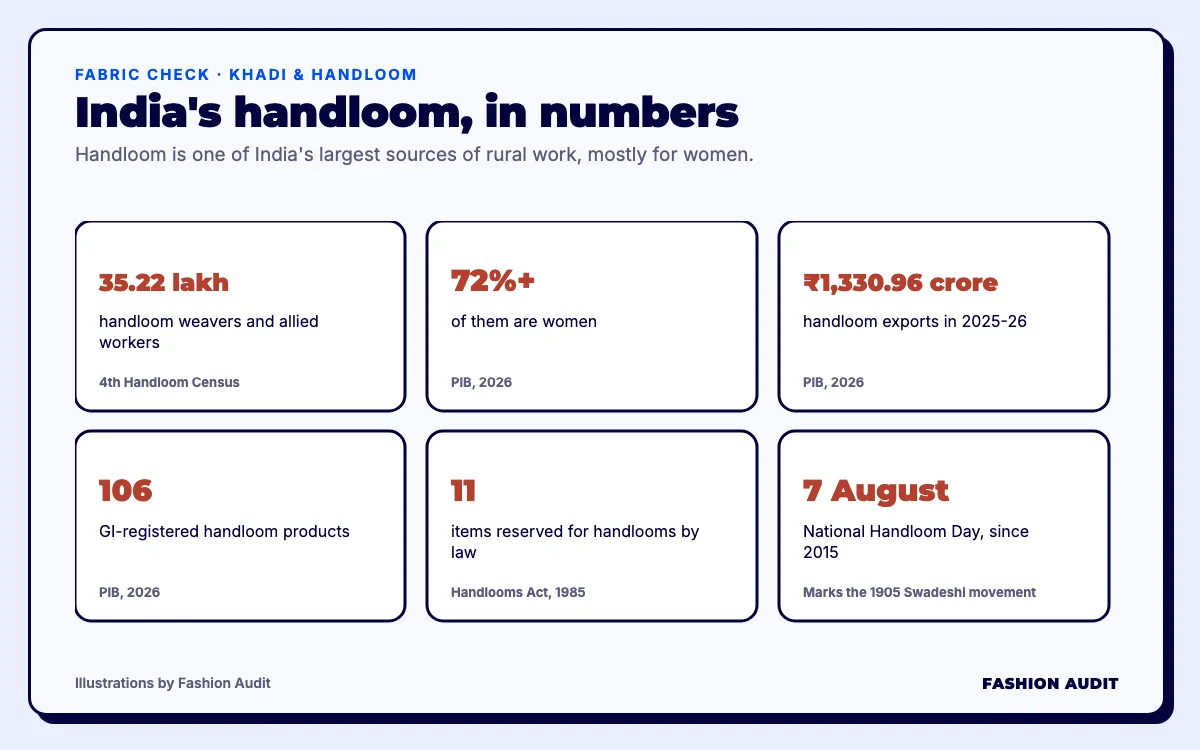
According to the government, India has 35.22 lakh handloom weavers and allied workers, and more than 72% of them are women. Handloom exports were about ₹1,330.96 crore in 2025-26, and 106 handloom products have Geographical Indication registrations (PIB).
Handloom weaves to know
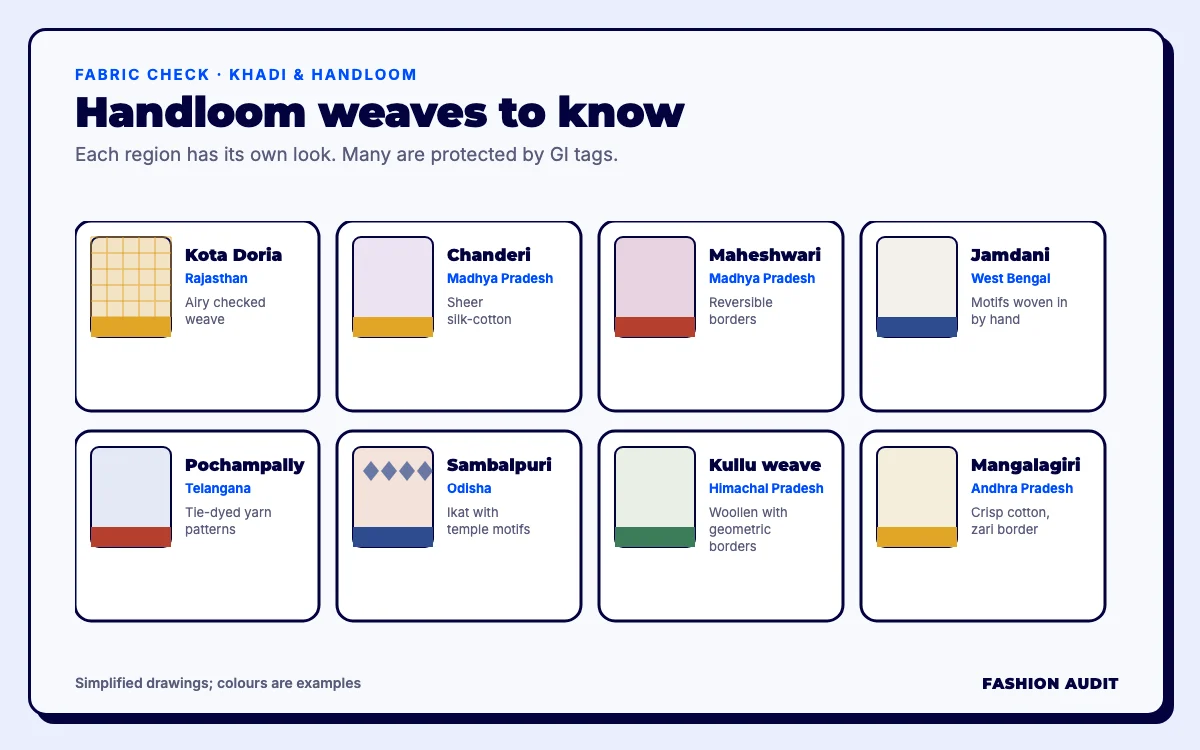
- Kota Doria (Rajasthan): airy, checked weave, perfect for summer sarees.
- Chanderi (Madhya Pradesh): sheer silk-cotton with fine motifs.
- Maheshwari (Madhya Pradesh): light sarees known for reversible borders.
- Jamdani (West Bengal): motifs woven in by hand on fine cotton.
- Pochampally ikat (Telangana): geometric patterns from tie-dyed yarn.
- Sambalpuri (Odisha): ikat with temple and nature motifs.
- Kullu weave (Himachal Pradesh): woollen shawls with geometric borders.
- Mangalagiri (Andhra Pradesh): crisp cotton with a zari border.
Our silk guide covers Banarasi, Kanjeevaram and other silk weaves.
How ikat gets its pattern
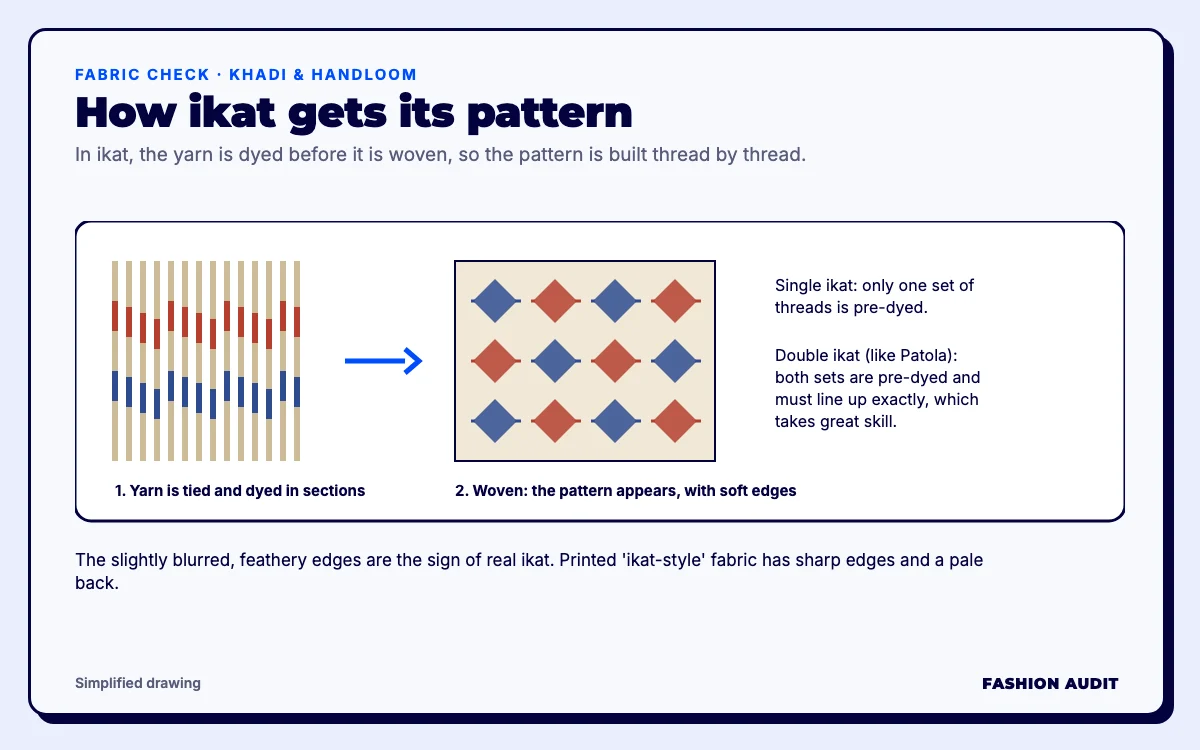
In ikat, sections of yarn are tied and dyed before weaving, so the pattern is built up thread by thread on the loom. In single ikat, one set of threads is pre-dyed; in double ikat, such as Patola, both are, and they must line up exactly. The soft, feathery edges of the pattern are the sign of real ikat. Printed “ikat-style” fabric has sharp edges and a pale reverse.
How to tell handloom from powerloom
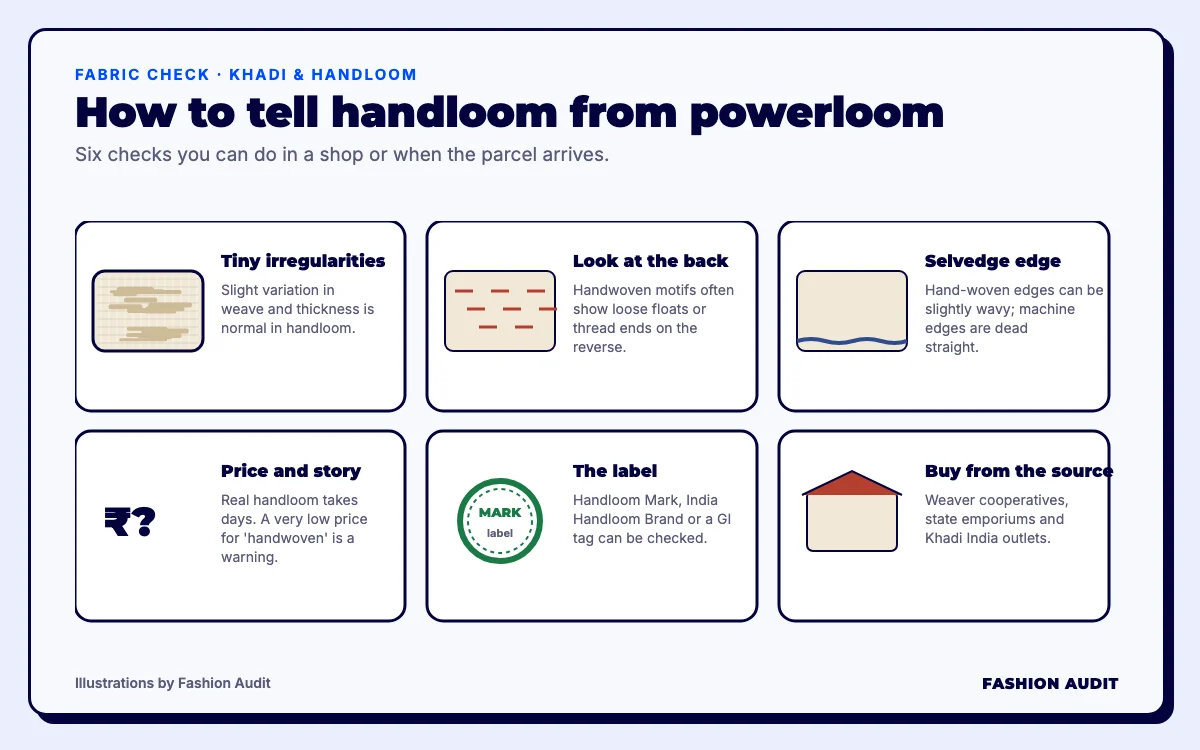
- Tiny irregularities in thickness and weave are normal in handloom; machine cloth is perfectly even.
- Look at the back: handwoven motifs often show loose floats or thread ends on the reverse.
- The edge: hand-woven selvedges can be slightly wavy.
- Price and story: real handloom takes days to weave, so a very low price for “handwoven” is a warning sign.
- Labels and sellers: look for official marks, and buy from cooperatives, state emporiums or Khadi India outlets.
The marks that help you buy genuine
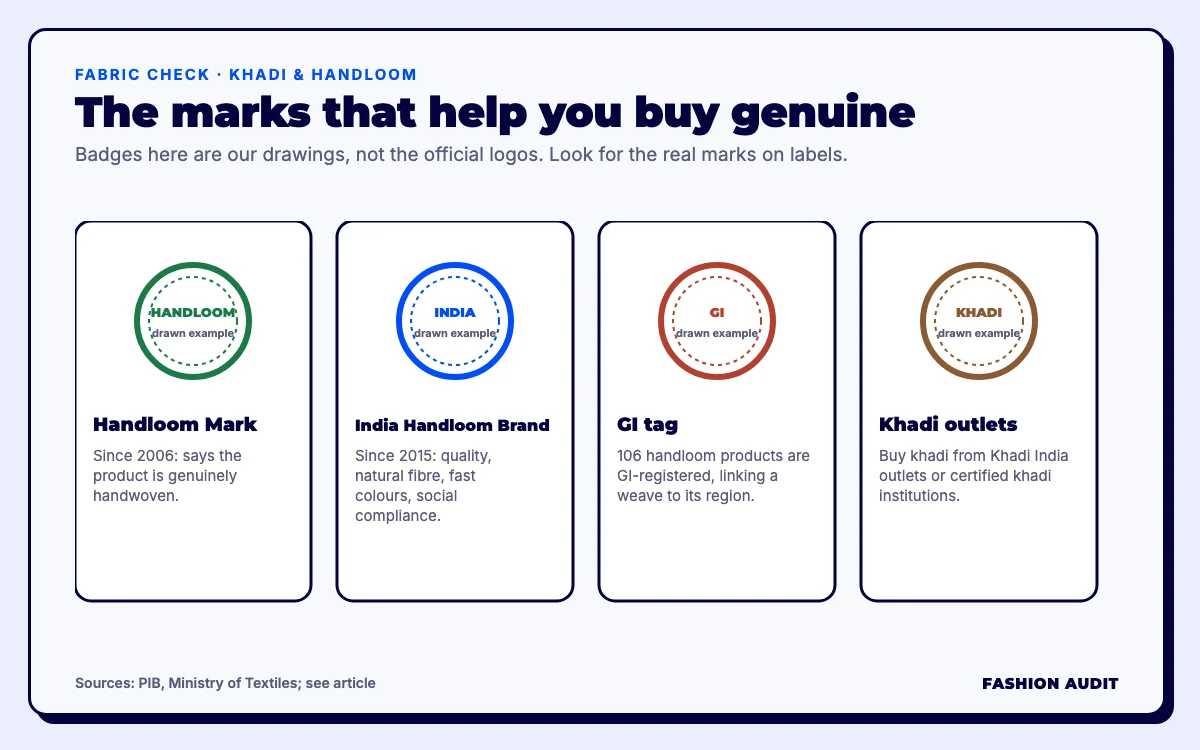
- Handloom Mark (since 2006): assures buyers that a product is genuinely handwoven.
- India Handloom Brand (since 2015): for high-quality handloom products in natural fibres with fast colours, skin-friendly dyes and social compliance.
- GI tag: links a weave to the region it comes from.
- Khadi: buy from Khadi India outlets or certified khadi institutions.
Details of the Handloom Mark and India Handloom Brand are from the government (PIB).
Pros, cons and care
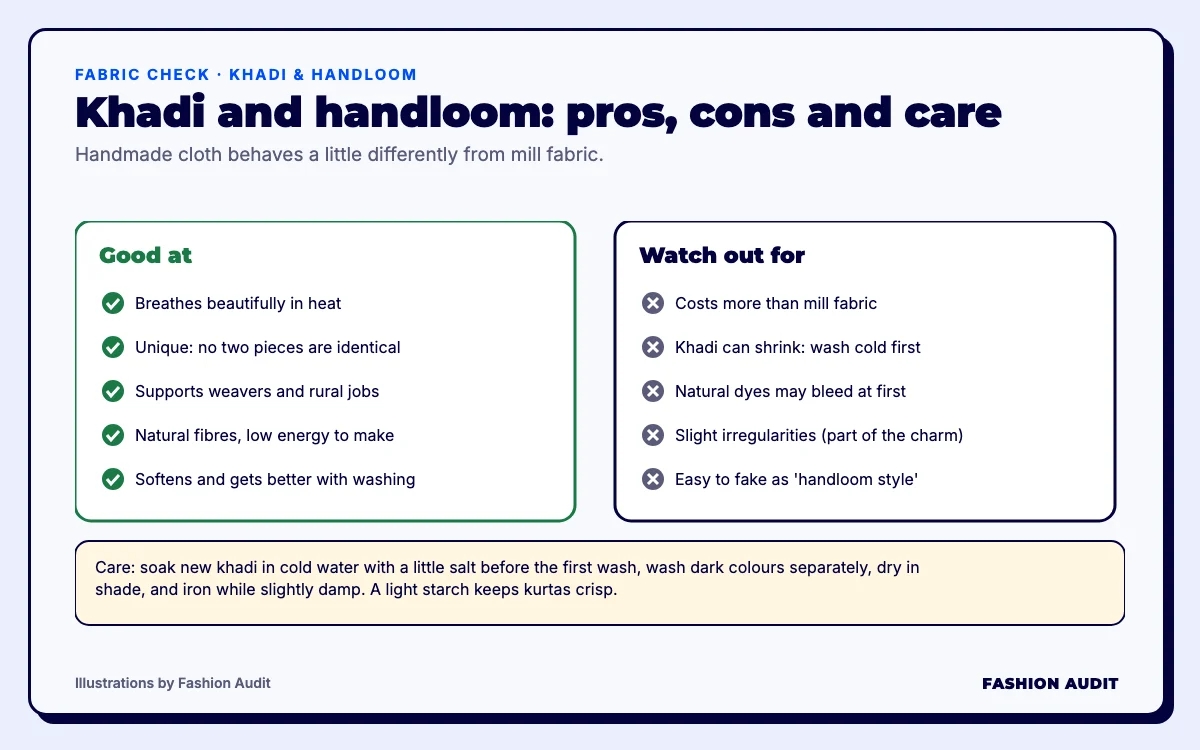
| What khadi and handloom do well | Where they fall short |
|---|---|
| Breathe beautifully in Indian heat | Cost more than mill fabric |
| Each piece is unique | Khadi can shrink in the first wash |
| Support weavers and rural jobs | Natural dyes can bleed at first |
| Natural fibres, low energy to make | Slight irregularities (part of the charm) |
| Soften and improve with washing | Easy to fake as “handloom style” |
- First wash: soak new khadi in cold water, with a little salt for coloured pieces, then wash gently.
- Wash dark colours separately for the first few washes.
- Dry in shade and iron while slightly damp. A light starch keeps kurtas crisp.
- Store fine handloom sarees folded in cotton or muslin cloth, and refold them now and then.
What is right for Indian weather
- Summer: cotton khadi, Kota Doria, Mangalagiri and light Chanderi are among the coolest things you can wear.
- Humid weather: loosely woven khadi dries reasonably fast and stays airy.
- Monsoon: handloom with natural dyes may bleed if soaked; avoid pale pieces on muddy days.
- Winter: woollen khadi and Kullu or Kashmiri handloom shawls keep you warm. See our wool guide.
Price check: what handloom costs in India
These are prices as listed in the Fashion Audit shop on 11 November 2026. Many marketplace listings use “khadi” or “ikat” for a look rather than a method, so check the description and seller.
- Taavi ikat woven design kurti: ₹467 (MRP ₹1,799). See our Taavi audit.
- Tilton khadi cotton kurta set: ₹666 (MRP ₹2,999). Check whether it is hand-spun khadi or khadi-style cotton.
- Pink Fort cotton handwoven dress: ₹1,796 (MRP ₹2,995).
- TrueBrowns ikat kurta set for men: ₹2,149 (MRP ₹4,299).
- Taavi ikat kurta with palazzos: ₹2,210 (MRP ₹6,699).
Genuine handloom sarees and khadi from cooperatives often cost more than these, because the price reflects days of skilled work. For more on a heritage handmade brand, see our Fabindia audit.
Where the marketing misleads
- “Khadi-style”, “khadi look” or “khadi cotton” can mean mill fabric with a textured finish. Real khadi is hand-spun and hand-woven.
- “Handloom feel” or “handcrafted look” is not handloom.
- “Ikat print” is a printed copy, not woven ikat.
- A regional name without a GI or a seller you can check may describe a style, not where it was made.
What it means for you
- For summer, cotton khadi and light handlooms are among the most comfortable choices in India.
- Buy from cooperatives, emporiums, Khadi India outlets, or products with official marks.
- Learn the handloom checks: small irregularities, the back of the motif, soft-edged ikat.
- Wash new khadi cold and dark handlooms separately.
- Paying a fair price for real handloom supports lakhs of weaver families, most of them women.
Common questions
What is the difference between khadi and handloom?
Khadi is hand-spun and hand-woven. Handloom is hand-woven but usually uses mill-spun yarn.
Does khadi shrink?
It can, especially in hot water. Soak and wash it in cold water the first time and dry it in shade.
How do I know if a saree is really handloom?
Look for small irregularities, check the back of the motifs, buy from trusted sellers, and look for the Handloom Mark, India Handloom Brand or a GI tag.
Why is handloom more expensive?
Each piece takes days of skilled handwork, and natural fibres and dyes cost more than mass production.
Is khadi only cotton?
No. Khadi can be cotton, silk or wool, as long as it is hand-spun and hand-woven.
The bottom line
Khadi and handloom are some of the best fabrics for Indian weather and some of the most meaningful to buy. Pay for the real thing from sellers you can check, accept the small irregularities that prove it is handmade, and wash it gently. Skip “khadi-style” and “ikat print” when you want the genuine article.
Sources
- PIB: National Handloom Day 2026
- PIB: Khadi & Village Industries, From Tradition to Enterprise
- New India Samachar (PIB), November 2021
Illustrations by Fashion Audit. Official marks are shown as our own drawings, not the real logos. Have a correction? Write to us through the contact page and we will update this guide with a dated note.