
Silk is a natural protein fibre spun by silkworms, unwound from their cocoons and woven into cloth with a soft sheen and fluid drape. In India it is the fabric of weddings, festivals and family heirlooms, from Banarasi and Kanjeevaram sarees to everyday silk kurtas. It is also the fabric most often faked. This guide explains India’s four silks, the famous weaves, how to check real silk and how to care for it.
Fabric Check is Fashion Audit’s series on the fabrics in your wardrobe. Prices checked 11 November 2026.
The short answer
For a saree or outfit you want to keep for years, buy pure silk with the Silk Mark label, and ask which silk and which weave it is. For everyday kurtas, cotton silk or silk blends give some of the look at a fraction of the price, as long as the label says so honestly. “Art silk” is not silk: it is usually viscose or polyester.
From silkworm to silk
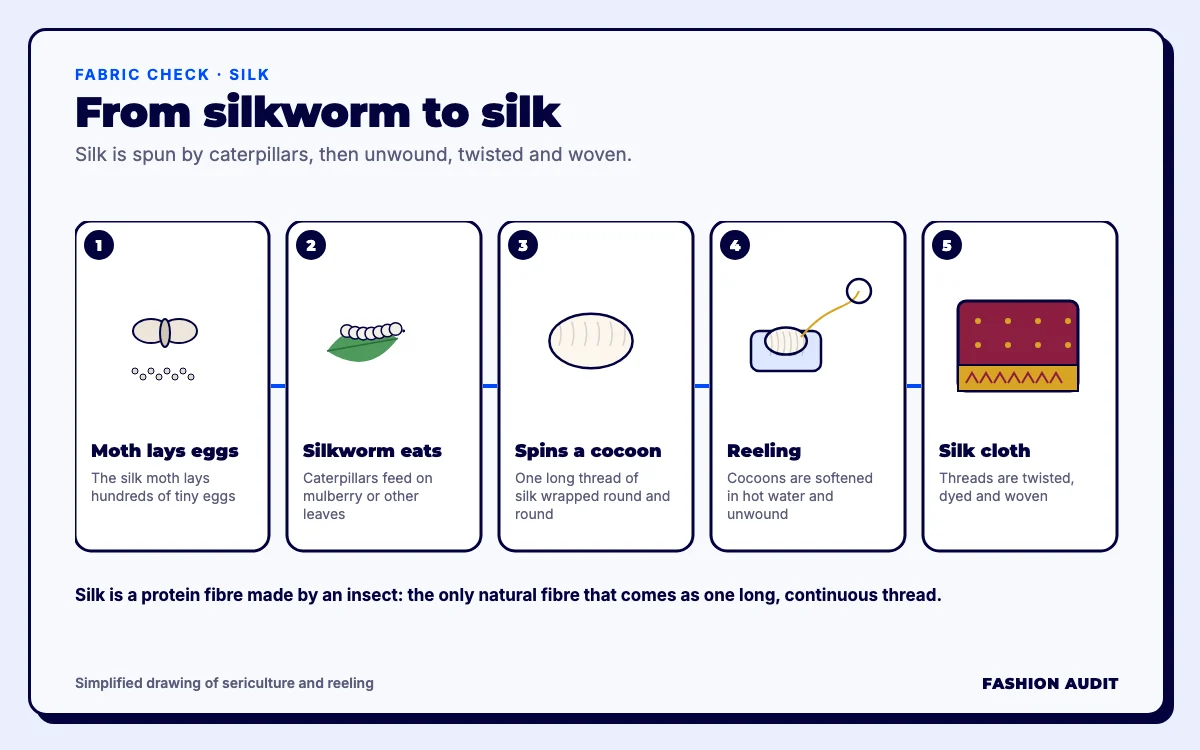
Silk comes from caterpillars, usually called silkworms, that spin a cocoon from a single long thread. Farmers raise the worms on leaves, mostly mulberry. The cocoons are softened in hot water and the thread is unwound, a step called reeling. Several threads are twisted into yarn, dyed and woven. Silk is the only natural fibre that comes as one long continuous thread, which is part of why it is so smooth and strong for its weight.
India’s four silks
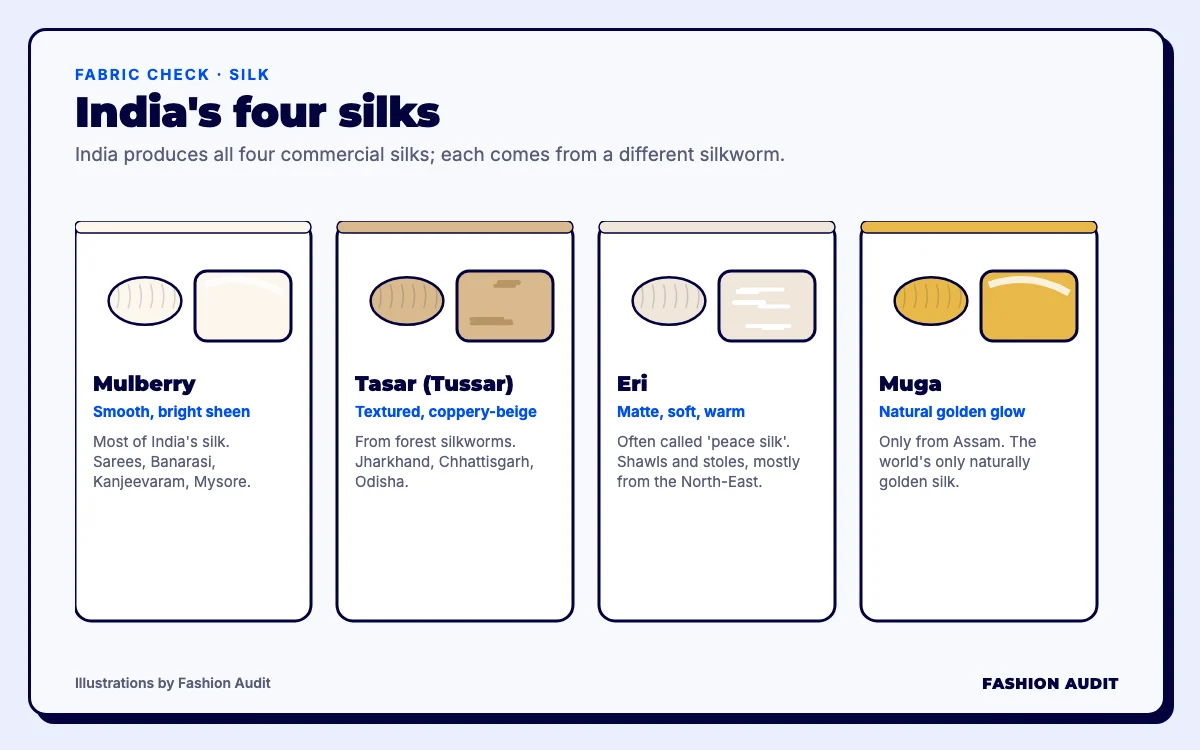
India is the world’s second-largest silk producer. Raw silk production reached 42,033 tonnes in 2025-26, and sericulture employs about 98 lakh people, according to Central Silk Board figures (IBEF). India is unusual because it produces all four commercial silks:
- Mulberry silk: most of India’s output. Smooth, bright and the silk of most famous sarees: Banarasi, Kanjeevaram and Mysore.
- Tasar (tussar) silk: from forest silkworms in states such as Jharkhand, Chhattisgarh and Odisha. Coppery-beige, textured and more matte.
- Eri silk: soft, matte and warm, used for shawls and stoles. It is often sold as “peace silk” or “ahimsa silk”, because the thread is commonly spun after the moth has left the cocoon.
- Muga silk: from Assam. The government describes it as the world’s only naturally golden silk and India’s first GI-tagged silk (PIB). Tasar, eri and muga together are called vanya (wild) silks.
4,000 years of silk in India
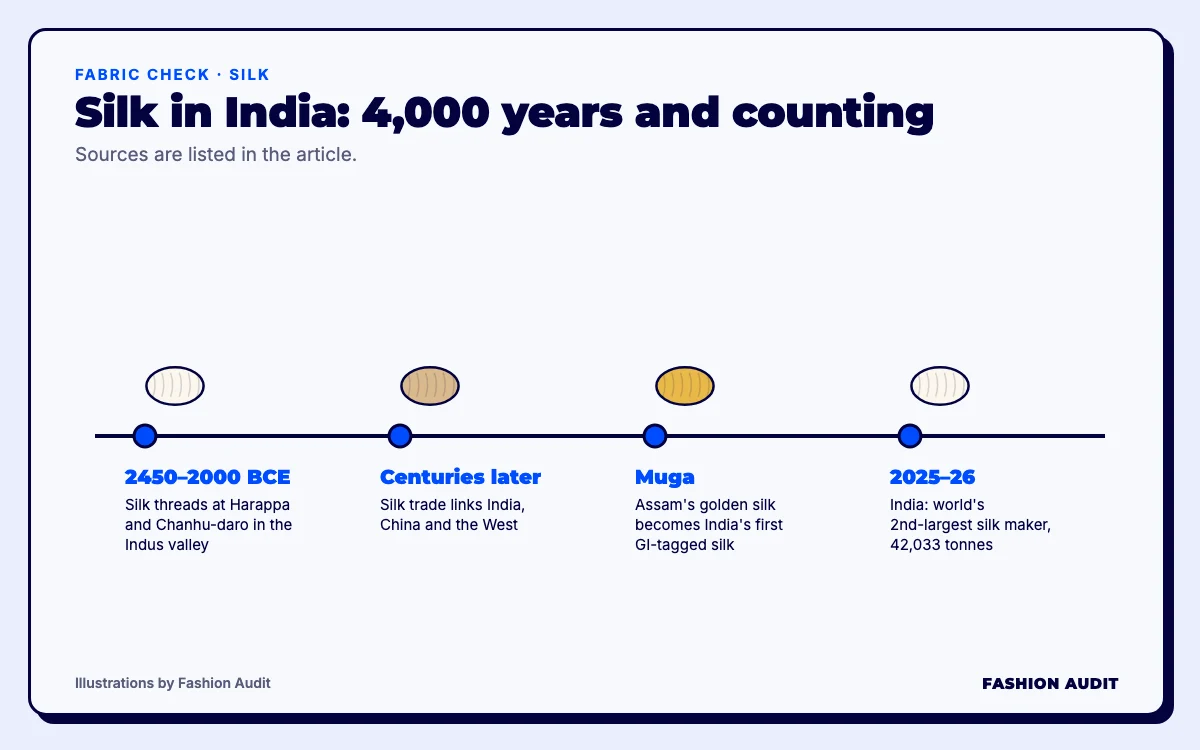
Silk is usually linked to China, but South Asia has its own early story. Silk threads found at Harappa and Chanhu-daro in the Indus valley, dated to about 2450–2000 BCE, are the earliest evidence of silk outside China (Good, Kenoyer and Meadow, 2009). Today India is both the second-largest producer and one of the biggest consumers of silk, much of it worn as sarees.
Why silk shines
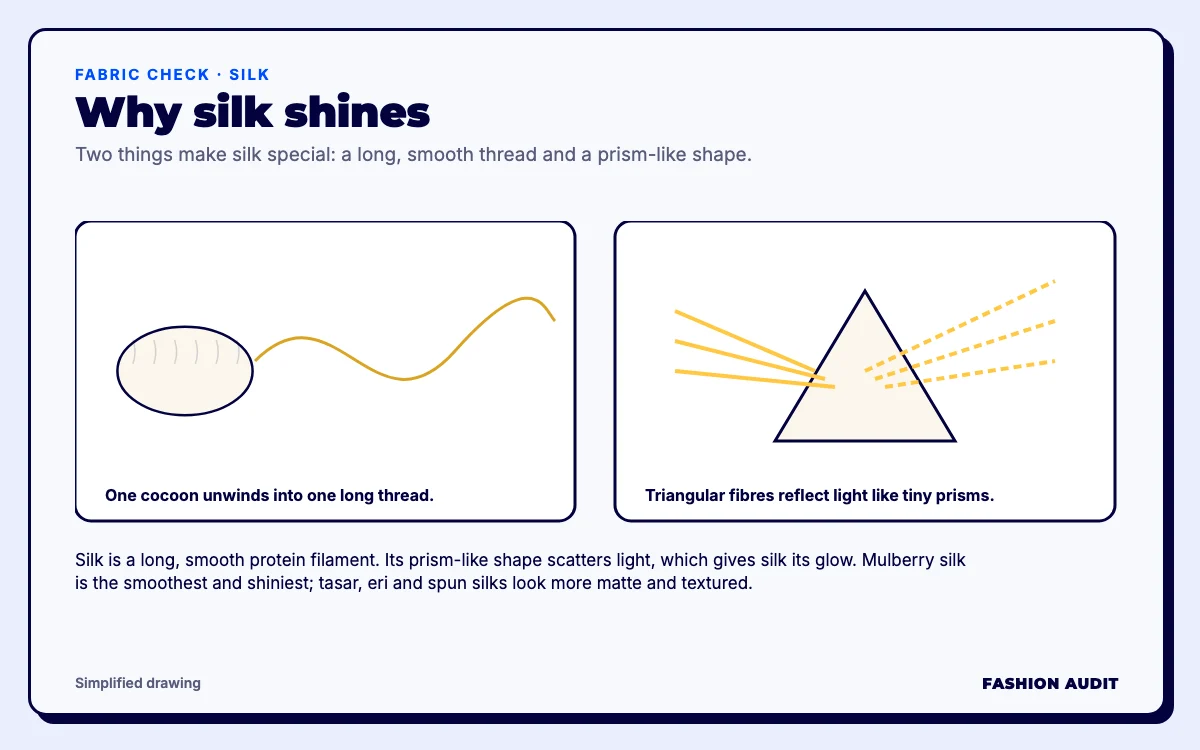
Silk’s glow comes from two things: the long, smooth filament and its prism-like shape, which scatters light. That is why mulberry silk has a soft, shifting sheen rather than the flat, even gloss of polyester satin. Tasar, eri and spun silks look more matte because their fibres are shorter or more textured.
Famous Indian silk weaves
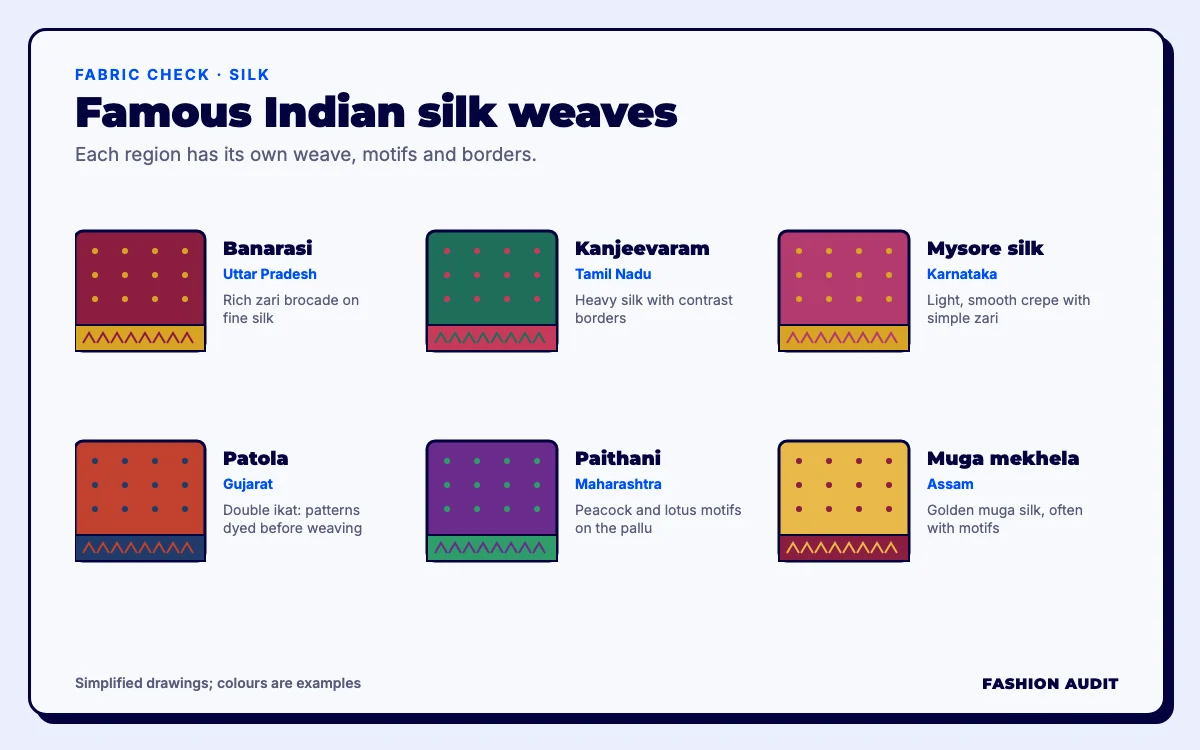
- Banarasi (Uttar Pradesh): fine silk with rich zari brocade.
- Kanjeevaram (Tamil Nadu): heavy silk with bold contrast borders.
- Mysore silk (Karnataka): light, smooth crepe with simple zari.
- Patola (Gujarat): double ikat, where threads are dyed in the pattern before weaving.
- Paithani (Maharashtra): peacock and lotus motifs on the pallu.
- Muga mekhela chador (Assam): golden muga silk, often with woven motifs.
Several of these weaves have Geographical Indication (GI) tags, which protect the name for products made in that region. A “Banarasi style” saree made elsewhere is a look, not a Banarasi.
Silk fabrics you will hear about
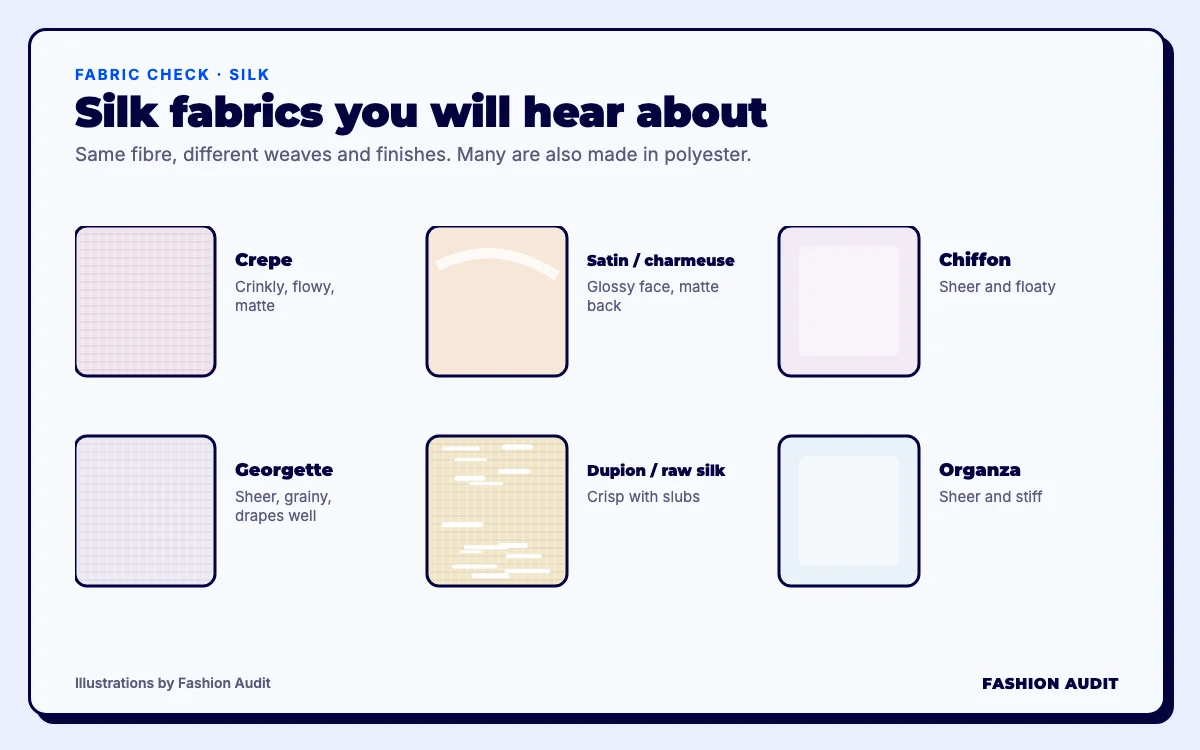
- Crepe: crinkly, flowy and matte.
- Satin or charmeuse: glossy face, matte back.
- Chiffon and georgette: sheer and floaty; georgette is grainier and drapes heavier.
- Dupion or raw silk: crisp with natural slubs.
- Organza: sheer and stiff.
- Chanderi: a light silk-cotton weave from Madhya Pradesh.
Many of these names are also used for polyester and viscose fabrics. Our polyester guide and rayon guide explain those versions.
Is it real silk? Three checks
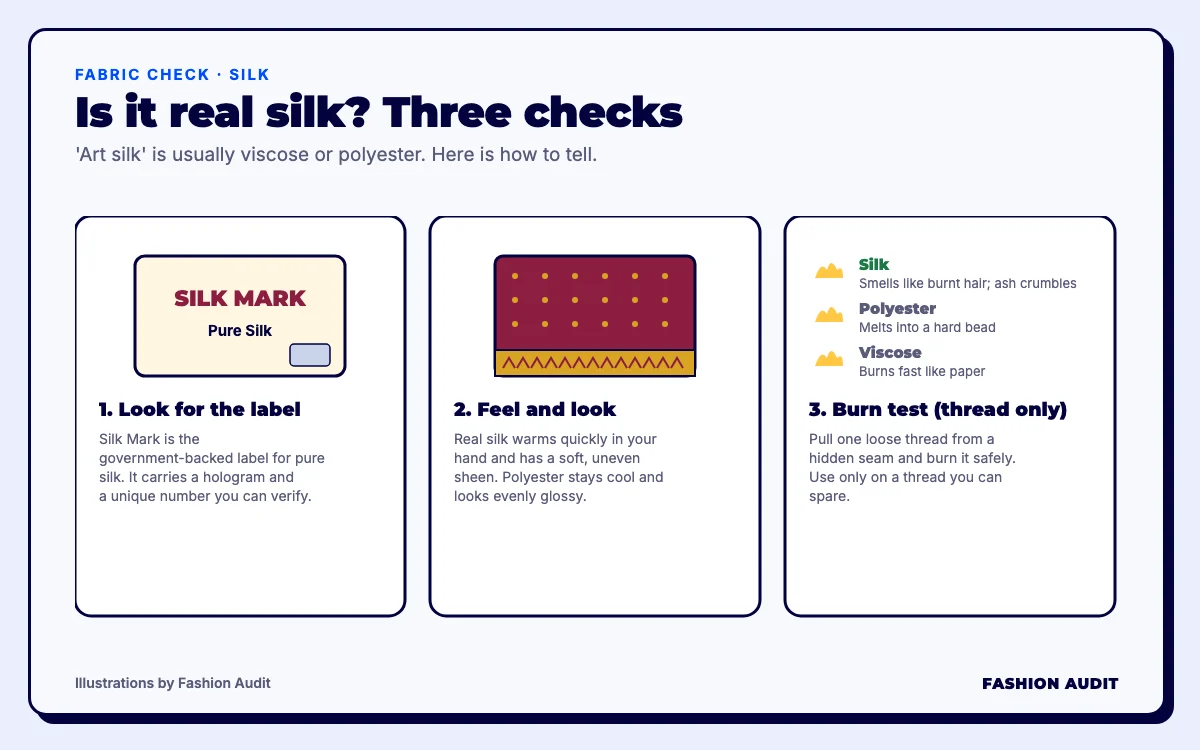
- Look for Silk Mark. Silk Mark is a quality assurance label for products made of pure silk (PIB), run under the Central Silk Board. Labels carry a hologram and a unique number that can be verified.
- Feel and look. Real silk warms up quickly in your hand and has a soft, uneven sheen. Polyester stays cool and looks evenly glossy.
- Burn test, on one thread only. Pull a loose thread from a hidden seam and burn it safely. Silk smells like burnt hair and leaves ash that crumbles. Polyester melts into a hard bead. Viscose burns quickly like paper.
Silk’s pros and cons
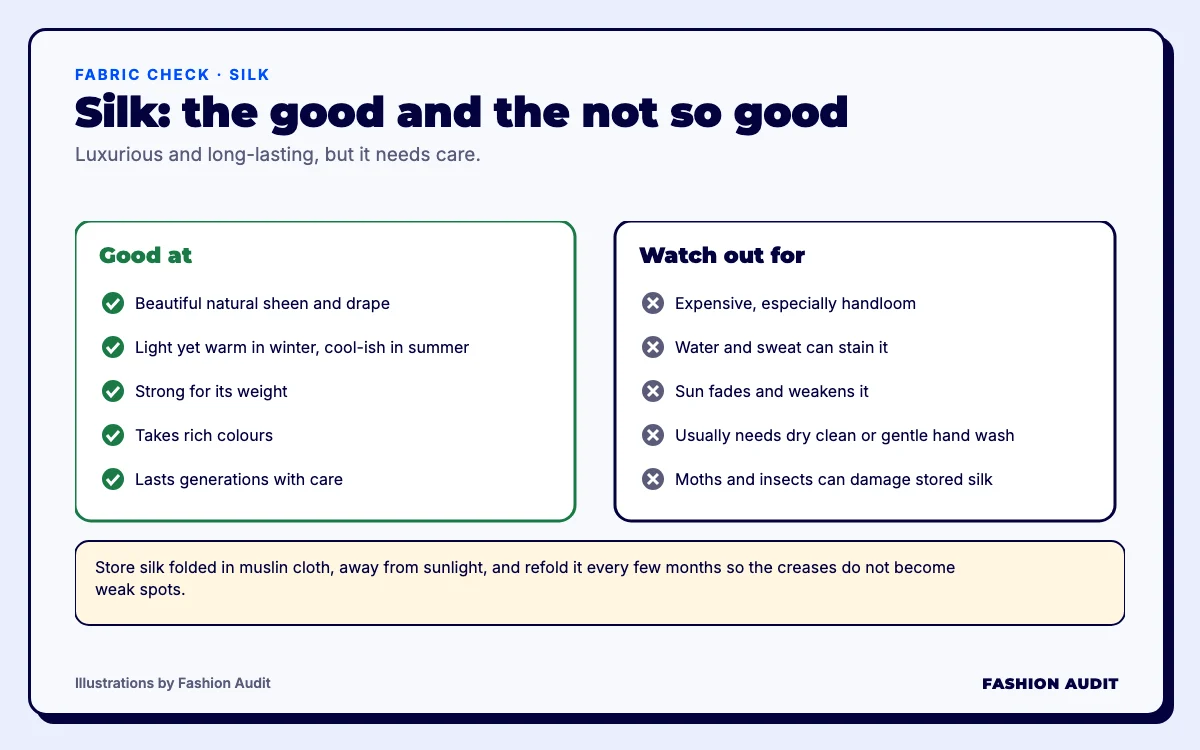
| What silk does well | Where silk falls short |
|---|---|
| Beautiful natural sheen and drape | Expensive, especially handloom |
| Light, yet warm in winter | Water and sweat can leave marks |
| Strong for its weight | Strong sun fades and weakens it |
| Takes rich, deep colours | Usually needs dry cleaning or careful hand washing |
| Lasts generations with good storage | Insects can damage stored silk |
What is right for Indian weather
- Summer: heavy silks feel warm and show sweat. Choose light silks, cotton silk or Chanderi, and keep heavy Kanjeevaram for evenings or air-conditioned venues.
- Monsoon: avoid good silk on rainy days; water spots and damp storage are its biggest enemies.
- Winter and wedding season: silk’s best time. Heavy silk sarees, eri shawls and tasar jackets all come into their own.
How to read a silk label
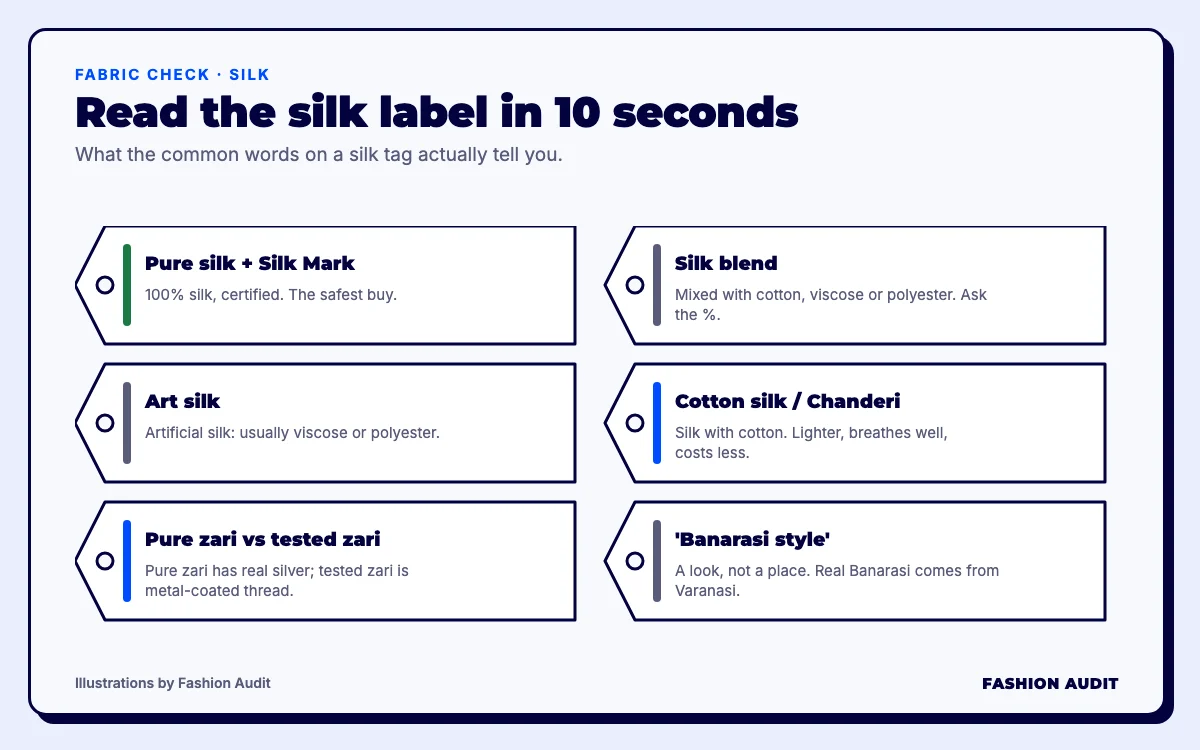
- “Pure silk” with Silk Mark is the safest buy for an expensive piece.
- “Silk blend” can mean very little silk. Ask for the percentage.
- “Art silk” means artificial silk, usually viscose or polyester.
- “Cotton silk” or “Chanderi” mixes silk with cotton: lighter, more breathable and cheaper.
- “Pure zari” vs “tested zari”: pure zari contains real silver (often gold-coated); tested zari uses metal-coated thread. Pure zari costs much more.
- “Banarasi style” or “Kanjeevaram look” describes a design, not where or how it was woven.
Price check: what silk costs in India
These are prices as listed in the Fashion Audit shop on 11 November 2026. Most are blends or silk-like fabrics; check each care label for the exact fibre.
- Gf Gul Fashion art silk kurta pant set: ₹462 (MRP ₹2,200). Art silk, not silk.
- VredeVogel cotton silk kurta pant set: ₹709 (MRP ₹3,499).
- Tavasya silk blend kurta set: ₹889 (MRP ₹3,499).
- Kinda Desi Chanderi silk kurta set: ₹1,381 (MRP ₹4,199).
- HERE&NOW dupion silk kurta set: ₹1,787 (MRP ₹4,550). See our Here & Now audit.
- Anouk embroidered pure silk kurta set: ₹2,589 (MRP ₹6,999).
Handloom pure silk sarees cost far more than these ready-made kurta sets; prices depend on the silk, the weave, zari and the hours of handwork. A “pure silk” saree priced like a budget kurta is a reason to ask for the Silk Mark.
Caring for silk
- Dry clean heavy and zari silks. For light silks, hand wash in cold water with a mild detergent; do not wring.
- Dry in shade, never in direct sun.
- Iron on low, on the reverse, with a cloth in between.
- Store folded in muslin or cotton cloth, not plastic, away from damp. Refold every few months so folds do not weaken.
- Keep zari away from perfume and moisture, which tarnish it.
Where the marketing misleads
- “Silk feel”, “silky” or “art silk” usually mean no silk.
- “Soft silk” describes a feel, not a fibre. Check the label for the actual silk content.
- “Handloom” without the India Handloom mark or a named weaver cluster is hard to check.
- Very low prices for “pure Banarasi” or “pure Kanjeevaram” are a red flag; ask for the Silk Mark and GI details.
What it means for you
- For heirloom sarees, buy pure silk with the Silk Mark and ask about zari.
- For everyday wear, cotton silk and Chanderi are the practical choices in Indian heat.
- Treat “art silk” as viscose or polyester and pay accordingly.
- Explore India’s vanya silks: tasar for texture, eri for warmth, muga for its natural gold.
- Store silk well: shade, muslin and refolding protect it for decades.
Common questions
How do I know if my saree is pure silk?
Look for the Silk Mark label first. You can also check how it feels and, if possible, burn a single spare thread: real silk smells like burnt hair and leaves crumbly ash.
What is art silk?
Artificial silk, usually viscose (rayon) or polyester made to look like silk. It is much cheaper and washes differently.
Which Indian silk is the most expensive?
Prices depend more on the weave, zari and handwork than the silk type alone. Muga and fine handloom weaves with pure zari are among the most costly.
Can I wash silk at home?
Light silks can be hand washed in cold water with mild detergent. Heavy sarees and anything with zari are safer dry cleaned.
Is silk good for summer?
Light silks and cotton silk are comfortable. Heavy silks feel warm and show sweat, so keep them for evenings and cooler months.
The bottom line
Silk is worth paying for when it is real and when you will keep it. Buy Silk Mark–certified pure silk for the pieces that matter, cotton silk for everyday, and never pay silk prices for art silk. Store it in muslin, away from sun and damp, and it will outlast most of your wardrobe.
Sources
- IBEF: Silk Industry and Export in India (Central Silk Board data)
- PIB: Mission for muga silk
- PIB: Handloom Silk Industry in Assam (Silk Mark)
- Good, Kenoyer and Meadow (2009): New Evidence for Early Silk in the Indus Civilization
Illustrations by Fashion Audit. Have a correction? Write to us through the contact page and we will update this guide with a dated note.