

Denim is a sturdy cotton twill with indigo-blue lengthwise threads and white crosswise threads. It is the fabric of jeans, jackets and shirts, and almost every Indian wardrobe has some. This guide explains how denim is made, why jeans fade the way they do, what selvedge, ounces and stretch mean, and how to pick and care for jeans in Indian weather.
Fabric Check is Fashion Audit’s series on the fabrics in your wardrobe. Prices checked 11 November 2026.
The short answer
For most Indians, the best everyday jeans are mid-weight cotton denim (about 10–13 oz) with a little stretch (1–2% elastane) in a straight or relaxed fit. That balances comfort in the heat with durability. Rigid 100% cotton lasts longer and fades better but takes time to soften. Skinny, heavy jeans are the hardest to live with in an Indian summer.
What denim is, in one line
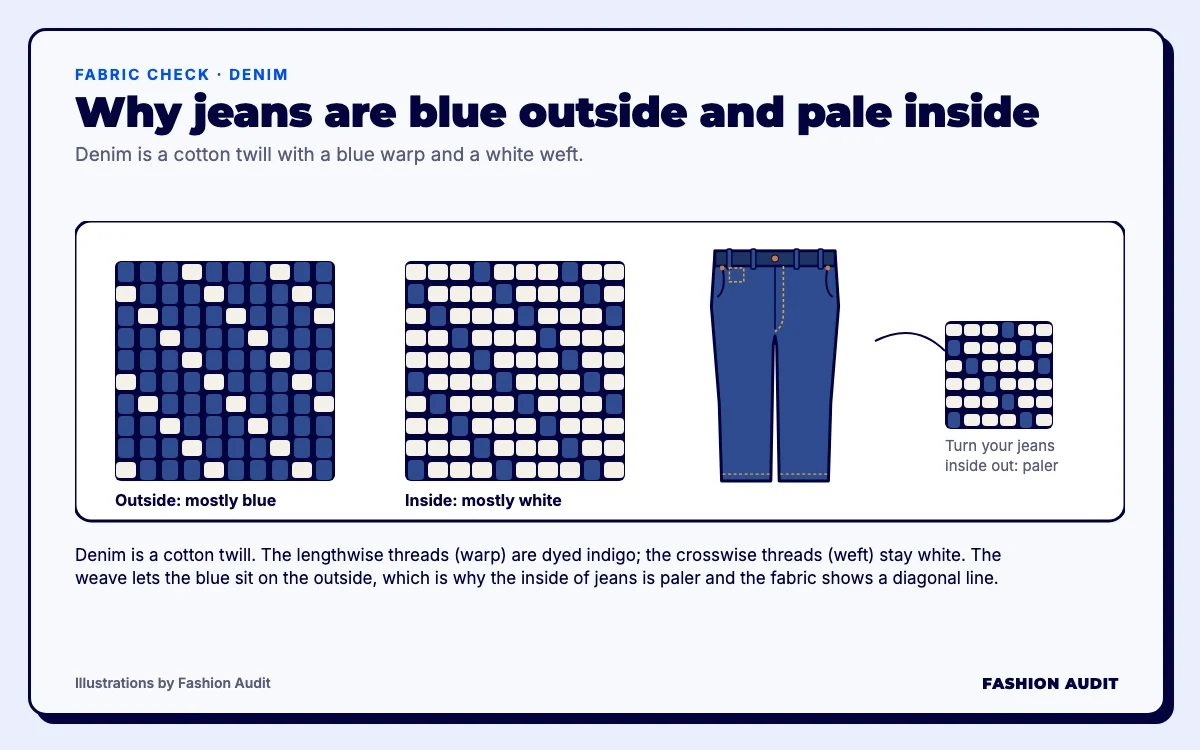
Denim is a twill: the weave steps across to make a diagonal line. The lengthwise threads, called the warp, are dyed indigo. The crosswise threads, the weft, are left white. Because of the twill, the blue threads sit mostly on the outside and the white ones mostly on the inside. That is why the inside of your jeans is pale. See our cotton guide for more on weaves.
How indigo fades
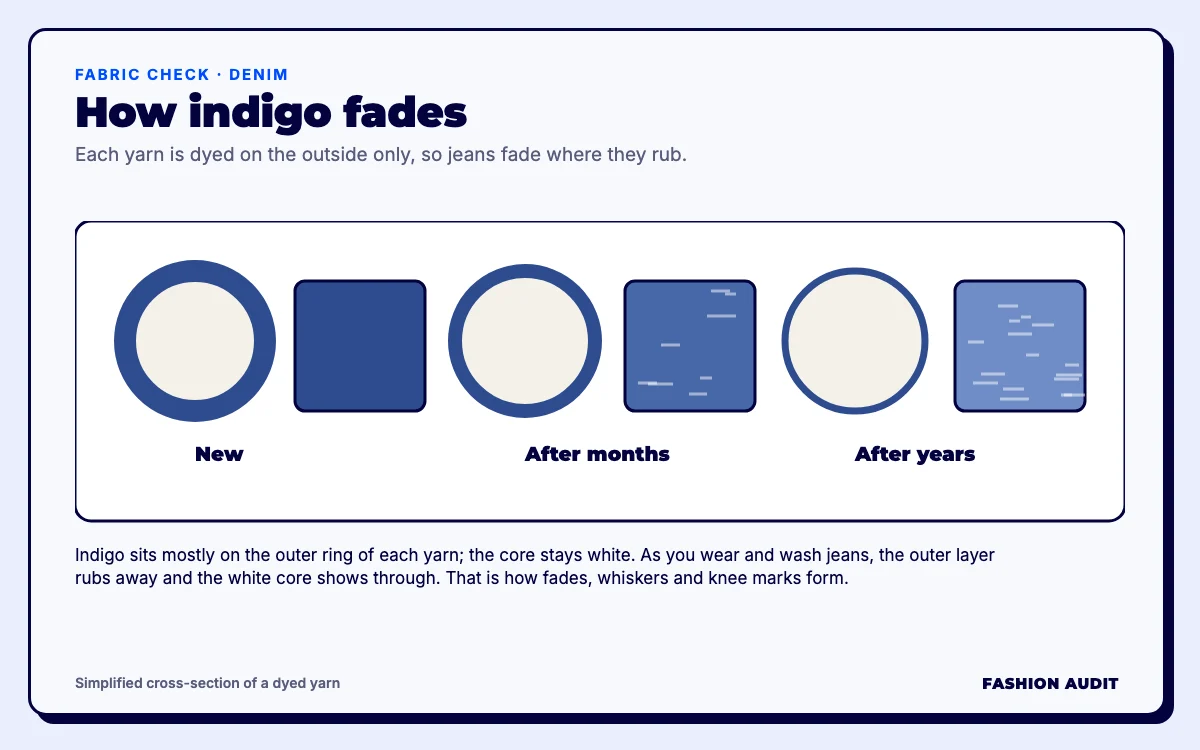
Indigo sits mostly on the outer layer of each yarn; the core stays white. As you wear and wash jeans, the outer layer rubs away and the white core shows through. That is how thigh fades, knee marks and “whiskers” at the hips form. It is also why jeans fade where they rub most.
India has a long link to this blue. Before synthetic indigo arrived in the late 1800s, nearly all indigo used for dyeing came from indigo plantations in India (Wikipedia, Jeans).
From work cloth to every wardrobe
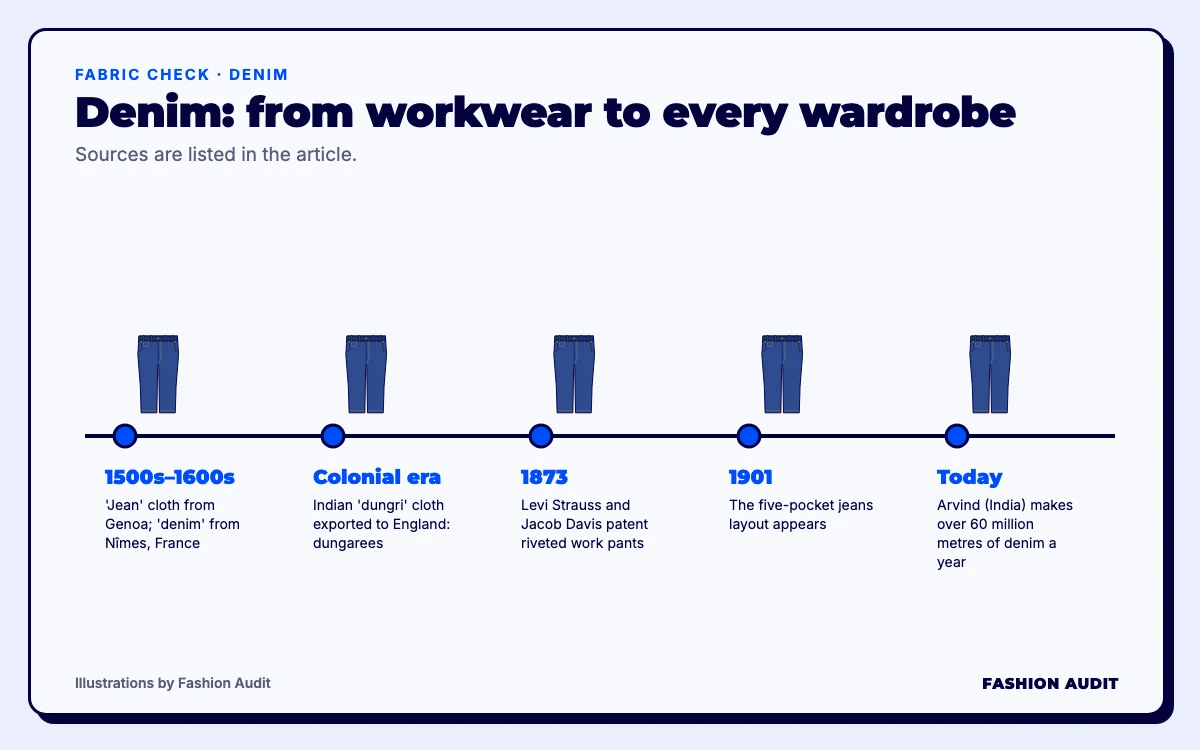
The word “jeans” comes from Genoa in Italy (Gênes in French), where a sturdy cotton cloth was traded from the 16th century. Weavers in Nîmes, France, made a similar twill that became known as de Nîmes: denim. India has its own thread in the story: a coarse cloth called “dungri” was exported to England and gave its name to dungarees (Wikipedia).
Modern jeans date from 20 May 1873, when Levi Strauss and tailor Jacob Davis received a US patent for putting copper rivets on work pants (Levi Strauss & Co.). The five-pocket layout followed in 1901. Today India is a major denim maker: Arvind says it produces over 60 million metres of denim fabric a year (Arvind).
Anatomy of a pair of jeans
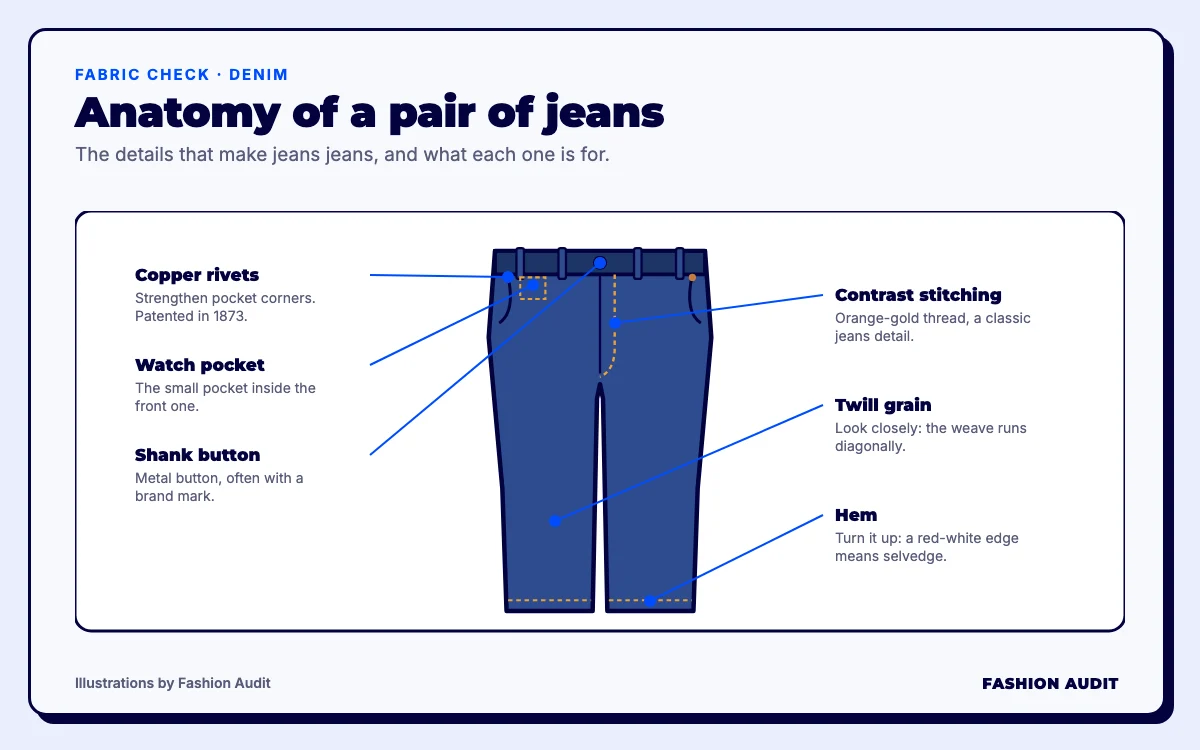
- Copper rivets strengthen pocket corners, the original 1873 idea.
- The small watch pocket was added for pocket watches and stayed as a design detail.
- Contrast stitching in orange-gold thread is a classic jeans look.
- Bar tacks (short dense stitches) at stress points matter more for durability than how many rivets there are.
Selvedge vs regular denim
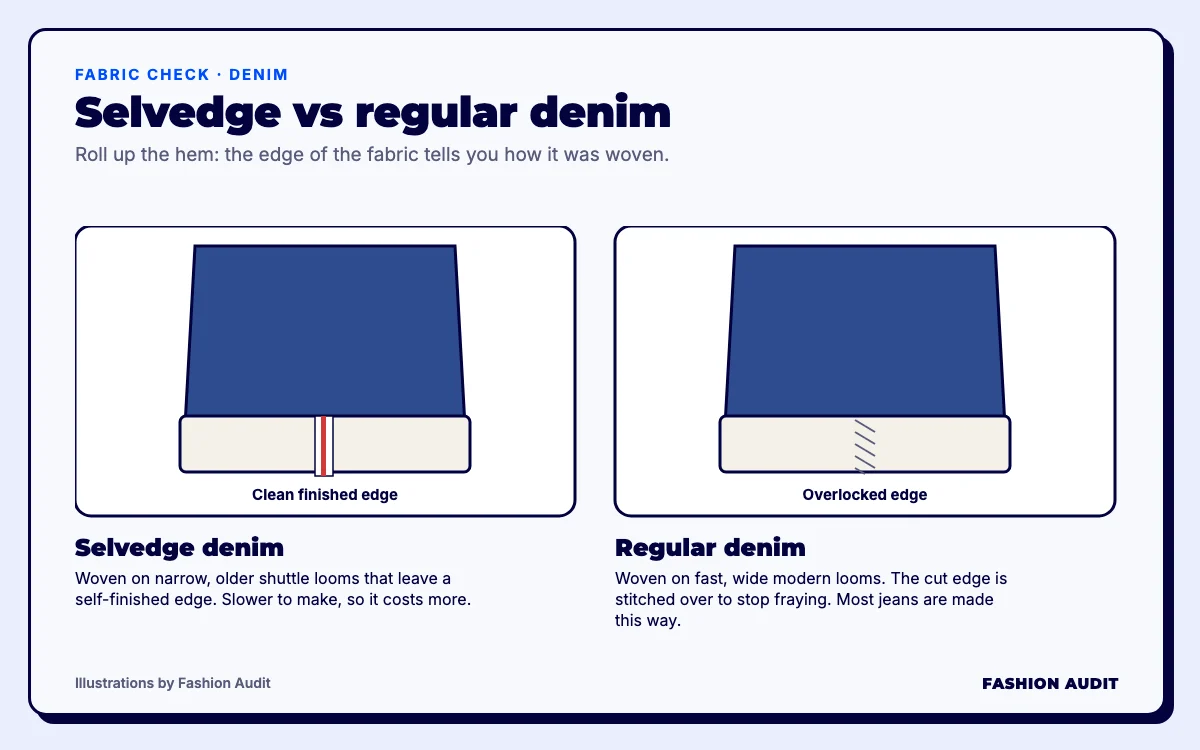
Selvedge (self-edge) denim is woven on narrow, older shuttle looms that leave a clean finished edge, often with a coloured line. It is slower to make and costs more. Regular denim is woven on fast, wide modern looms; the cut edge is overlocked to stop fraying. Selvedge is a sign of how the cloth was made, not automatically of better quality: a well-made regular denim can outlast a cheap selvedge one.
Weight and stretch: the two numbers that matter
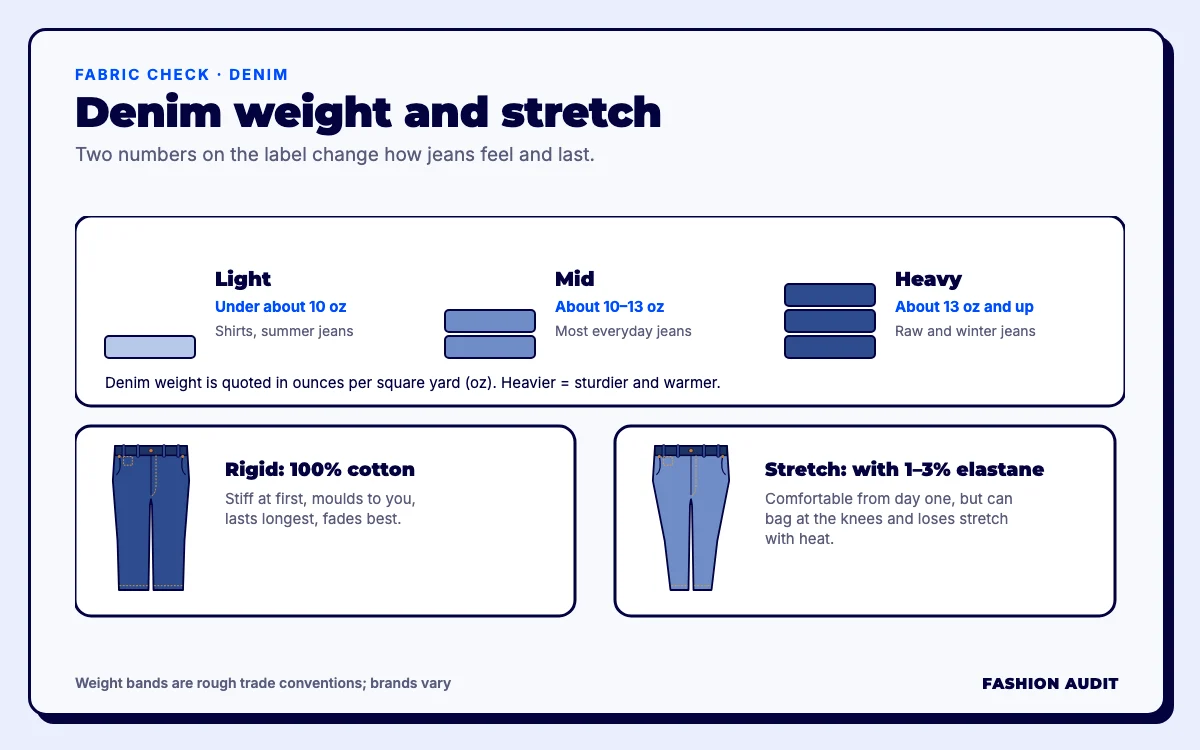
Denim weight is quoted in ounces per square yard. As a rough guide, under about 10 oz is light (shirts and summer jeans), about 10–13 oz is mid-weight (most everyday jeans), and heavier denim is sturdier and warmer. Brands vary, and many Indian listings do not state the weight at all; see our Killer Jeans audit for one brand that does.
Rigid denim is 100% cotton. It is stiff at first, moulds to your body and lasts longest. Stretch denim adds elastane (spandex), usually 1–3%. It is comfortable from day one but can bag at the knees and lose stretch over time, especially with hot washing and drying.
Washes: from raw to distressed
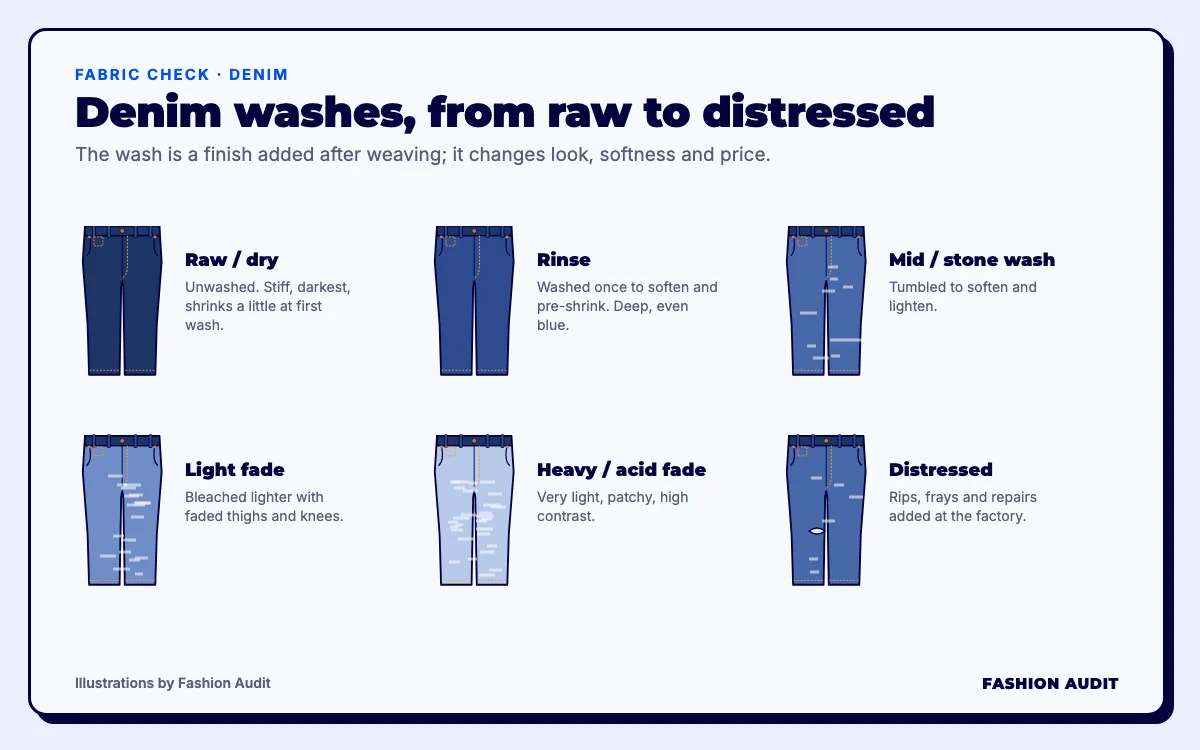
- Raw or dry: unwashed, stiff and darkest. Expect some shrinkage at the first wash unless it says pre-shrunk or sanforised.
- Rinse: washed once to soften and pre-shrink. Deep, even blue; the most versatile.
- Stone or mid wash: tumbled to soften and lighten.
- Light fade and heavy or acid fade: bleached lighter, often with faded thighs.
- Distressed: rips and frays added in the factory. Heavy distressing shortens the life of the jeans.
Fits you will see in Indian shops
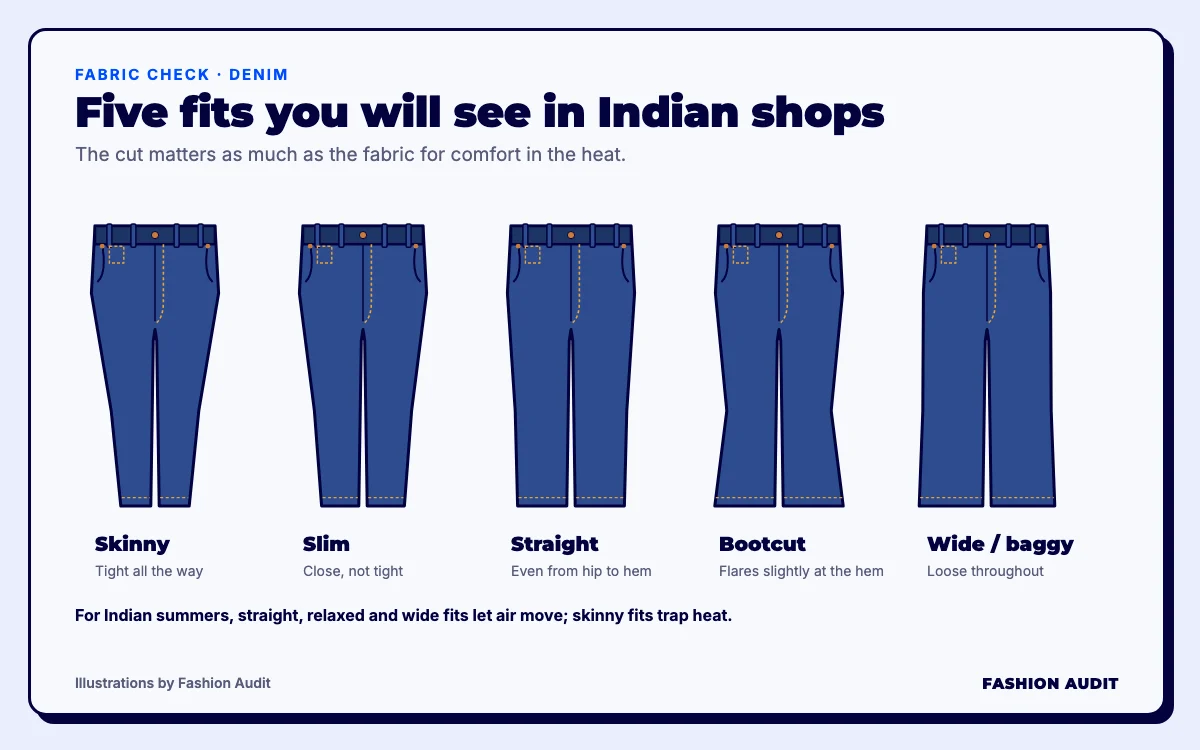
Skinny and slim fits trap heat against the skin. Straight, relaxed, bootcut and wide fits let air move, which makes a real difference in an Indian summer. Wide and baggy fits are back in fashion, which helps.
Denim’s pros and cons
| What denim does well | Where denim falls short |
|---|---|
| Very durable, especially rigid cotton denim | Heavy and hot in peak summer |
| Hides dirt and looks better with age | Slow to dry, a problem in the monsoon |
| Goes with almost everything | Indigo can bleed onto light clothes and bags |
| Fades into a personal look | Stretch denim can bag and lose shape |
| Easy care: does not need ironing | Washing and finishing use a lot of water and chemicals |
What is right for Indian weather
- Dry summer heat: choose light denim (under about 10 oz) in relaxed fits, or switch to cotton or linen trousers on the hottest days. See our linen guide.
- Humid heat: lighter washes and loose fits; skip heavy raw denim.
- Monsoon: denim is slow to dry and heavy when wet. Wear lighter jeans or quick-dry trousers on rainy days.
- North Indian winter: heavy rigid denim is at its best.
How to read a jeans label
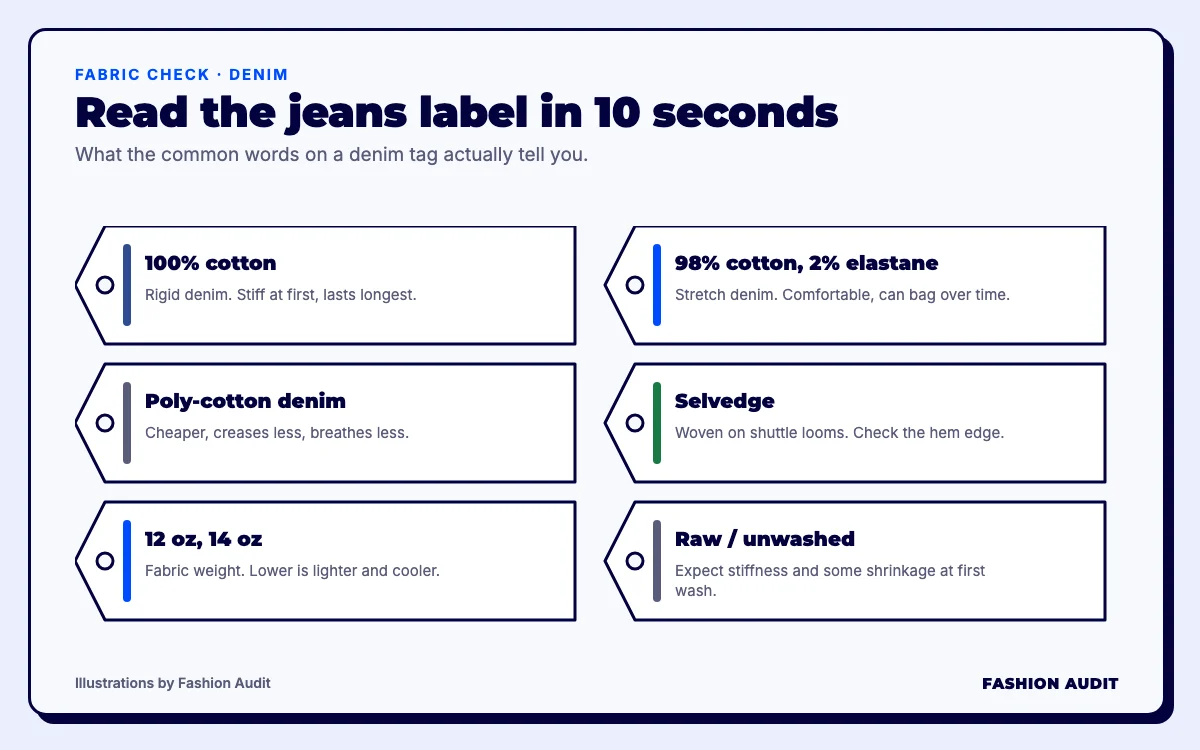
- “100% cotton” means rigid denim.
- “98% cotton, 2% elastane” means stretch denim. More elastane means more stretch and more chance of bagging.
- “Poly-cotton” or polyester in the mix makes jeans cheaper and less wrinkly, but less breathable.
- “Selvedge” should be visible at the hem or the outside leg seam.
- “Sanforised” or “pre-shrunk” means the fabric was shrunk at the mill.
- “12 oz”, “14 oz” is the fabric weight.
Price check: what jeans cost in India
These are prices as listed in the Fashion Audit shop on 11 November 2026.
- Glitchez straight-fit jeans: ₹694 (MRP ₹1,699). See our Glitchez audit.
- Mast & Harbour straight-fit light-fade stretch jeans: ₹696 (MRP ₹1,699).
- Roadster pure cotton straight-fit jeans: ₹871 (MRP ₹2,599). See our Roadster audit.
- Flying Machine slim straight-fit jeans: ₹1,117 (MRP ₹2,599).
- Levi’s 513 straight-fit stretch jeans: ₹1,549 (MRP ₹3,099).
- Levi’s 505 straight-fit stretch jeans: ₹1,960 (MRP ₹3,699).
- Roadster denim jacket: ₹957 (MRP ₹3,199).
Jeans in Indian shops run from under ₹700 to over ₹3,000 even before premium labels. The price gap is mostly cut, finishing, stitching quality and brand. Check the fibre mix, the stitching at the crotch and pockets, and whether the fabric weight is stated.
Caring for jeans
- Wash less often, inside out, in cold water. It keeps the colour and the shape.
- Wash dark jeans separately for the first few washes; indigo bleeds.
- Air-dry in shade; dryers and strong sun weaken elastane and fade colour unevenly.
- Raw denim: soak or wash before hemming if it is not pre-shrunk.
- Monsoon: dry jeans fully before storing; damp denim smells musty quickly.
Where the marketing misleads
- “Premium denim” has no definition. Ask for weight, fibre mix and finishing.
- “Japanese” or “selvedge” style can describe a look, not the cloth. Check the hem.
- “Comfort stretch” with a high elastane share can mean jeans that sag within months.
- “Sustainable wash” without naming the method or a certificate is a claim you cannot check.
What it means for you
- For everyday wear in India, buy mid-weight, slightly stretchy jeans in a straight or relaxed fit.
- For longest life, pick 100% cotton and give it a few weeks to soften.
- Keep heavy and raw denim for winter and air-conditioned offices.
- Wash less, wash cold, dry in shade.
- Check stitching at stress points; it matters more than rivets or brand logos.
Common questions
Why do my jeans fade?
Indigo dyes only the outside of each yarn. Wear and washing rub that layer away and the white core shows through.
Is selvedge denim better?
It is made more slowly on older looms and often costs more, but quality depends on the cotton, weight and stitching too.
Should I buy stretch or rigid jeans?
Stretch is more comfortable from day one; rigid lasts longer and keeps its shape. Up to about 2% elastane is a good balance.
How often should I wash jeans?
Only when they are dirty or smell. Washing less keeps the colour and fit longer.
Are jeans good for Indian summer?
Light, loose denim is fine for most days. On the hottest days, cotton or linen trousers are cooler.
The bottom line
Denim earns its place by lasting. Buy mid-weight cotton jeans with a little stretch in a fit that lets air move, wash them less, and they will serve you for years. Pay more only for things you can check: a stated fabric weight, honest fibre mix and strong stitching. Skip heavy skinny jeans for the Indian summer.
Sources
Illustrations by Fashion Audit. Have a correction? Write to us through the contact page and we will update this guide with a dated note.