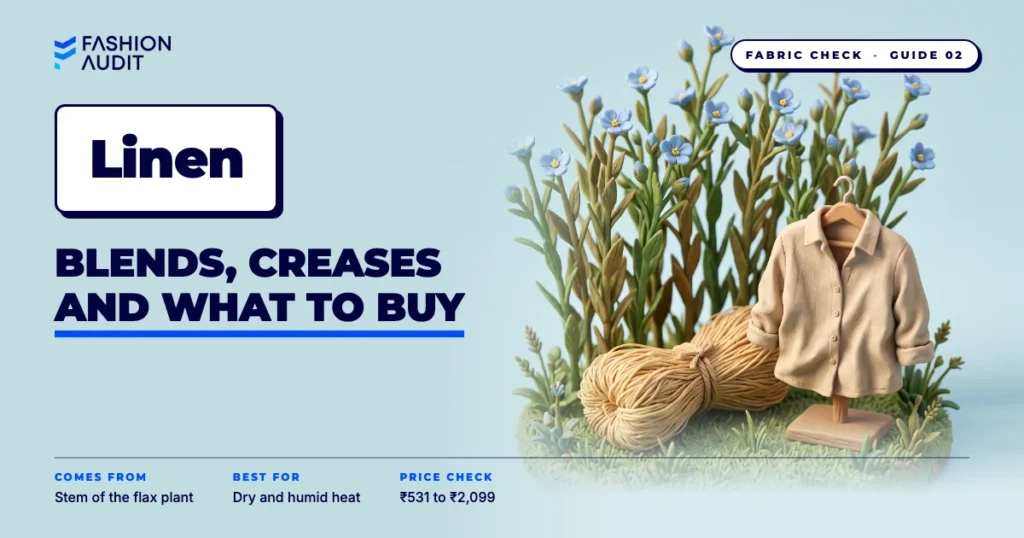
Linen is cloth made from the fibre inside the stem of the flax plant. It is one of the coolest fabrics you can wear in an Indian summer, and also the one people complain about most: it creases, it costs more, and much of what is sold as “linen” is a blend. This guide explains where linen comes from, the types you will see, its real pros and cons, and how to buy it well.
Fabric Check is Fashion Audit’s series on the fabrics in your wardrobe. Prices checked 10 November 2026.
The short answer
For dry heat and humid coastal summers, loose 100% linen or a linen-rich blend is the coolest everyday fabric you can buy. Expect creases and pay a little more than for cotton. If creases bother you or your budget is tight, cotton-linen gives you much of the airiness with fewer creases. Skip “linen look” polyester: it copies the texture but not the comfort.
What linen is, in one line
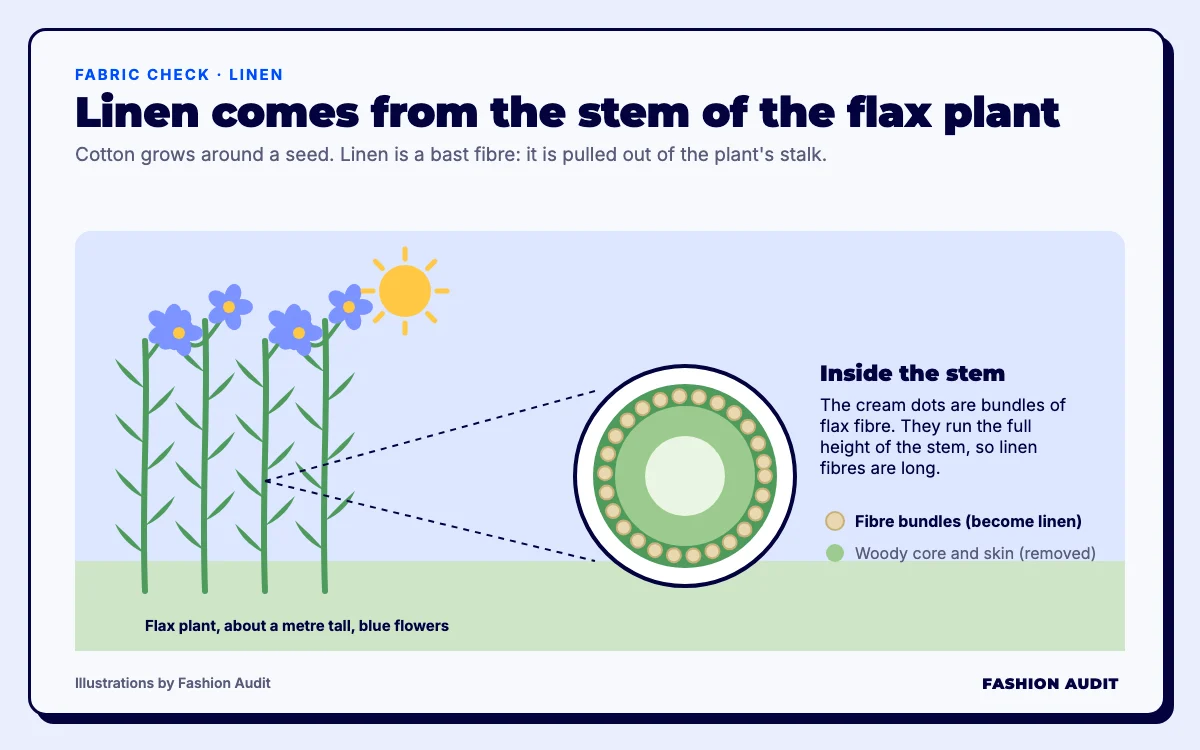
Cotton grows as fluffy hair around a seed. Linen is different: it is a bast fibre, meaning it comes from the stalk of the plant. The flax plant grows about a metre tall with small blue flowers. Bundles of fibre run along the full height of its stem, which is why linen fibres are long, straight and strong.
The oldest fabric fibre we know
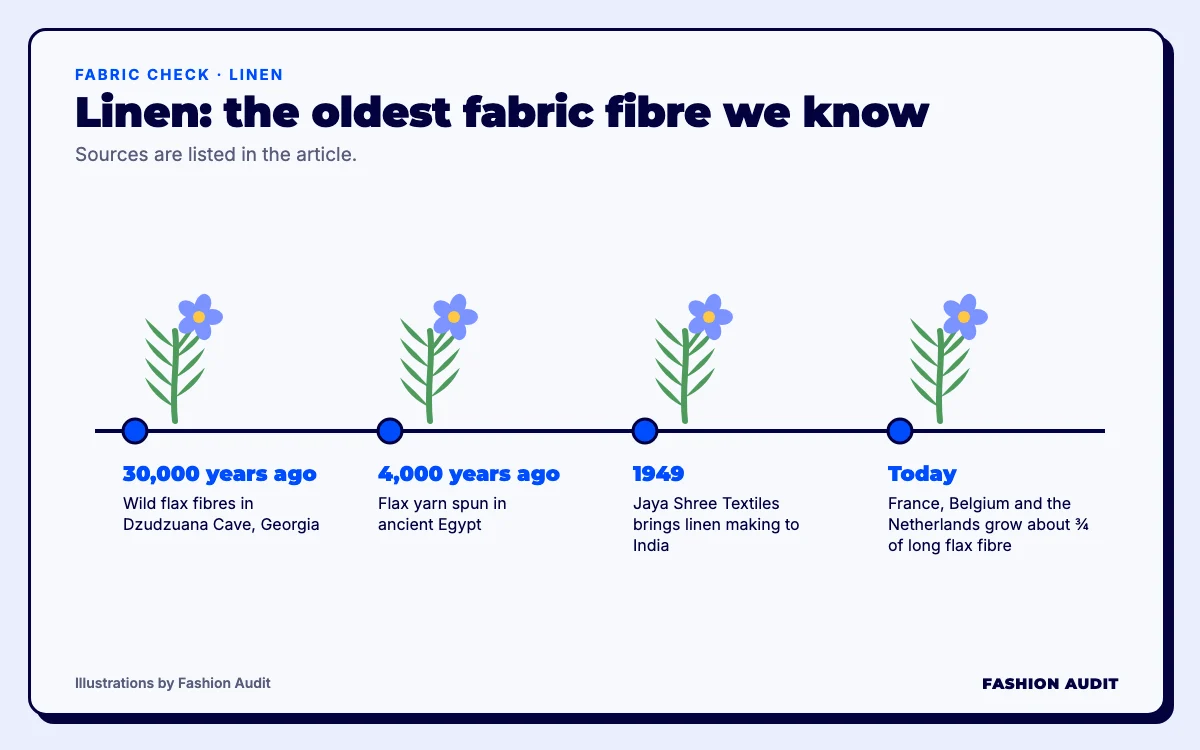
Linen has a longer history than any other fabric fibre. Researchers found wild flax fibres in Dzudzuana Cave in Georgia, in the Caucasus, dated to about 30,000 years ago. They suggest early people were already twisting flax into cords and possibly cloth (Kvavadze et al., Science, 2009). Ancient Egypt was spinning flax yarn around 4,000 years ago (study of a 4,000-year-old Egyptian flax yarn).
In India, linen making is recent. Jaya Shree Textiles, now part of Grasim (Aditya Birla Group), introduced linen manufacturing in India in 1949 and later built the Linen Club brand. It says it sources its flax from France, Belgium and other parts of Europe (Grasim).
That last detail matters. Flax for fine linen grows best in cool, damp climates. According to the Alliance for European Flax-Linen and Hemp, France, Belgium and the Netherlands produce about three-quarters of the world’s long flax fibre, and flax is less than 0.5% of the world’s textile fibre (Alliance for European Flax-Linen & Hemp). So most linen sold in India is woven here from imported flax or yarn.
From flax field to linen shirt
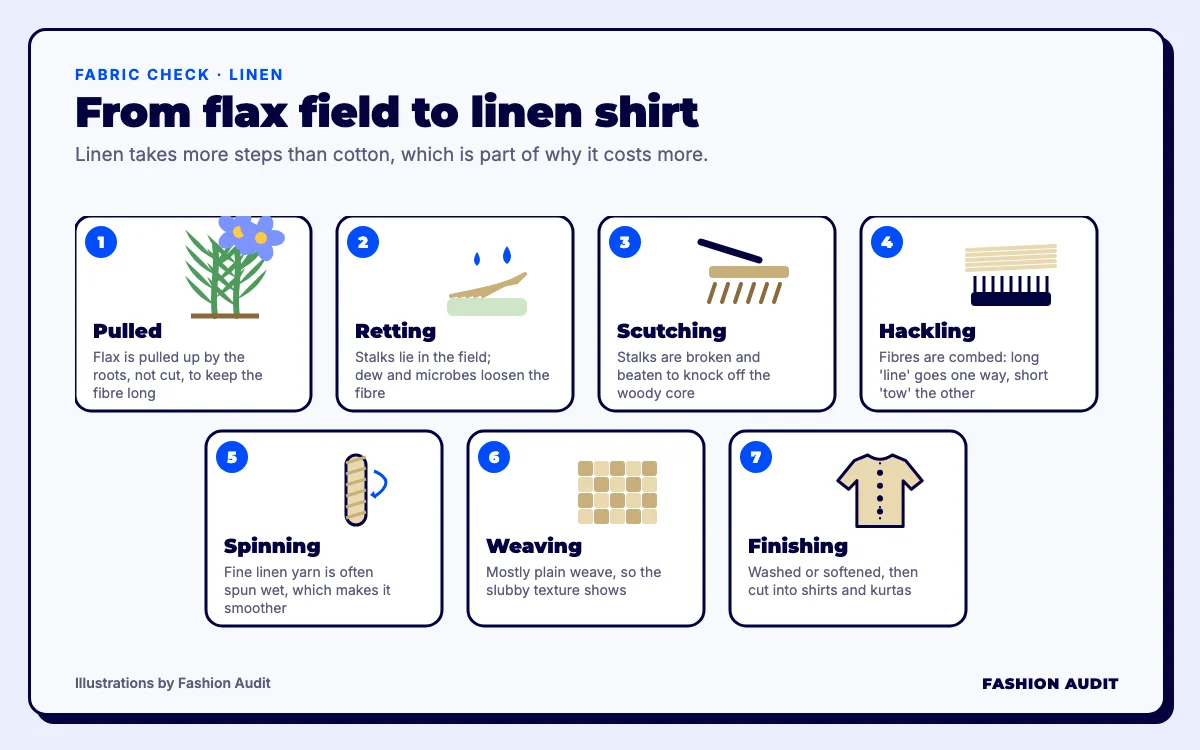
- Pulling: flax is pulled out by the roots rather than cut, to keep the fibre as long as possible.
- Retting: the stalks lie in the field, where dew and microbes slowly loosen the fibre from the woody core. Field (dew) retting is the industry standard today; retting in water gives a lighter fibre but pollutes the water at scale (Spin Off).
- Scutching: the dried stalks are crushed and beaten to knock away the woody parts.
- Hackling: the fibres are combed. The long fibres become line; the short leftovers are tow.
- Spinning: fine linen yarn is often spun wet, which softens the fibre and gives a smoother thread.
- Weaving: mostly plain weave, so linen’s natural texture shows.
- Finishing: washing, softening or dyeing, then cutting into garments.
Line vs tow: two grades from one plant
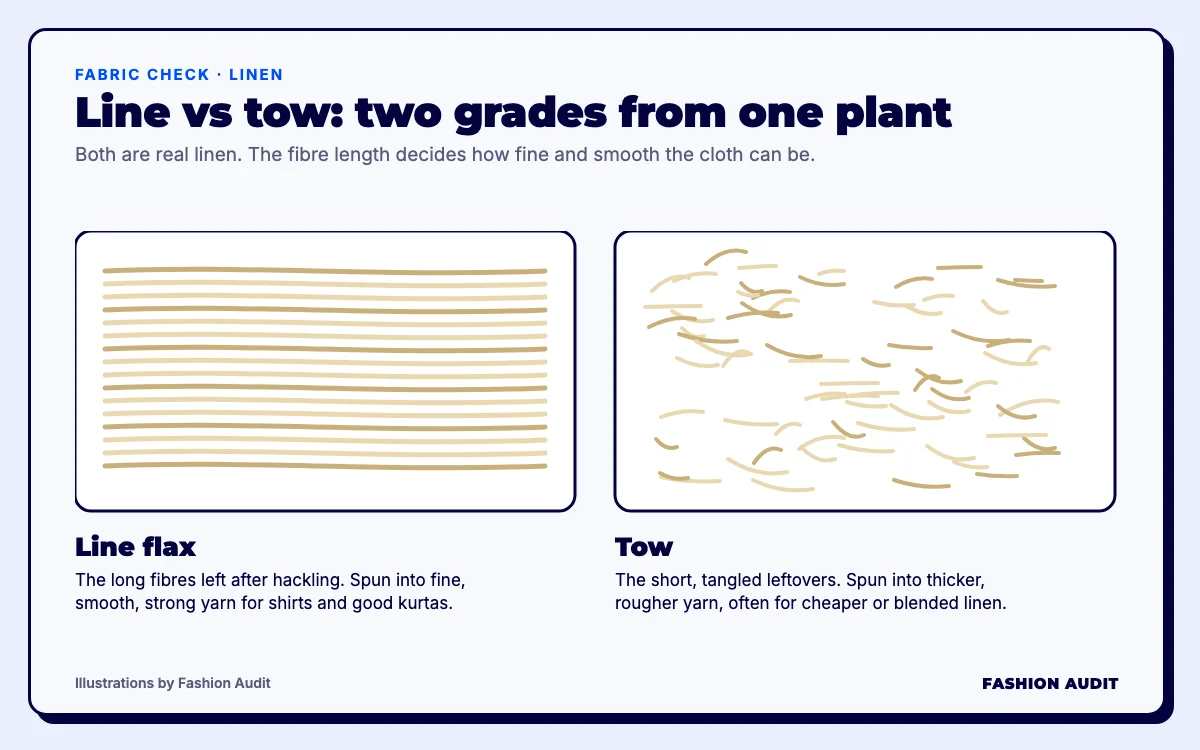
Line flax is the long fibre. It spins into fine, smooth, strong yarn for good shirts, kurtas and dresses. Tow is the short, tangled fibre left after combing. It makes thicker, rougher yarn and often ends up in heavier fabrics or blends. Labels almost never say which one you are buying, but the feel tells you: fine, even linen with a gentle sheen is usually line; coarse, hairy linen is often tow.
Linen vs cotton
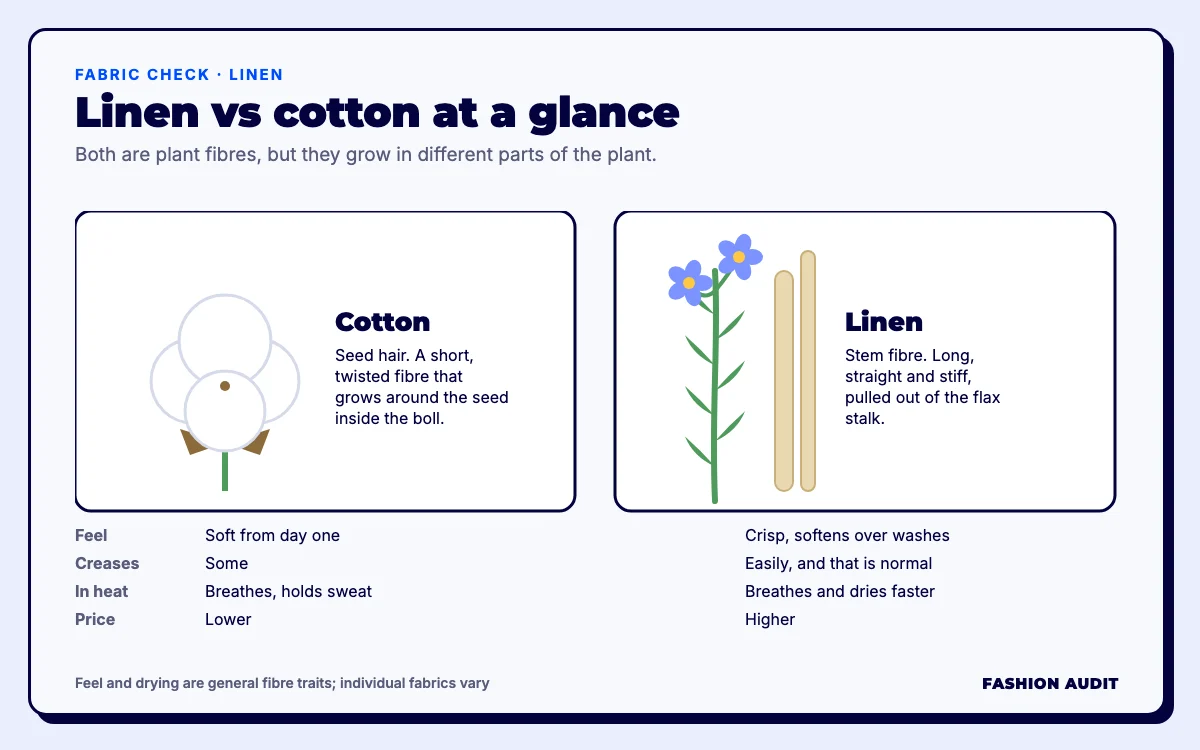
Both are natural plant fibres that breathe. Cotton is soft from the first wear and costs less. Linen starts crisp, softens with every wash, creases far more, and tends to dry faster. Our cotton guide covers cotton types in detail.
The kinds of linen you will see in Indian shops
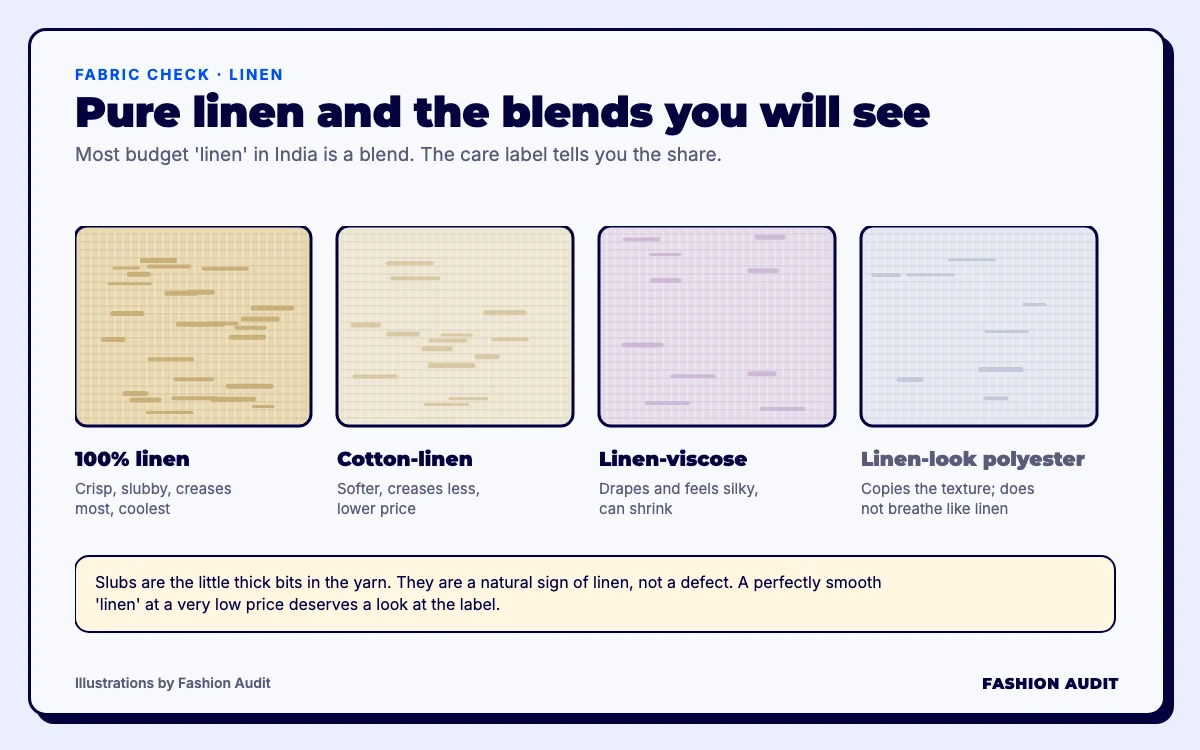
By fibre
- 100% linen (pure linen): the coolest and crispest. Creases the most. Price is highest.
- Cotton-linen: usually somewhere from 40/60 to 70/30. Softer, creases less, costs less. A good everyday compromise.
- Linen-viscose: drapes and feels smoother, popular in women’s kurtas and trousers. Viscose can shrink, so wash gently.
- Linen with polyester: creases less and is cheaper, but traps more heat.
- “Linen look” or “linen feel”: usually no linen at all. Polyester or viscose woven to copy linen’s slubby texture.
By weave and finish
- Plain-weave linen: the classic shirt and kurta cloth.
- Linen twill and herringbone: heavier, drapier, for trousers and blazers.
- Handkerchief linen: very fine, light linen for summer shirts.
- Washed, stonewashed or enzyme-washed linen: pre-softened, so it feels relaxed and creases look natural from the start.
- Garment-dyed linen: dyed after stitching, for a soft, lived-in colour.
- Yarn-dyed linen: checks and stripes woven from coloured yarn, so they do not fade as quickly as prints.
Slubs, the small thick bits in the yarn, are a normal trait of linen, not a flaw. A fabric sold as linen that looks perfectly smooth and uniform at a very low price deserves a look at the care label.
Yes, linen creases
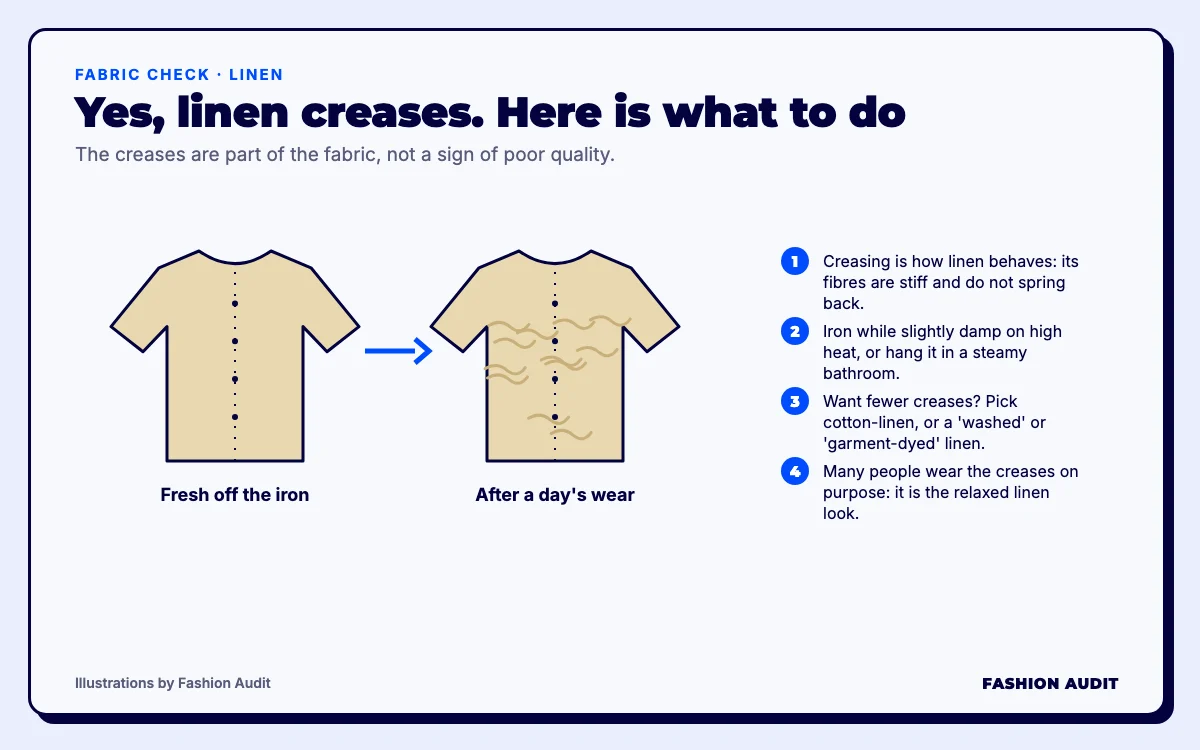
Linen fibre is stiff and does not spring back like cotton or polyester, so it creases wherever you bend. This is the single biggest complaint about linen, and the honest answer is that it cannot be fully avoided. You can reduce it: iron linen while slightly damp on a high setting, hang it in a steamy bathroom, or choose cotton-linen or a washed linen. Many people simply wear the creases as part of the relaxed linen look.
Linen’s pros and cons
| What linen does well | Where linen falls short |
|---|---|
| Very breathable; loose linen feels cool in dry heat | Creases easily and visibly |
| Tends to dry faster than cotton, useful in humidity and monsoon | Costs more than cotton for the same garment |
| Strong, long fibre; good linen lasts years | Feels stiff or scratchy at first; softens with washing |
| Gets softer with every wash | Folds can wear thin over time if always pressed in the same place |
| Natural plant fibre, biodegradable when not blended with synthetics | Pure linen can shrink in hot water |
| Natural texture looks good casual or dressed up | Pale linen shows stains and sweat marks |
What is right for Indian weather
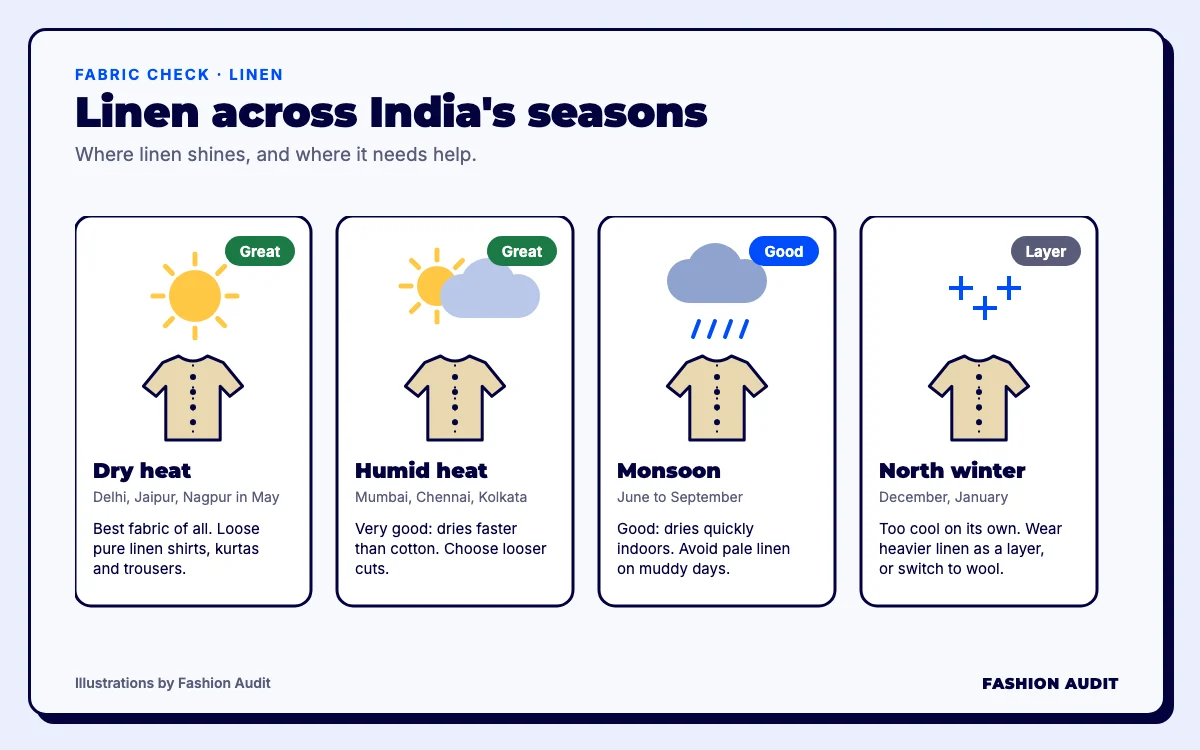
- Dry heat (Delhi, Jaipur, Nagpur in May): linen’s best season. Loose pure linen shirts, kurtas and wide trousers.
- Humid heat (Mumbai, Chennai, Kolkata): still a strong choice because it tends to dry faster than cotton. Pick relaxed cuts so it does not cling.
- Monsoon: useful because it dries quickly indoors. Avoid pale colours on muddy days.
- North Indian winter: too cool on its own. Heavier linen works as a layer, or switch to wool.
How to read a linen label
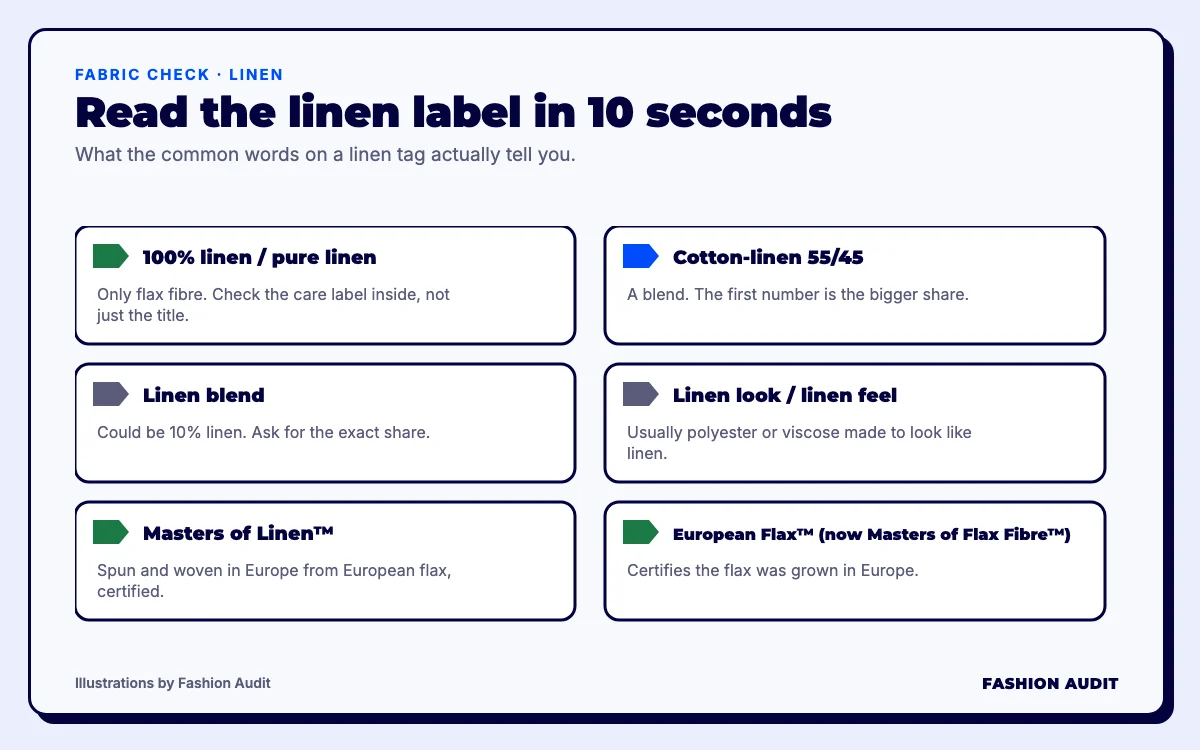
- Read the care label inside the garment, not just the product title. Listings often say “linen” for a blend.
- “Cotton-linen 55/45”: the first number is the bigger share.
- “Linen blend”: could mean a small share of linen. Ask for the exact percentage.
- “Linen look” or “linen feel”: usually polyester or viscose.
- Masters of Linen™: a certification for linen spun and woven in Europe from European flax. Masters of Flax Fibre™ (earlier called European Flax™) certifies the flax was grown in Europe (Alliance for European Flax-Linen & Hemp).
- The hand check: real linen feels cool to the touch, has uneven slubs and creases when you scrunch it in your fist. Polyester bounces back.
Price check: what linen costs in India
These are prices as listed in the Fashion Audit shop on 10 November 2026. Check each product’s care label for the exact fibre mix before you buy.
- HERE&NOW casual linen shirt: ₹531 (MRP ₹2,799). At this price, check the care label for the linen share. See our Here & Now audit.
- Spykar slim-fit cotton-linen shirt: ₹1,049 (MRP ₹2,499).
- Mast & Harbour solid casual linen shirt: ₹1,499 (MRP ₹2,449). More in our Mast & Harbour audit.
- Roadster relaxed-fit linen trousers: ₹839 (MRP ₹2,799).
- H&M relaxed-fit linen-blend trousers: ₹2,099 (MRP ₹2,999).
- SAADAA airy linen wide-leg trousers for women: ₹1,094 (MRP ₹2,598).
- Indo Era linen embroidered kurta set with dupatta: ₹1,799 (MRP ₹6,399). See our Indo Era audit.
A big gap between MRP and selling price is common on Indian marketplaces, so treat the selling price as the real one. As a rough rule, a 100% linen shirt from a brand that names its linen will cost more than a cotton shirt of the same make. A “linen” shirt priced like a basic cotton one is very likely a blend.
Caring for linen in Indian conditions
- Wash cool or lukewarm, on a gentle cycle. Hot water can shrink pure linen.
- Skip the dryer. Line-dry in shade; strong sun fades dark linen.
- Iron slightly damp on the linen setting, or steam it.
- Do not over-starch or always fold on the same line. Sharp folds in the same place can wear thin over time. Hang linen instead.
- Monsoon: linen dries fast, but do not store it damp. Mildew spots on pale linen are hard to remove.
- Hard water stiffens linen. A little fabric conditioner helps.
Where the marketing misleads
- “Linen” in the product title does not mean 100% linen. The care label is what counts.
- “Linen look”, “linen texture”, “linen feel” usually mean no linen.
- “Wrinkle-free linen” is usually a blend or a chemically treated finish. Pure linen creases.
- “European linen” without a certificate is a claim you cannot check. Look for the Masters of Linen™ or Masters of Flax Fibre™ marks.
What it means for you
- For the hottest months, a loose pure linen shirt or kurta is the coolest thing you can wear. Accept the creases.
- For office wear and travel, choose cotton-linen: cooler than cotton, tidier than pure linen.
- For women’s trousers and kurtas that drape, linen-viscose works, but wash it gently.
- Always check the care label. A low price often means a blend, which is fine as long as you know.
- Buy linen in relaxed fits. Tight linen creases more and feels less airy.
Common questions
Is linen better than cotton for summer?
In dry heat and humid heat, loose linen usually feels cooler and dries faster. Cotton is softer and cheaper. Many people find cotton-linen the best balance.
Why is linen so expensive?
Flax needs more processing steps than cotton, most fine flax is grown in Europe and imported, and it is a much smaller crop worldwide.
Does linen shrink?
Pure linen can shrink in hot water or a dryer. Wash cool and line-dry. Pre-washed linen shrinks less.
How do I stop linen from creasing?
You cannot stop it fully. Iron it damp, steam it, choose washed linen or a cotton-linen blend, and pick relaxed cuts.
Is linen the same as flax?
Flax is the plant and its fibre. Linen is the yarn and cloth made from that fibre.
The bottom line
For an Indian summer, pure linen in a loose cut is the best hot-weather fabric you can buy, as long as you are willing to live with creases. If you are not, buy cotton-linen and you will still be cooler than in plain cotton. Spend extra only on linen whose label states the fibre clearly. Do not pay linen prices for “linen look” polyester.
Sources
- Kvavadze et al., “30,000-year-old wild flax fibers”, Science (2009)
- Lessons on textile history and fibre durability from a 4,000-year-old Egyptian flax yarn
- Grasim: Linen Club
- Alliance for European Flax-Linen & Hemp
- Spin Off: Try Flax Retting 2 Ways
Illustrations by Fashion Audit. Have a correction? Write to us through the contact page and we will update this guide with a dated note.