
Cotton is the soft fibre that grows around the seeds of the cotton plant, spun into yarn and then woven or knitted into cloth. It is the fabric most Indians wear every day, from a ₹299 vest to a ₹1,490 Supima T-shirt. Those two are not the same cotton, and the label rarely tells you why. This guide explains every type, how it is made, what it costs and what to buy for Indian weather.
Fabric Check is Fashion Audit’s series on the fabrics in your wardrobe. Prices checked 10 November 2026.
The short answer
For most Indians, most of the year, the best everyday cotton is 100% combed, ring-spun cotton at 140–180 GSM. It breathes in the heat, softens with washing and does not cost a premium. Extra-long-staple cottons such as Supima feel smoother and last longer, but cost more: a Supima tee was ₹1,490 at Uniqlo India when we checked. “Cotton rich” and poly-cotton blends cost less and wrinkle less, but trap more heat.
What cotton is, in one line
Each cotton seed grows thousands of fine hairs inside a pod called a boll. When the boll bursts open, those hairs are picked, cleaned, twisted into yarn and turned into cloth. Almost every quality difference you feel in a cotton shirt comes from three things: how long those hairs are, how carefully they are cleaned and twisted, and how the yarn is woven or knitted.
A 7,000-year story that starts in South Asia
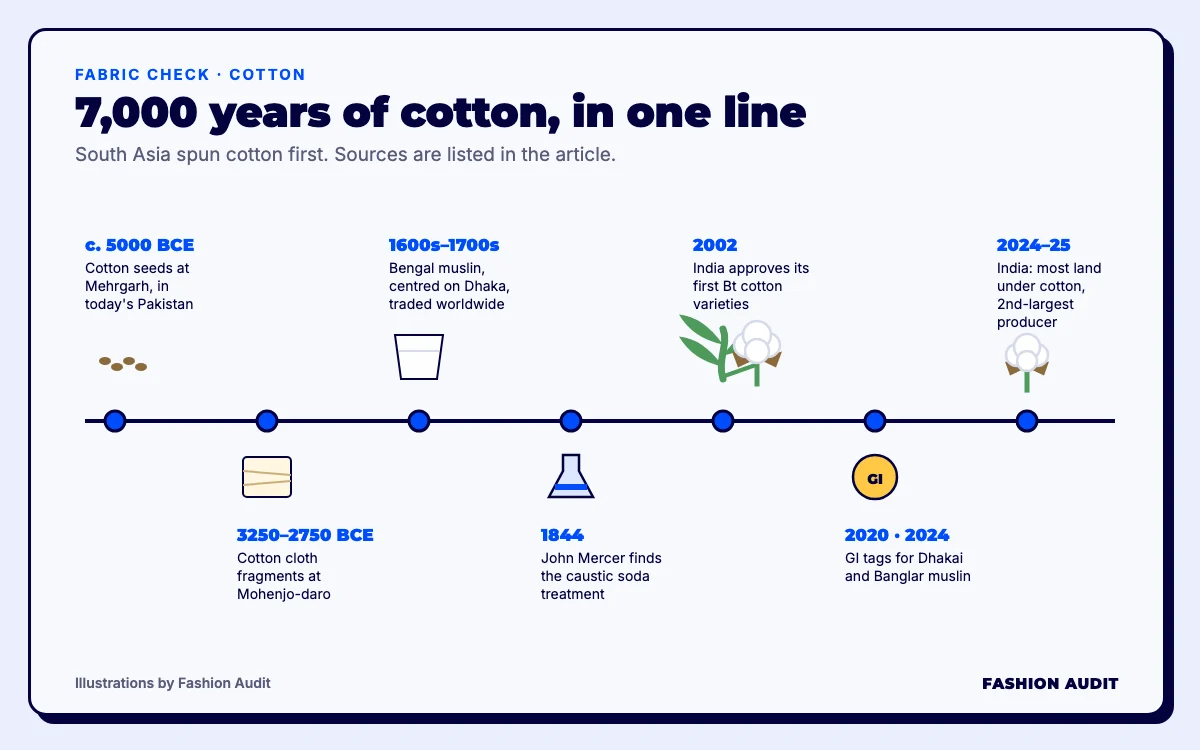
South Asia was spinning cotton long before anyone else. Cotton seeds found at Mehrgarh, in present-day Pakistan, are dated to about 5000 BCE. In 1929, archaeologists at Mohenjo-daro found fragments of cotton cloth dated to between 3250 and 2750 BCE (Harappa.com).
The most famous cotton cloth in history came from Bengal. Dhaka muslin was woven from a local cotton called phuti karpas into yarn of at least 300 count, fine enough to look almost see-through. In the 17th and 18th centuries, Mughal Bengal was the world’s leading muslin exporter. Weaving declined in the late 18th century as cheap machine-made cloth arrived from England. Revival projects followed: Dhakai Muslin received a Geographical Indication (GI) tag in Bangladesh in 2020, and Banglar Muslin received one in West Bengal in 2024 (Wikipedia, Muslin).
Two chemistry and farming changes shaped the cotton you buy today. In 1844, the English chemist John Mercer found that treating cotton with caustic soda changed its fibres. This later became mercerisation, the process that gives some cotton its sheen (Beltwide Cotton Conferences, 2000). In 2002, India approved its first three Bt cotton varieties for commercial farming. These are genetically modified to resist bollworm pests (USDA GAIN report, April 2002).
Today India has more land under cotton than any other country: 114.84 lakh hectares, according to the government (PIB). It is the second-largest producer, with an estimated 294.25 lakh bales in the 2024–25 season (Ministry of Textiles).
The types of cotton plant, and why fibre length matters
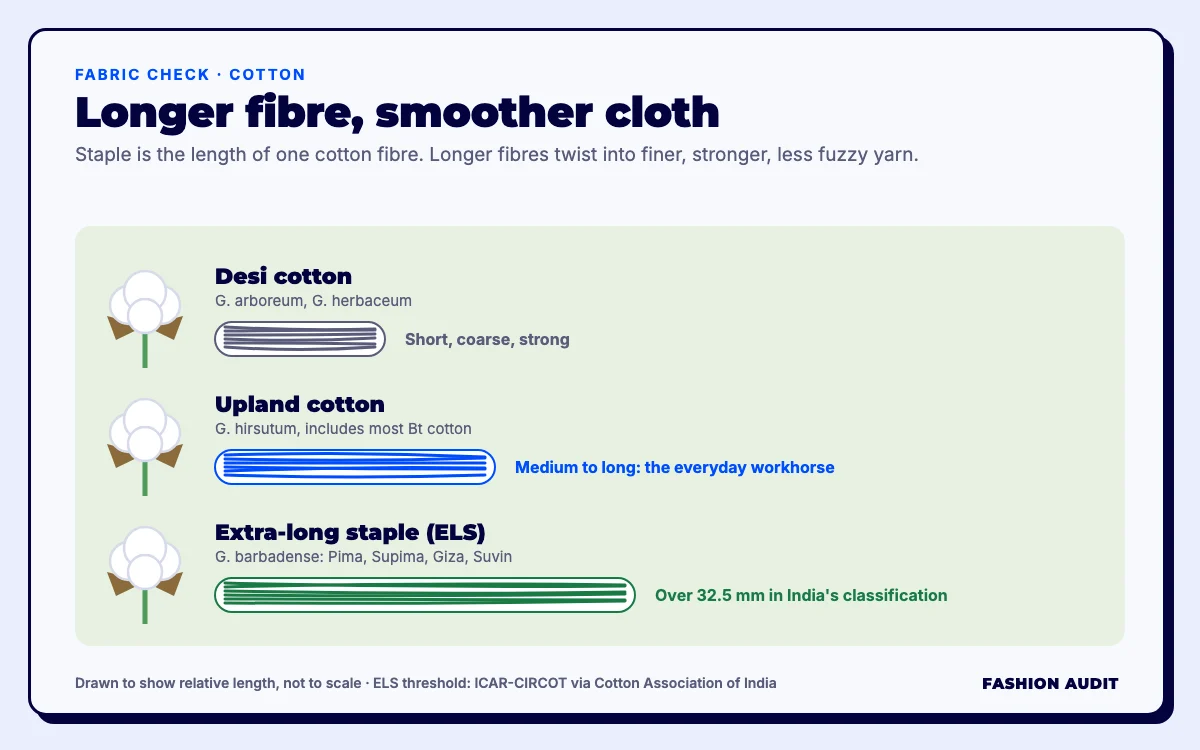
Cotton fibre length is called staple. Longer fibres can be twisted into thinner, smoother, stronger yarn with fewer loose ends poking out. That is why long-staple cotton feels silkier and pills less. Four species of cotton are grown for cloth, and they fall into three groups.
Desi cotton (Old World cotton)
Gossypium arboreum and Gossypium herbaceum are the cottons native to India and Africa. Their fibres are shorter and coarser, but the plants are hardy and cope with dry weather. Desi cotton suits thicker handloom cloth, durries and some khadi rather than fine shirting.
Kala cotton
Kala cotton is an Old World cotton native to Kachchh in Gujarat. It is purely rain-fed, and its farmers do not use pesticides or synthetic fertilisers (Khamir). The cloth is slightly rough, with a handwoven, textured look. Buy it for its story and its low-water farming, not for silkiness.
Upland cotton
Gossypium hirsutum is the world’s everyday cotton, and most Bt cotton belongs to it. It has a medium-to-long staple. If a label just says “100% cotton” with no other detail, it is almost certainly upland.
Extra-long-staple (ELS) cotton
Gossypium barbadense gives the longest fibres. India’s classification, from the ICAR-Central Institute for Research on Cotton Technology, treats cotton with a staple longer than 32.5 mm as ELS (Cotton Association of India). The names you will see on labels:
- Pima: ELS cotton, grown in the US and also in Peru, Australia and Israel (Wikipedia).
- Supima®: a trademark for American-grown Pima. Supima says it is less than 1% of the world’s cotton (Supima).
- Egyptian or Giza cotton: ELS cotton grown in Egypt, sold under variety names such as Giza 45. Look for the licensed Egyptian Cotton™ logo. The words “Egyptian cotton” on their own have been used loosely on labels.
- Suvin: an Indian ELS cotton, listed alongside Pima and Giza in Textile Exchange’s fibre guide (Textile Exchange). It is grown in small quantities.
Organic, Bt and “responsible” cotton
Organic cotton is grown without synthetic pesticides and fertilisers, and is not genetically modified. India accounts for the largest share of the world’s organic cotton (Textile Exchange Organic Cotton Market Report 2022). On a label, trust a certificate such as GOTS or OCS over the word “organic” alone. Organic tells you about the farm, not the feel: an organic tee can still be a short-staple, open-end one.
Better Cotton (earlier called BCI) is a farming standard aimed at less water and chemical use. It is not organic, and it usually does not tell you which farm your shirt came from.
From boll to T-shirt: where quality is decided
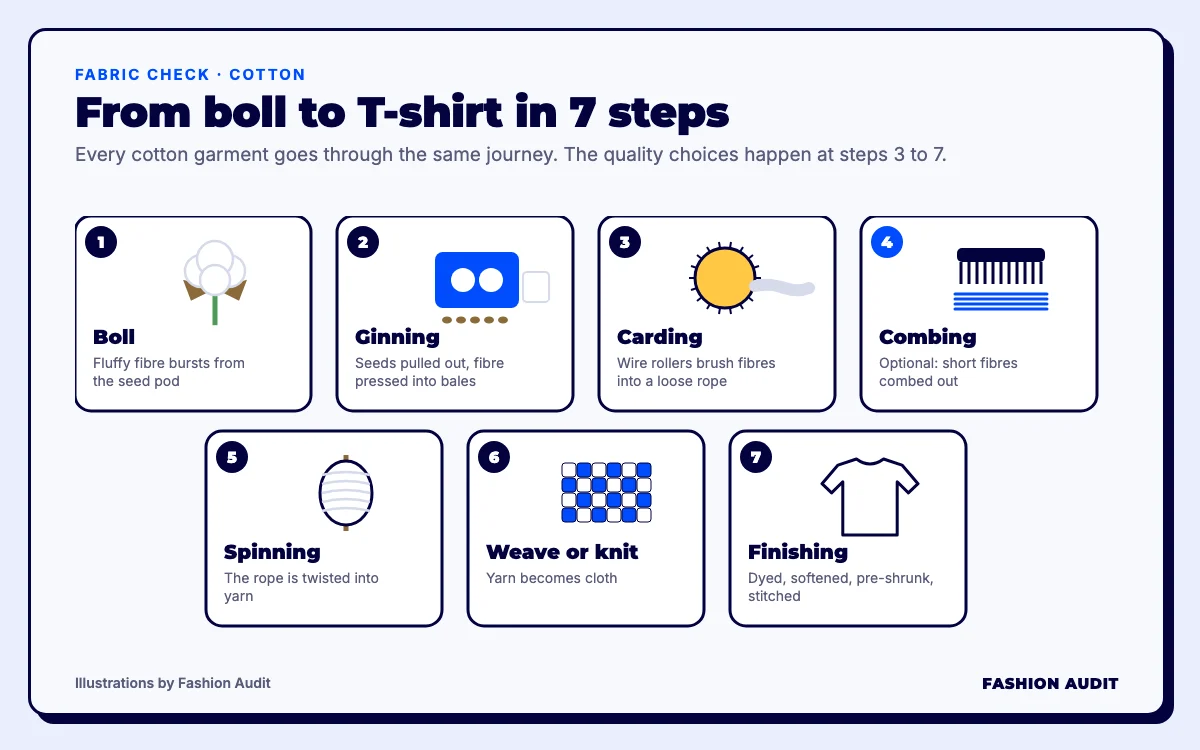
After picking, cotton is ginned to remove the seeds and pressed into bales. At the mill it is carded: brushed into a loose rope of fibres. Better yarns are then combed, then spun, then woven or knitted, then finished. Two of these steps show up on labels, so they are worth understanding.
Carded vs combed
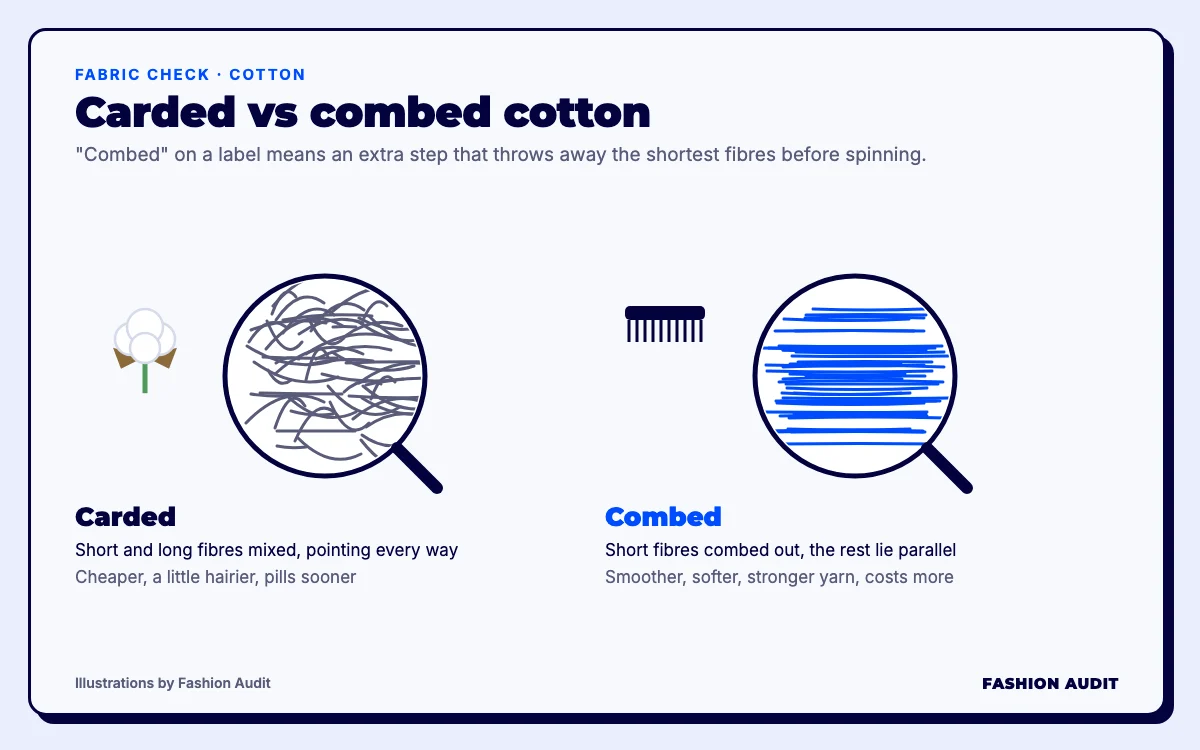
Carded cotton keeps short and long fibres together, pointing every which way. It is cheaper, a little hairier, and pills sooner. Combed cotton goes through an extra step that throws out the shortest fibres. The yarn is smoother, softer and stronger. “Super combed”, common on Indian innerwear packs, is a marketing term for a finer combing. It is not a standard grade, but it does tell you the combing step happened.
Open-end, ring-spun and compact yarn
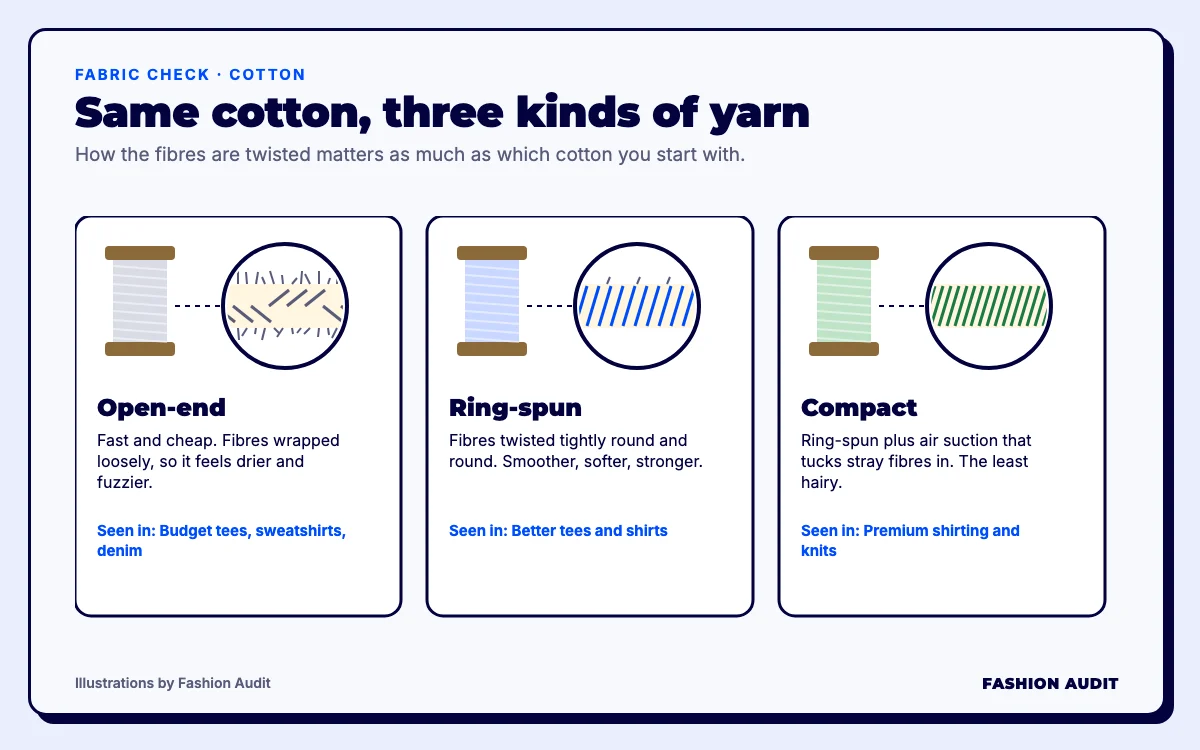
- Open-end (rotor) yarn is fast and cheap to make. Fibres are wrapped loosely, so it feels drier and fuzzier. Common in budget tees, sweatshirts and much denim.
- Ring-spun yarn twists fibres tightly. It is softer and stronger and the standard for better tees and shirts.
- Compact yarn is ring-spun with an air-suction step that tucks stray fibres in. It is the smoothest of the three and is used in premium shirting.
Woven cotton fabrics you will see on labels
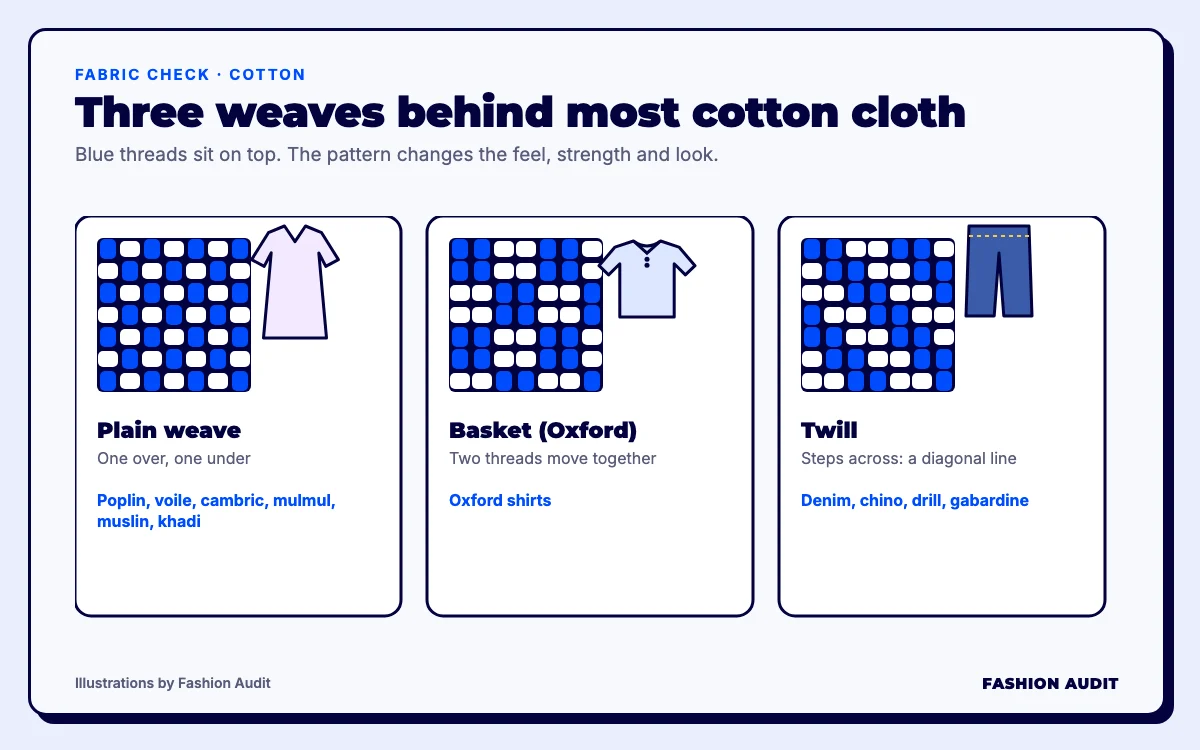
Woven cloth has threads crossing at right angles. It holds its shape, does not stretch much, and is used for shirts, kurtas, trousers and jeans. The same cotton becomes very different fabrics depending on the weave and yarn thickness.
Plain weave family (one over, one under)
- Poplin: tight, smooth and slightly crisp. The classic office shirt.
- Cambric: light, close-woven, with a soft finish. Common in kurtis and lightweight shirts.
- Voile: sheer and airy. Good for summer kurtas and dupattas, often needs a lining.
- Mulmul: the Indian name for soft, fine, loosely woven cotton. Light and breathable, the summer favourite.
- Muslin: today a broad word for plain-woven cotton, from fine sheers to coarse sheeting. Historic Dhaka muslin was something far finer.
- Khadi: hand-spun and hand-woven cloth, with a textured, uneven surface that breathes well.
- Chambray: a coloured warp with a white weft, so it looks like light denim but is plain-woven and lighter.
Basket weave
- Oxford: two threads move together, giving a soft, slightly textured, durable shirt fabric. Casual and forgiving to wear.
Twill family (a diagonal line)
- Denim: a twill with an indigo warp and a white weft. Heavy, strong and slow to dry.
- Chino and drill: lighter cotton twills for trousers and uniforms.
- Gabardine: a tight, smooth twill for structured trousers.
Raised and pile cotton
- Flannel: brushed to raise a soft fuzz. Warm, for winter shirts.
- Corduroy: cut pile in ridges called wales. Warm and hard-wearing.
Knitted cotton: why your T-shirt stretches
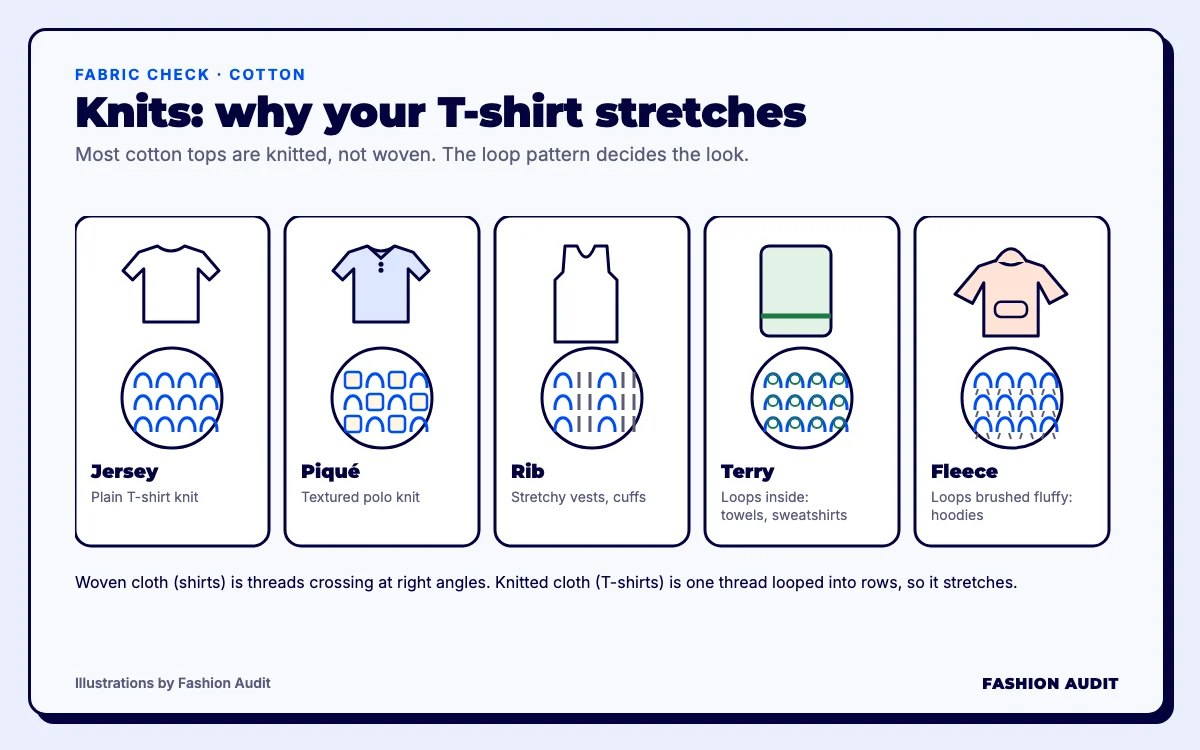
- Single jersey: the plain T-shirt knit. Smooth on the front, little loops on the back.
- Piqué: the waffle-like texture on polo shirts. It breathes well and hides sweat marks better than jersey.
- Rib: raised vertical lines that stretch and spring back. Used for vests, tank tops, cuffs and collars.
- Terry: loops on the surface that soak up water. Towels and bathrobes.
- French terry: flat on the outside, loops inside. Light sweatshirts and joggers for a mild Indian winter.
- Fleece: the inside loops are brushed into fluff. Warm hoodies for North Indian winters.
Finishes and newer ideas
- Mercerised cotton: treated with caustic soda under tension. It gets a gentle sheen, takes dye more deeply and gains strength. Common in better polos.
- Bio-wash or enzyme wash: an enzyme treatment that removes surface fuzz, so the fabric feels softer and pills less at first.
- Pre-shrunk: the fabric has been shrunk at the mill so the garment keeps its size after washing. Worth looking for on any 100% cotton piece.
- Garment-dyed: dyed after stitching, giving a softer, lived-in colour.
- Slub cotton: yarn with deliberate thick and thin patches, for a textured, casual look.
- Recycled cotton: made from cutting waste or old garments. Fibres get shorter in recycling, so it is usually blended with fresh cotton or polyester.
- Cotton with Lycra or elastane (2–5%): adds stretch to jeans and fitted tees. It also makes the garment slightly warmer and slower to dry.
- Cotton-modal blends: softer and more drapey than plain cotton. Common in premium innerwear.
GSM: how heavy the cloth is
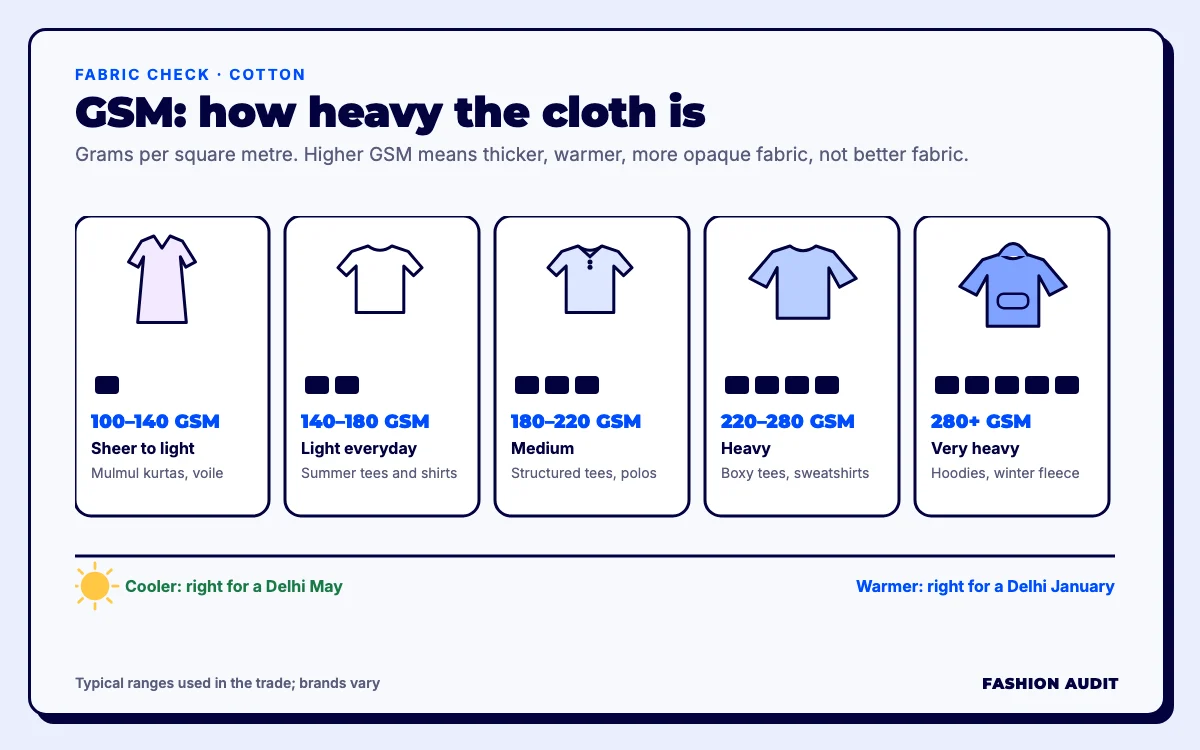
GSM is grams per square metre: how much a fabric weighs. These are typical trade ranges, and brands vary. Around 100–140 GSM is sheer to light (mulmul, voile). 140–180 is the everyday summer tee. 180–220 is a sturdier tee or polo. 220–280 is a heavy, boxy tee or light sweatshirt, and 280 and above is hoodie territory. In a Delhi May, a 240 GSM “premium heavyweight” tee is the wrong buy, however good the cotton. Our Killer Jeans audit shows how GSM also matters in denim.
Cotton’s pros and cons
| What cotton does well | Where cotton falls short |
|---|---|
| Breathes and lets heat out, which matters most in Indian summers | Holds sweat and dries slowly, so it feels heavy during a humid workout |
| Absorbs moisture, so it feels cool on dry hot days | Wrinkles easily, especially poplin and cambric |
| Gentle on skin, rarely causes irritation | Can shrink if not pre-shrunk, mainly in hot washes and dryers |
| Softens with washing and lasts years if combed and ring-spun | Cheap carded, open-end cotton pills and loses shape quickly |
| Easy to wash at home, takes dye well | Dark colours fade in strong sun and hard water |
| Biodegradable when not blended with synthetics | Conventional farming uses a lot of water and pesticides |
What is right for Indian weather
- Dry summer heat (North and Central India, April to June): light, loose cotton. Mulmul, cambric and voile kurtas; 140–170 GSM tees. Avoid stretch blends, which feel clingy.
- Humid coastal summer (Mumbai, Chennai, Kolkata): cotton still breathes, but it holds sweat. Piqué polos and loose weaves dry faster than tight jersey. Linen-cotton blends help.
- Monsoon: thick cotton such as denim and heavy tees takes long to dry indoors and can smell musty. Choose lighter weights and dry them with a fan.
- North Indian winter: flannel shirts, French terry and fleece hoodies work as layers. Cotton alone is not warm enough for the coldest weeks.
How to read a cotton label
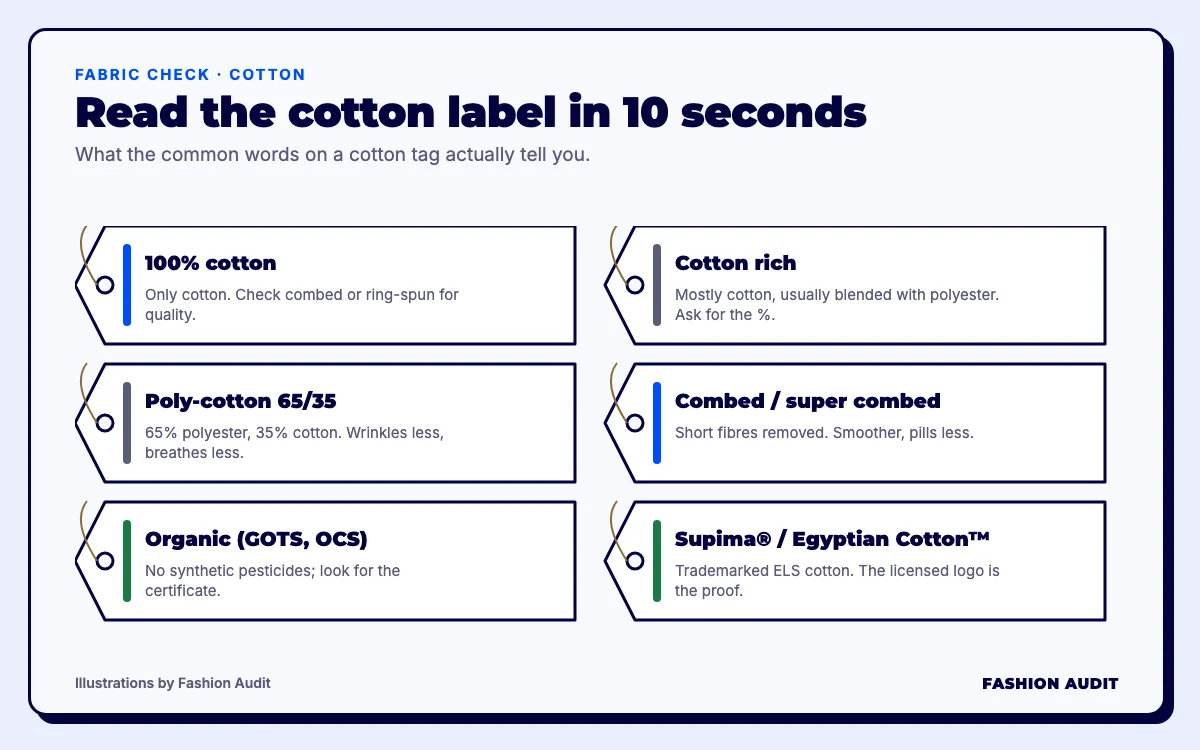
- “100% cotton” tells you the fibre, not the quality. Look for “combed” or “ring-spun” next to it.
- “Cotton rich” usually means a blend with polyester. Check the exact percentage on the care label inside.
- “Poly-cotton 65/35” means 65% polyester and 35% cotton. It wrinkles less and dries faster, but traps more heat.
- “Organic” should come with a certificate name such as GOTS or OCS.
- “Supima” or “Egyptian Cotton” are trademarks. A licensed logo is the real proof. A tee at a marketplace low price with these words deserves a second look.
- The hand check: hold the fabric up to light. Even, tight cloth with few loose fibres on the surface usually means better yarn. Rub it between your fingers: open-end cotton feels drier and rougher.
Price check: what cotton costs in India
These are prices as listed in the Fashion Audit shop and on brand sites on 10 November 2026. They show how much the type of cotton changes the price.
- Lux Cozi 100% cotton round-neck vest, pack of 3: ₹379 (MRP ₹453), about ₹126 a vest. See our Lux Cozi audit.
- Jockey super combed cotton rib vest: ₹299 (MRP ₹349) for one. You pay more per piece for the combed, rib-knit fabric.
- Lyphy poly-cotton polo: ₹370 (MRP ₹1,999). The polyester blend keeps the price low.
- Bershka heavy boxy pure cotton T-shirt: ₹1,349. You pay for weight and cut more than for the cotton type.
- Uniqlo Supima cotton crew-neck T-shirt: ₹1,490 on uniqlo.com/in. A long-staple tee from a brand that names the cotton.
- Roadster pure cotton straight-fit jeans: ₹871 (MRP ₹2,599). More in our Roadster audit.
- Anouk pure cotton kurta set with dupatta: ₹1,499 (MRP ₹5,999).
A gap of 60–80% between MRP and selling price, which you can see on several listings above, is normal on Indian marketplaces. Treat the selling price as the real price. For handloom and khadi cotton, see our Fabindia audit.
Caring for cotton in Indian conditions
- Wash cool or lukewarm. Hot water is the main cause of shrinking.
- Turn dark cotton inside out and dry it in shade. Strong sun fades indigo and black quickly.
- Hard water leaves cotton stiff and dull. A little fabric conditioner or a vinegar rinse helps.
- Monsoon drying: spread clothes out under a fan and do not leave damp cotton folded, or it develops a musty smell and mildew spots.
- Ironing: iron cotton while slightly damp, on the cotton setting. Mulmul and voile need a lower heat.
- White cotton: use oxygen bleach rather than chlorine bleach, which weakens fibres and yellows prints.
Where the marketing misleads
- “Premium cotton” has no definition. Ask which cotton and which yarn.
- “Heavyweight” is not “high quality”. A thick open-end tee can feel worse than a thin combed one.
- Thread count matters for bedsheets, not clothes, and very high numbers can be reached with thin multi-ply yarns.
- “Feels like cotton” or “cotton touch” usually means a polyester fabric.
- “Organic” without a certificate is a claim you cannot check.
What it means for you
- For everyday tees, pay for combed, ring-spun, 100% cotton at 140–180 GSM. It is the best value in Indian shops.
- Pay extra for Supima, Giza or Suvin only if you want a smoother tee that lasts longer, and check for the licensed logo.
- For summer kurtas, choose mulmul, cambric or voile. For office shirts, poplin or Oxford.
- Buy poly-cotton only when you need low-iron clothes for travel or uniforms.
- Read the inside care label, not the listing title. The care label is where the exact fibre percentage has to appear.
Common questions
Is 100% cotton always better than a blend?
For Indian heat, usually yes, because pure cotton breathes better. A small amount of elastane is fine for stretch. Blends with lots of polyester trap heat and sweat.
Why does my cotton T-shirt shrink?
Cotton fibres relax and tighten when washed in hot water or tumble-dried. Buy pre-shrunk pieces, wash cool and dry flat or on a line.
What is the difference between combed and super combed cotton?
Both have had their shortest fibres combed out. “Super combed” is a brand term for finer combing, not an industry grade.
Is Supima the same as Egyptian cotton?
No. Both are extra-long-staple cottons from the same species. Supima is grown in the US and Egyptian cotton in Egypt, each with its own trademark.
What GSM T-shirt is best for Indian summer?
Around 140–180 GSM. Heavier tees above 220 GSM are better kept for winter or air-conditioned offices.
The bottom line
For most people, the cotton worth paying for is not the most famous one. It is ordinary upland cotton that has been combed and ring-spun, in a light weight for Indian heat. A ₹500–₹900 tee with those words on the label will serve you better than a ₹1,500 heavyweight tee made from open-end yarn. Spend on extra-long-staple cotton when you want a shirt or tee to last several years. Skip poly-cotton unless low ironing matters more to you than comfort.
Sources
- Harappa.com: Empire of Cotton (Mehrgarh and Mohenjo-daro dates)
- Wikipedia: Muslin (Dhaka muslin, GI tags)
- Beltwide Cotton Conferences 2000: Continuous Mercerization of Raw Cotton Fibers
- USDA GAIN report: India Enters the GMO Era, April 2002
- PIB: White Gold, India’s Cotton Story
- Ministry of Textiles: Cotton
- Cotton Association of India: Extra Long Staple Cotton Production in India
- Textile Exchange: Organic Cotton Fiber Classification Guide
- Textile Exchange: Organic Cotton Market Report 2022
- Supima: The Cotton
- Wikipedia: Gossypium barbadense
- Khamir: Kala Cotton Initiative
Diagrams by Fashion Audit. Have a correction? Write to us through the contact page and we will update this guide with a dated note.