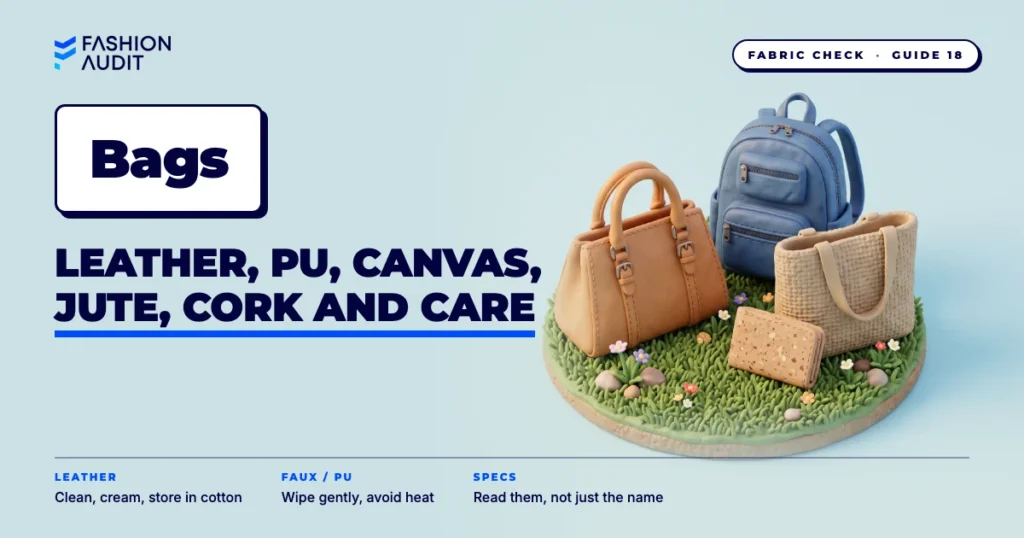
A bag goes everywhere with you, so its material matters as much as its shape. Leather ages well but needs care. Faux leather is light and cheap but can wear at the surface. Canvas, nylon and polyester handle daily use. Jute and cork are natural options. This guide explains each material, what our shop’s bags are made of, how to clean and store them, and what to check before you buy.
Fabric Check is Fashion Audit’s series on the materials and making of what you wear.
The short answer
Choose the material for how you will use the bag. Leather lasts years if you clean, condition and store it well. Faux leather (PU) costs less and needs little care, but its surface can rub off over time. Canvas is tough and easy to spot-clean. Nylon and polyester are light and shrug off rain. Jute and cork are natural options. And always read the specifications, not just the product name: they do not always match.
Bag materials at a glance
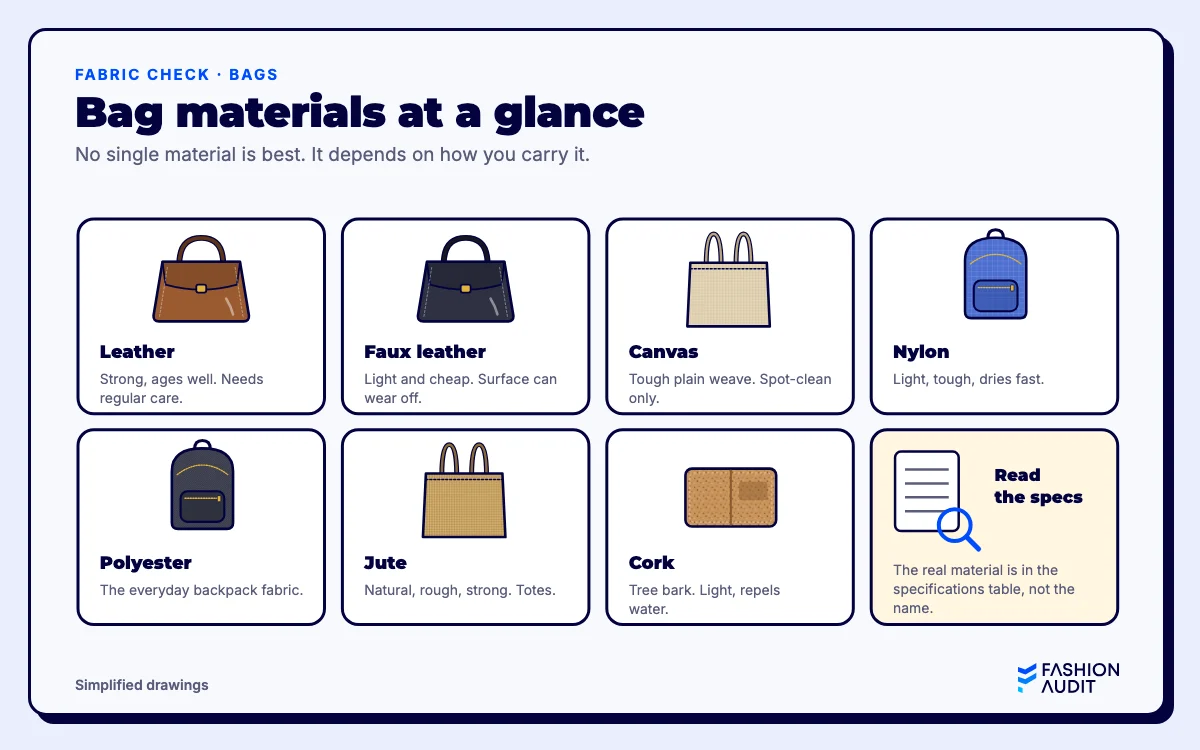
- Leather: strong, ages well, needs regular care. Heavier and costlier.
- Faux leather (PU or PVC): light, cheap, easy to wipe. The surface can wear off with time.
- Canvas: a heavy plain-woven fabric, tough and easy to spot-clean. Marks if left wet.
- Nylon and polyester: light, tough, quick to dry. The usual choice for backpacks.
- Jute: a natural plant fibre, rough and strong. Best for totes and shopping bags.
- Cork: tree bark, light and water-repelling. Mostly small items such as wallets.
Leather bags
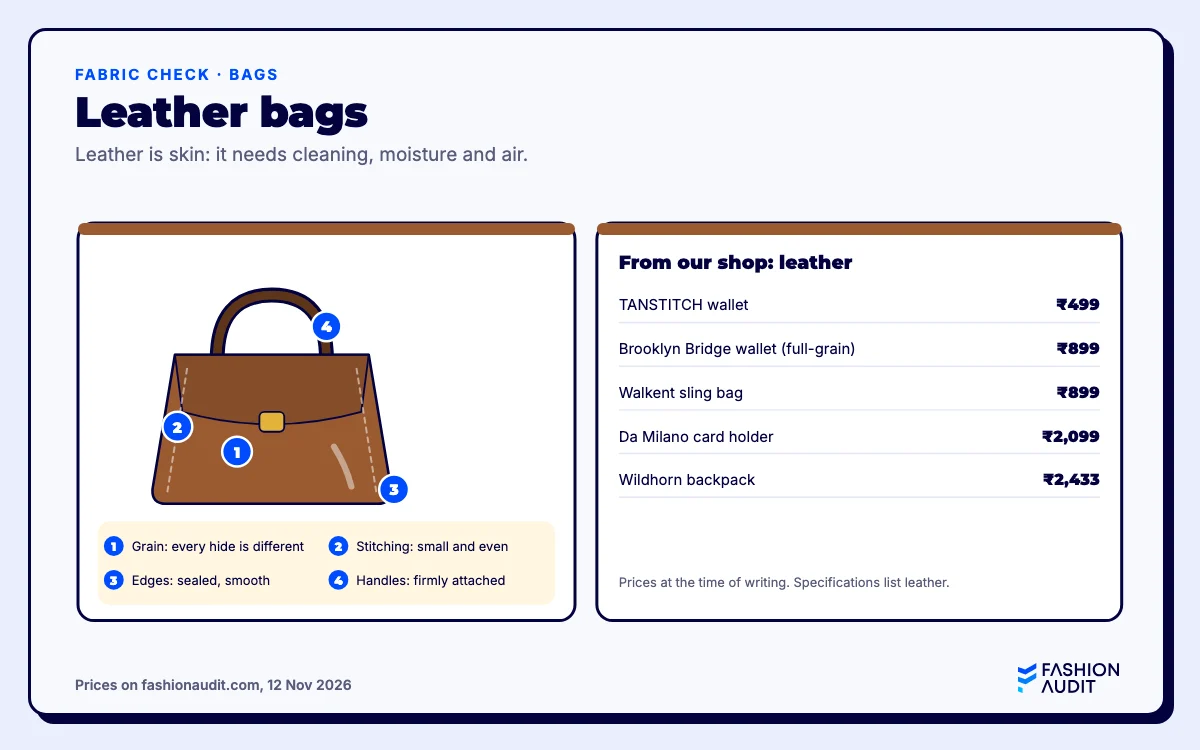
Leather is a natural material, so every hide has its own grain. Good leather bags last for years and look better with use, but they are heavier, cost more, and need cleaning and conditioning. Words such as “full-grain” and “genuine leather” describe different grades: our leather guide explains what each one means.
From our shop (prices at the time of writing; their specifications list leather):
- TANSTITCH genuine leather wallet: ₹499.
- Brooklyn Bridge slim wallet: ₹899. Its specifications say full-grain leather.
- Walkent leather sling bag: ₹899.
- Da Milano leather card holder: ₹2,099. See our Da Milano brand audit.
- Wildhorn leather backpack: ₹2,433.
Faux leather, PU and “vegan leather”
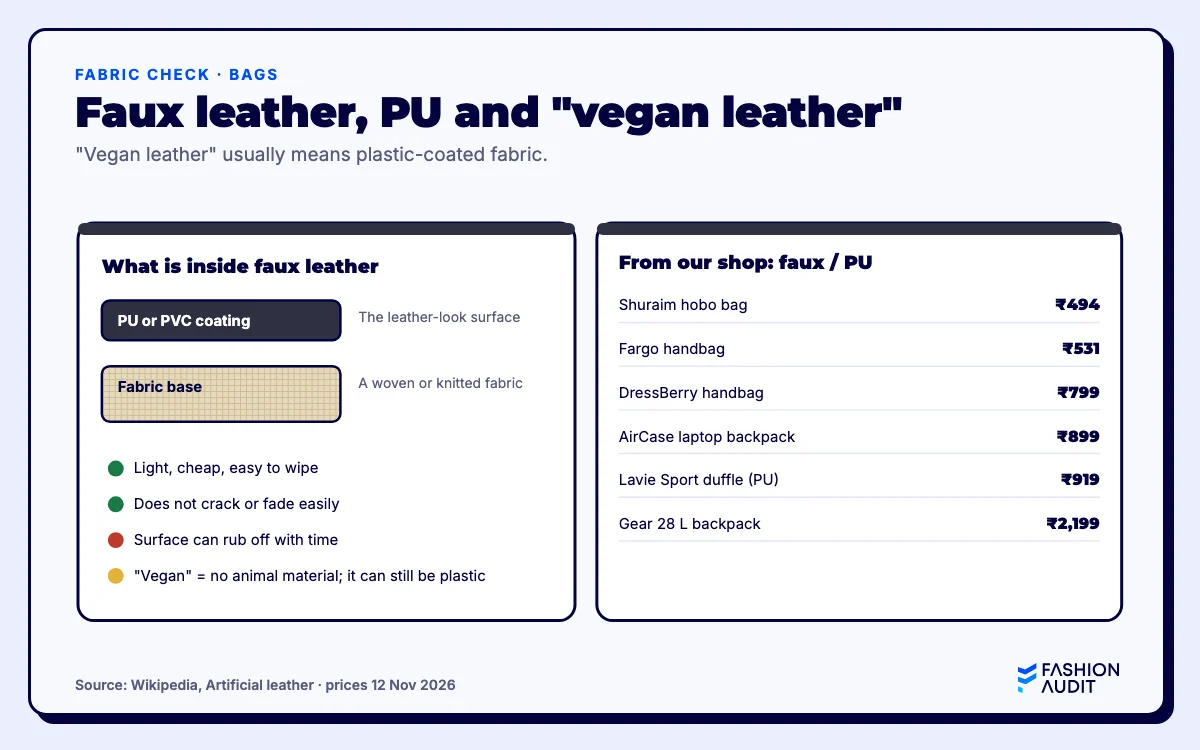
Artificial leather goes by many names: faux leather, synthetic leather, leatherette, PU leather, pleather and vegan leather. Most of it is a fabric base coated with polyurethane (PU) or PVC. It needs little care and does not crack or fade easily, but the surface of some artificial leathers can rub and wear off with time. PU versions can be wiped clean; PVC versions are harder to clean (Wikipedia: Artificial leather).
“Vegan” means no animal material. It does not tell you whether the bag is plastic or plant-based, so check the specifications.
From our shop (specifications list faux, synthetic, PU or vegan leather):
- Shuraim faux leather hobo bag: ₹494.
- Fargo faux leather handbag: ₹531.
- DressBerry synthetic leather handbag: ₹799. See our DressBerry brand audit.
- AirCase vegan leather laptop backpack: ₹899.
- Lavie Sport 32 L duffle: ₹919. Its specifications say PU. See our Lavie brand audit.
- Gear faux leather 28 L backpack: ₹2,199.
Canvas and jute
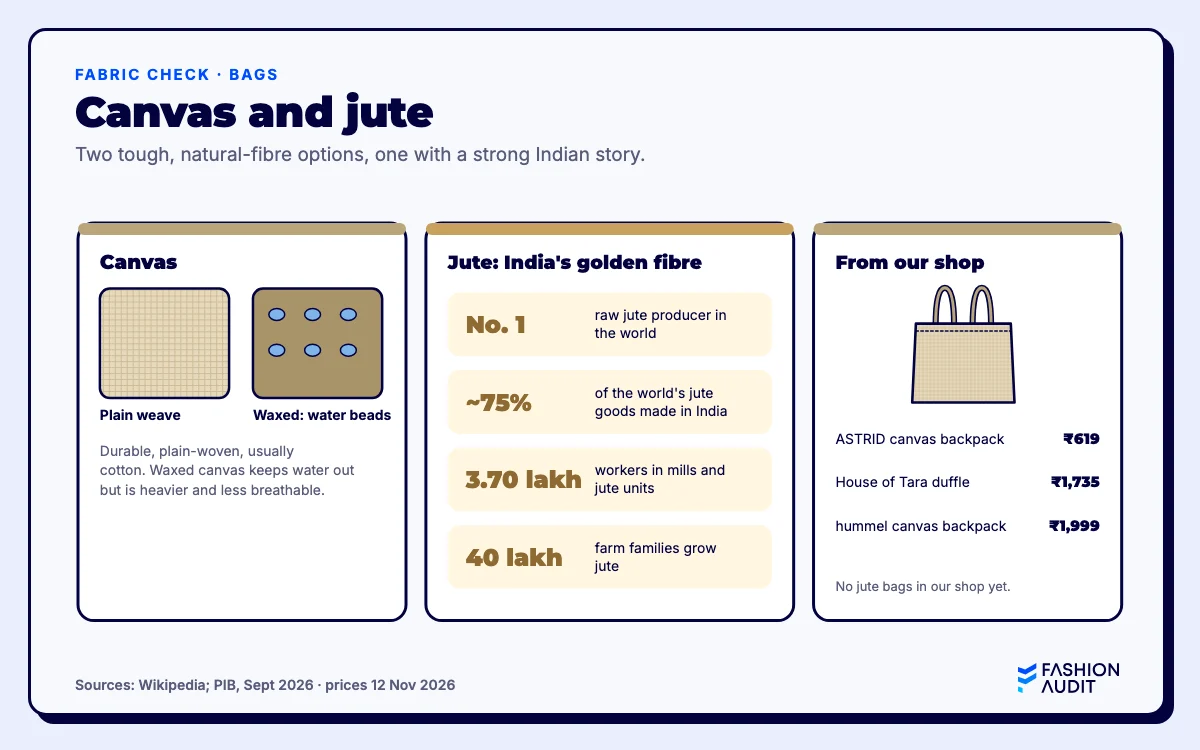
Canvas is a durable plain-woven fabric, used for sails, tents and backpacks as well as handbags and shoes (Wikipedia: Canvas). Most canvas bags are cotton; see our cotton guide. Waxed canvas is treated with paraffin or beeswax to keep water out. It is less breathable, and heavier than modern synthetics (Wikipedia: Waxed cotton).
Jute, India’s “golden fibre”, is a homegrown success. India is the world’s largest producer of raw jute and makes about 75% of the world’s jute goods. West Bengal grows the most, followed by Bihar, Assam, Odisha and Jharkhand. The industry directly employs about 3.70 lakh workers and supports nearly 40 lakh farm families. Jute is biodegradable, which makes it a natural alternative to plastic shopping bags (PIB, September 2026).
From our shop (specifications list canvas): ASTRID canvas backpack, ₹619; The House of Tara canvas duffle, ₹1,735; hummel canvas backpack, ₹1,999. Our shop does not carry jute bags yet.
Nylon, polyester and what “600D” means
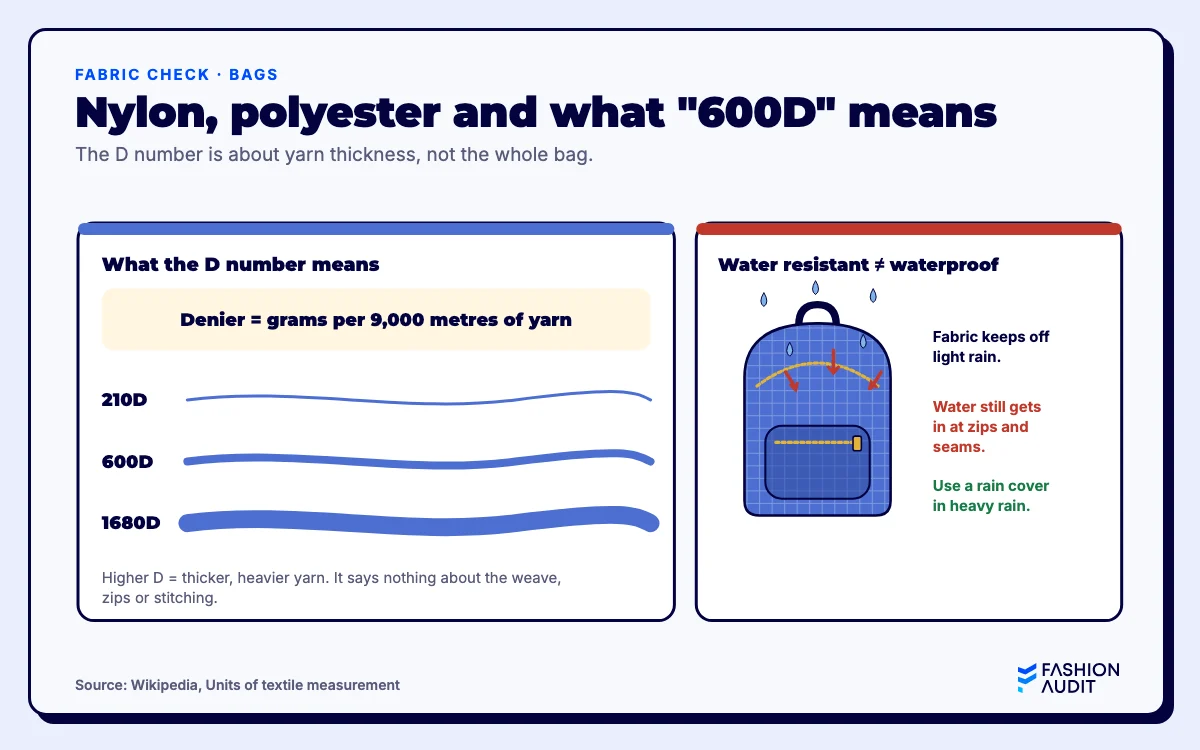
Most backpacks are nylon or polyester: light, tough and quick to dry. Our polyester guide explains how the fibre is made.
Bag listings often say “600D” or “1680D”. D stands for denier: the weight in grams of 9,000 metres of yarn (Wikipedia: Units of textile measurement). A higher number means a thicker, heavier yarn. It does not tell you how tightly the fabric is woven, or how good the zips, stitching and coating are.
“Water resistant” is not waterproof. The fabric may keep off light rain, but water can still get in through zips and seams. In heavy rain, use a rain cover and keep electronics in a pouch.
From our shop: Skybags 20 L polyester backpack, ₹499 (see our Skybags brand audit); Safari 26 L polyester backpack, ₹579 (see our Safari brand audit); Red Lemon 25 L nylon backpack, ₹1,998.
Cork

Cork is the bark of the cork oak, which grows in south-west Europe and north-west Africa. It is light, elastic and repels water. Once a tree is about 25 years old, its bark is stripped by hand about every nine years, in a season when this does not cause the tree lasting harm. Cork oaks live for about 300 years, and Portugal produces about half of the world’s cork (Wikipedia: Cork).
Cork bags and wallets usually use a thin layer of cork on a fabric backing. From our shop: the Clan Earth Ibis cork wallet, ₹1,300. Its specifications list waxed canvas and printed cork.
How to care for a leather bag
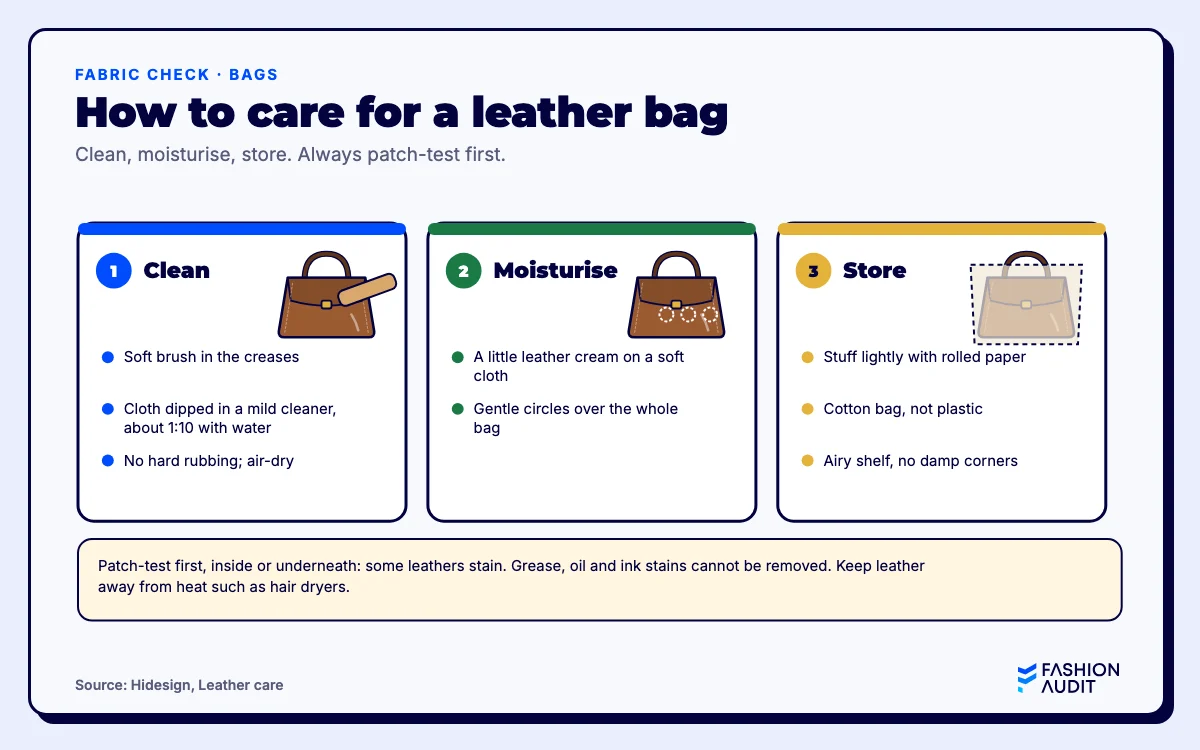
Indian leather brand Hidesign suggests three steps (Hidesign: Leather care):
- Clean: brush dust out of the creases with a soft brush. Wipe gently with a cloth dipped in a mild cleaner well diluted in water, about one part to ten. Do not rub hard, and let the bag dry naturally.
- Moisturise: rub in a little leather cream with a soft cloth, in gentle circles. If you have no leather cream, Hidesign says gentle body lotion or coconut oil can work instead.
- Store: stuff the bag lightly with rolled paper, corners too, put it in a cotton bag and keep it on an airy shelf.
Always patch-test first on the inside or the bottom of the bag, because some leathers stain. Hidesign also warns that grease, oil and ink stains cannot be removed from leather, so keep pens capped and food sealed. Keep leather away from heat such as hair dryers, which dries and cracks it. If a leather bag gets soaked, stuff it to hold its shape and let it dry in normal light. For mould, it suggests wiping with a soft cloth in a mild antiseptic-and-water mix. See our Hidesign brand audit.
Caring for fabric and faux leather bags
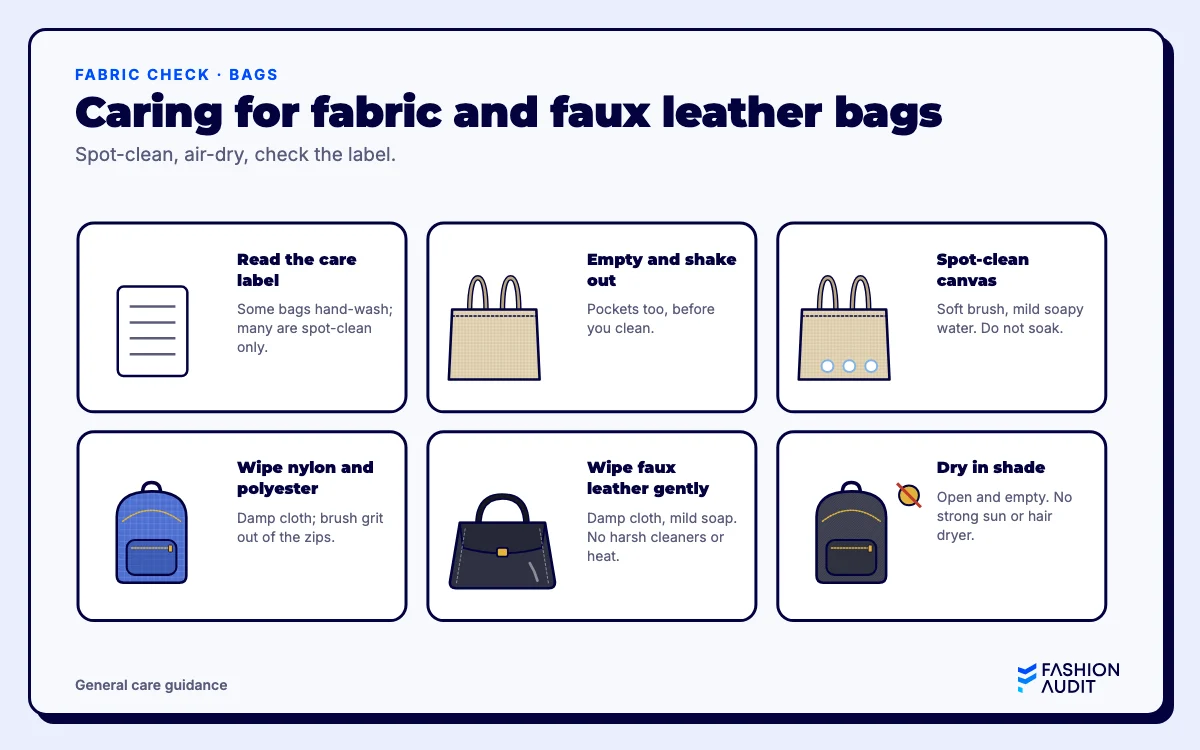
- Read the care label first. Some fabric bags can be hand-washed; many should only be spot-cleaned.
- Empty it and shake it out, pockets too, before you clean.
- Spot-clean canvas with a soft brush and mild soapy water. Do not soak it, and dry it fully so it does not mark or smell.
- Wipe nylon and polyester with a damp cloth. Clean the zips with a dry brush so grit does not jam them.
- Wipe faux leather with a damp cloth and mild soap. Avoid harsh cleaners and heat, which can damage the coating.
- Dry in shade, open and empty, never in strong sun or with a hair dryer.
How to store bags

- Stuff to keep the shape: rolled paper in the body and corners, without overfilling. Use plain paper for light-coloured bags.
- Cotton dust bag, not plastic: leather needs to breathe, and plastic traps damp.
- Airy shelf, not a damp corner: keep silica gel nearby in the monsoon.
- Empty every pocket: leaking pens and forgotten food leave stains.
- Keep out of strong sun, which fades colour and dries leather.
- Use bags in turn: a bag left in a cupboard for months is more likely to get mould.
What to check before you buy
- The specifications table: the real material is listed there, and it does not always match the product name.
- Stitching: small, even stitches, especially where the straps join the body.
- Zips: they should run smoothly, with no catching.
- Edges and lining: neat, sealed edges on leather and faux leather, and a lining that does not tear easily.
- Straps: padded and adjustable on backpacks, firmly attached on handbags.
- The return policy: so you can send back a bag that does not match its listing.
Where the marketing misleads
- “Vegan leather” usually means PU or PVC. That is a fair choice, but it is not a plant material unless the specifications say so.
- The name is not the spec. In our shop we found a bag sold as “nylon” whose specifications list coated canvas and vegan leather, and a “vegan leather” wallet whose specifications list waxed canvas and printed cork. Read the specifications table every time.
- “Waterproof” fabric does not make a waterproof bag if water can get in at the zips and seams.
- A high “D” number means thicker yarn, not a better-made bag.
- “Genuine leather” is a grade, not a guarantee of top quality. See our leather guide.
What it means for you
- Daily office or college bag: nylon or polyester for light weight, or leather if you will care for it.
- Budget handbag: faux leather looks smart for less; wipe it gently and avoid heat.
- Casual and shopping: canvas or jute, and jute supports a big Indian industry.
- Monsoon: nylon or polyester with a rain cover, and dry every bag fully before you put it away.
- Always: read the specifications, not just the name.
Common questions
Is PU leather the same as real leather?
No. PU leather is fabric coated with polyurethane. It is lighter and cheaper and needs less care, but it does not age like leather, and its surface can wear off over time.
How do I remove mould from a leather bag?
Wipe it with a soft cloth dipped in a mild antiseptic-and-water mix, then let it dry naturally in an airy room, out of strong sun. Patch-test first, and store the bag somewhere drier.
Can I wash a canvas bag in a machine?
Only if the care label says so. Many canvas bags have leather trims, cardboard stiffeners or printed designs that a wash can damage. Spot-cleaning by hand is safer.
What does 600D mean on a backpack?
The yarn weighs 600 grams per 9,000 metres. A higher number is a thicker yarn, but the weave, zips and stitching matter just as much.
Is a jute bag good for daily use?
Jute is strong and biodegradable, and good for totes and shopping. It is rough and can lose its shape when wet, so it suits casual use more than office use.
The bottom line
Every bag material has its strengths. Choose leather for long life with care, faux leather for low cost, canvas and jute for natural and casual, and nylon or polyester for light, everyday toughness. Clean gently, dry in shade, store with air and paper, and read the specifications before you buy.
Sources
- Hidesign: Leather care
- PIB: Jute, India’s Golden Fibre (September 2026)
- Wikipedia: Artificial leather
- Wikipedia: Canvas
- Wikipedia: Waxed cotton
- Wikipedia: Units of textile measurement
- Wikipedia: Cork
- Product specifications on fashionaudit.com, checked 12 November 2026.
Illustrations by Fashion Audit. Prices change often; check the product page before you buy. Have a correction? Write to us through the contact page and we will update this guide with a dated note.