
Nylon and spandex are two synthetic fibres that quietly hold much of your wardrobe together. Nylon is tough and smooth: socks, backpacks, rain jackets, swimwear and innerwear. Spandex, also called elastane or LYCRA®, is the stretch inside jeans, leggings and tees. This guide explains what each one is, how they differ from polyester, what “Lycra” really means on Indian listings, and how to keep stretch clothes from going baggy.
Fabric Check is Fashion Audit’s series on the fabrics in your wardrobe. Prices checked 11 November 2026.
The short answer
Buy nylon where toughness matters: bags, socks, swimwear and light rain jackets. Look for a small share of spandex (about 1–5%) in everyday clothes for comfort, and more only in activewear and leggings. Because spandex is usually the first part of a garment to wear out, wash stretch clothes cold and keep them away from heat.
Nylon: the first fully synthetic fibre
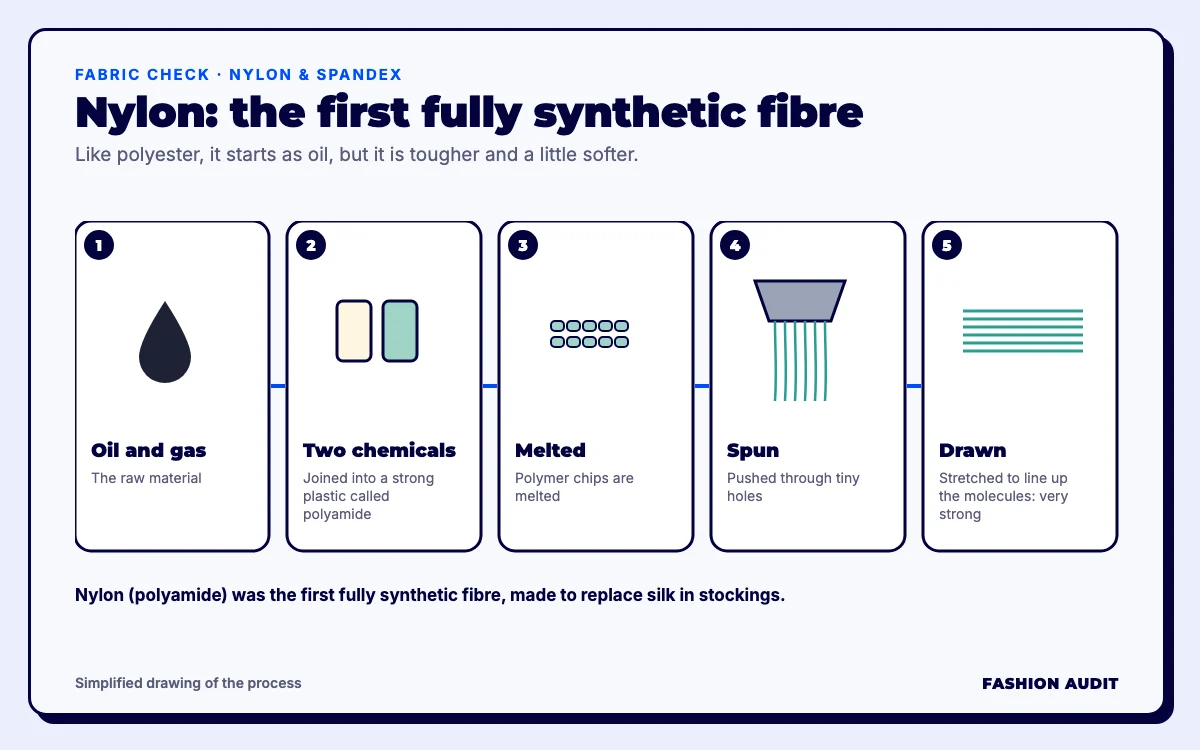
Nylon is a polyamide, a plastic made from oil-based chemicals. It is melted, pushed through tiny holes and then stretched (“drawn”), which lines up its molecules and makes the fibre very strong. It was invented to replace silk in stockings and became the first commercially successful fully synthetic polymer (Wikipedia, Nylon).
A short history
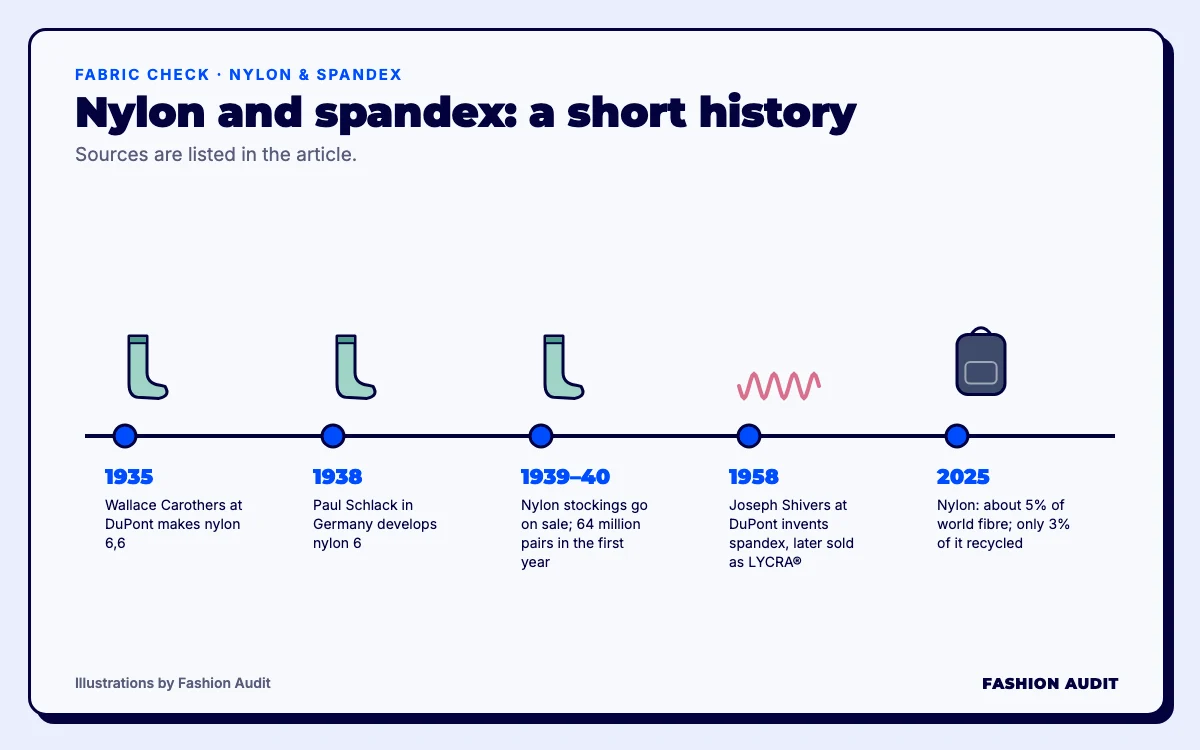
Wallace Carothers made the first nylon, nylon 6,6, at DuPont on 28 February 1935. In Germany, Paul Schlack developed nylon 6 in 1938. Nylon stockings went on sale in 1939–40 and sold 64 million pairs in their first year (Wikipedia). In 1958, DuPont chemist Joseph Shivers invented spandex, later sold as LYCRA®; unlike rubber, it could stretch about five times its length and recover (National Inventors Hall of Fame).
Today nylon is about 5% of the world’s fibre production, around 7.3 million tonnes, and only about 3% of that is recycled (Textile Exchange Materials Market Report 2026). Elastane is a much smaller fibre by weight, but it is in a huge share of clothing.
Where nylon and spandex show up
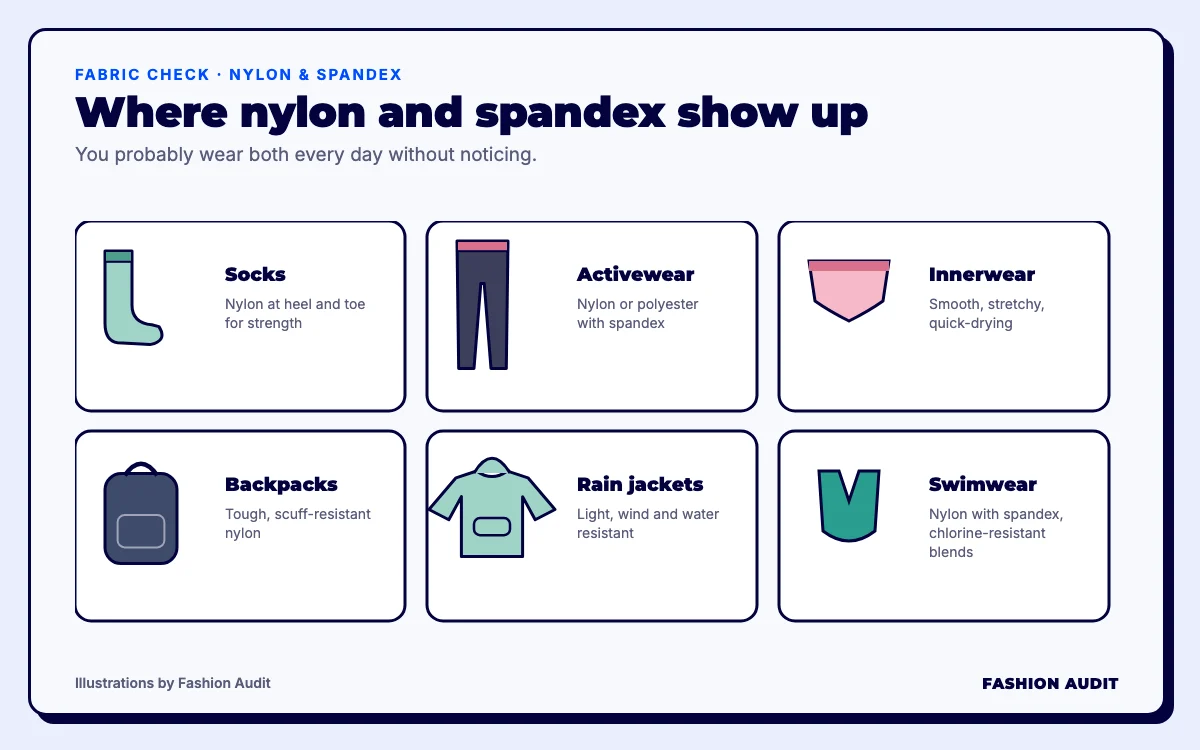
- Socks: nylon at the heel and toe adds strength.
- Activewear and leggings: nylon or polyester with spandex for stretch.
- Innerwear: smooth, stretchy and quick-drying nylon-spandex.
- Backpacks and bags: tough, scuff-resistant nylon.
- Rain and wind jackets: light nylon shells.
- Swimwear: nylon with spandex, often in chlorine-resistant blends.
Nylon vs polyester
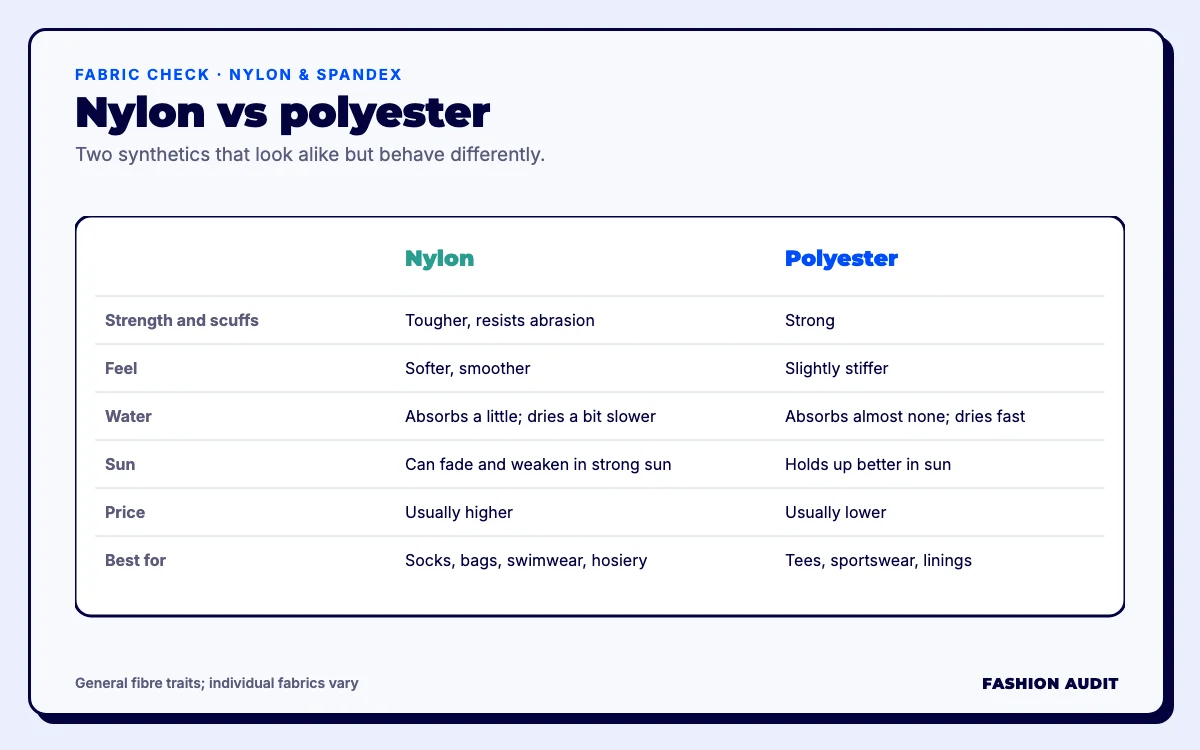
Nylon and polyester are both oil-based and often look identical. Nylon is generally tougher against abrasion and feels softer and smoother, which is why it is used for socks, bags and hosiery. It absorbs a little more water, so it can dry slightly slower, and it can fade and weaken in strong sun. Polyester is usually cheaper and handles sun better. Our polyester guide covers it in detail.
Denier and ripstop: bag and jacket jargon
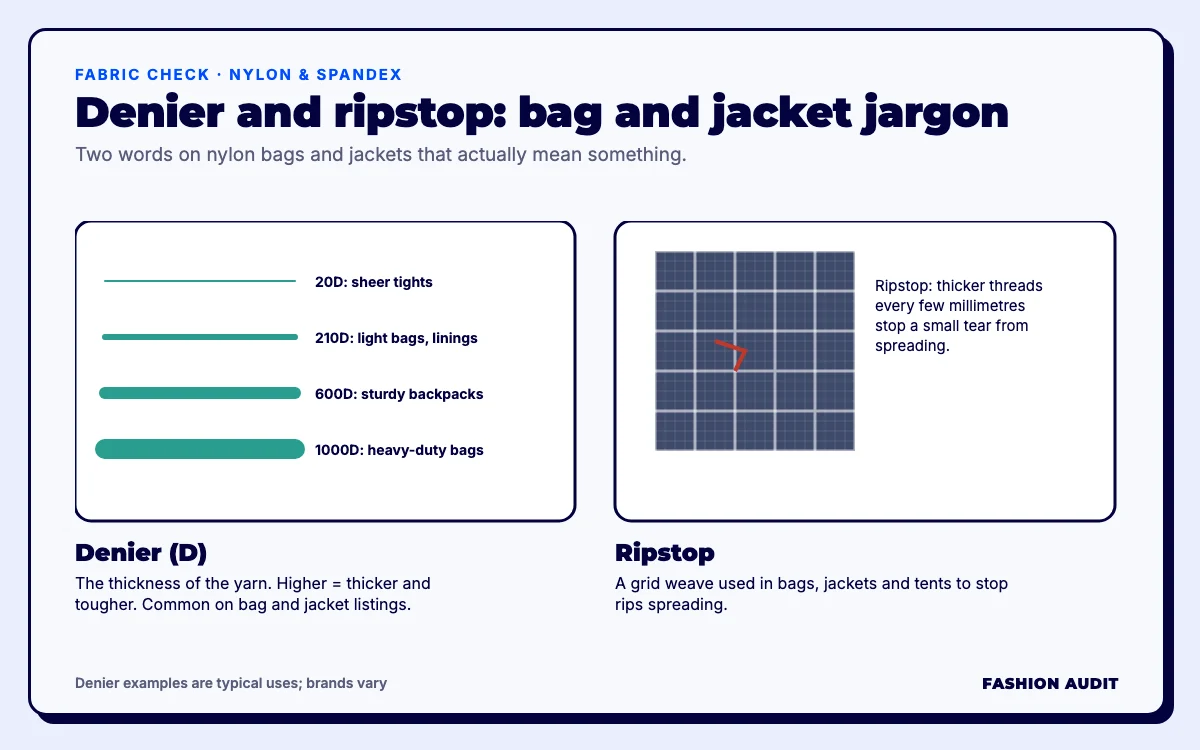
Denier (D) measures yarn thickness. Higher numbers mean thicker, tougher yarn: very low deniers are used for sheer tights, while bags often list figures such as 600D or more. Ripstop is a weave with thicker threads in a grid every few millimetres, so a small tear does not spread. Both are useful signals when you compare backpacks and jackets.
Spandex: the spring inside stretchy clothes
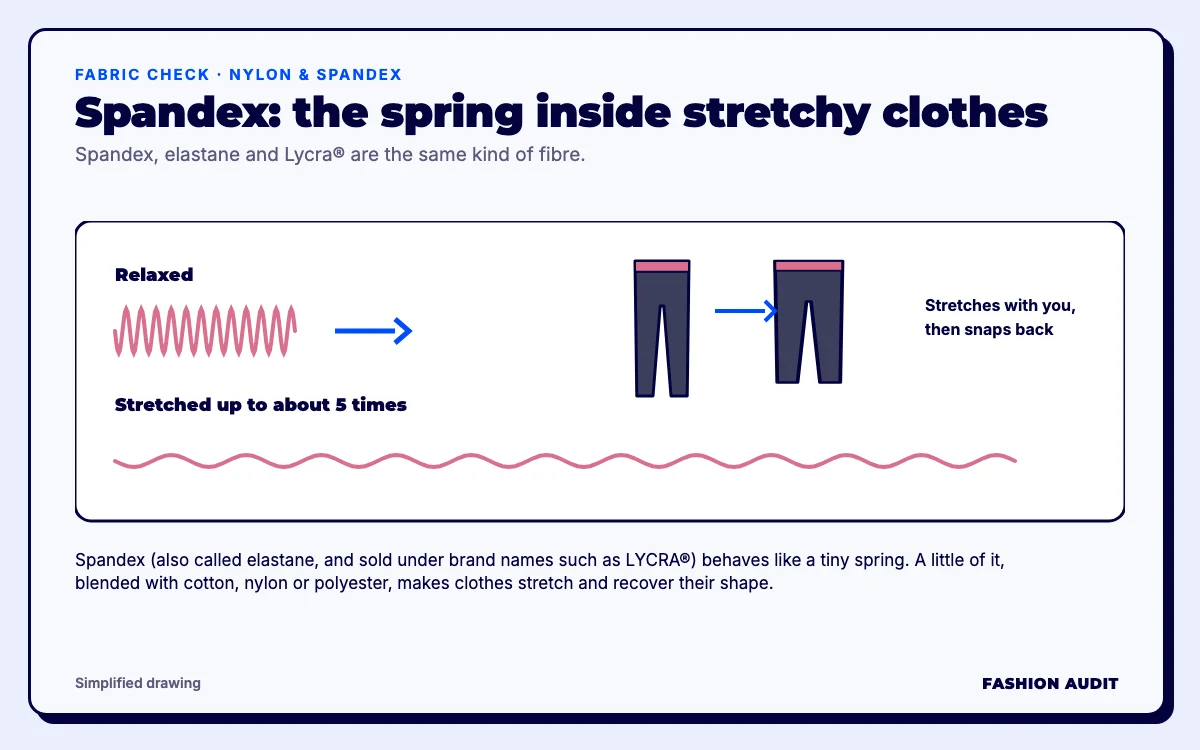
Spandex works like a tiny spring. It is almost never used alone; a small amount is blended with cotton, nylon or polyester so the fabric stretches and recovers its shape. “Spandex” is the common name in the US, “elastane” in most other countries, and LYCRA® is a brand name for it.
How much spandex is in your clothes
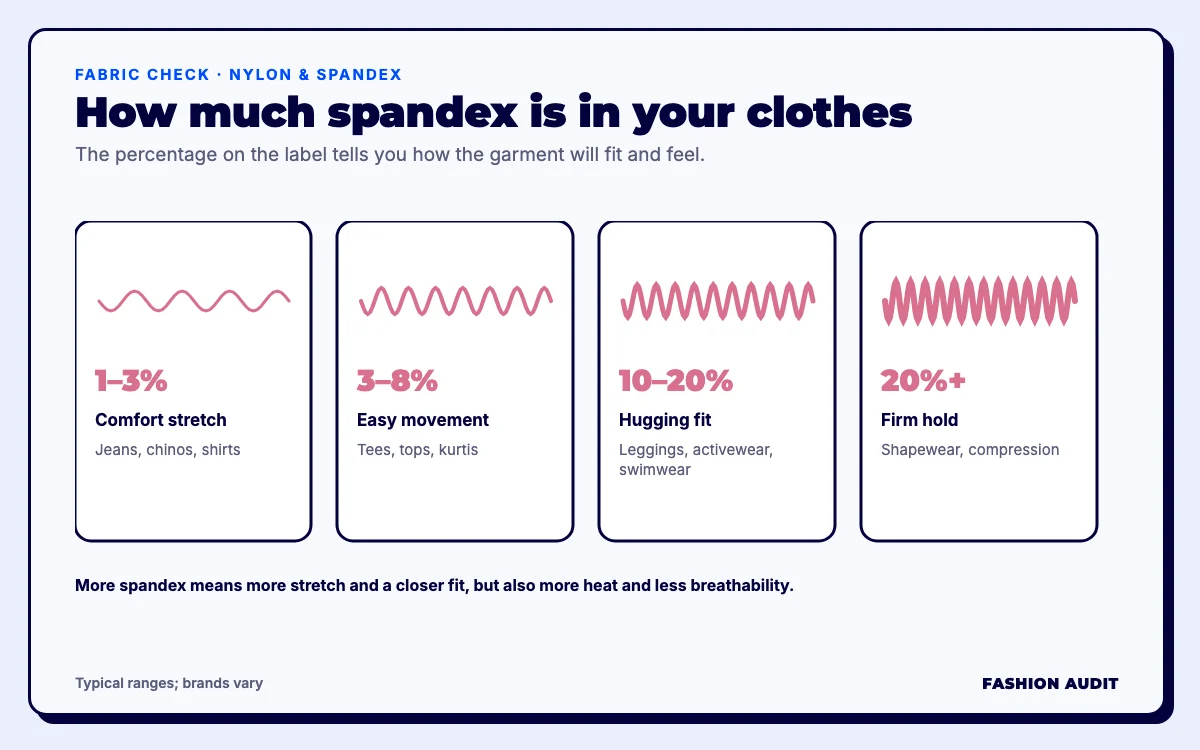
As a rough guide: about 1–3% gives comfort stretch in jeans, chinos and shirts; about 3–8% gives easy movement in tees, tops and kurtis; about 10–20% gives the hugging fit of leggings, activewear and swimwear; and shapewear and compression wear go higher. Brands vary. More spandex means a closer fit, but also more heat and less breathability, which matters in Indian summers. See our denim guide for how stretch changes jeans.
Why stretch clothes go baggy
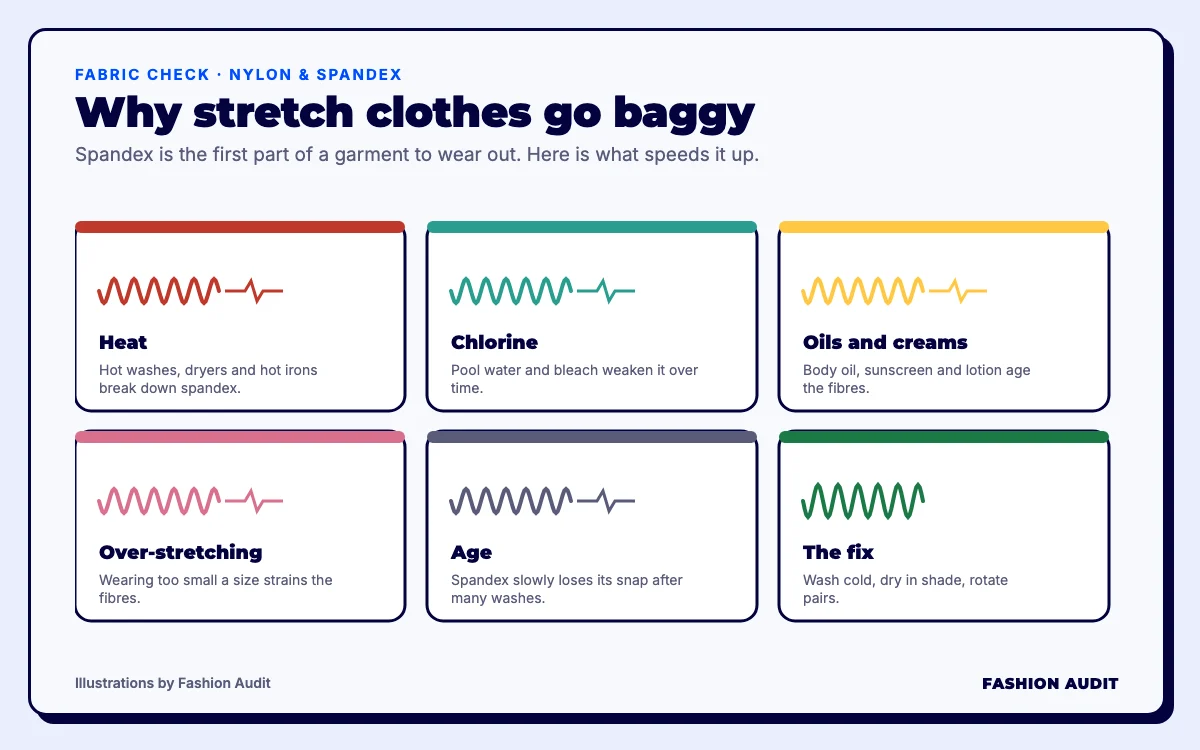
Spandex breaks down with heat (hot washes, dryers and irons), chlorine (pools and bleach), body oils, sunscreen and lotions, over-stretching from a size too small, and simple age. That is why leggings lose their snap and stretch jeans bag at the knees. Washing cold, drying in shade and rotating between pairs makes a big difference.
Pros and cons
| What nylon and spandex do well | Where they fall short |
|---|---|
| Nylon is very tough and resists scuffs | Both are oil-based and shed microfibres in the wash |
| Nylon feels smooth and soft | Neither breathes like cotton or linen |
| Spandex gives stretch and shape recovery | Spandex is damaged by heat, chlorine and oils |
| Both are light and dry fairly quickly | Nylon can fade and weaken in strong sun |
| Long-lasting in bags, socks and swimwear | Blends with spandex are hard to recycle |
What is right for Indian weather
- Summer: high-spandex, tight clothes trap heat. Choose cotton with a little stretch for daily wear.
- Humid heat and workouts: nylon-spandex activewear is comfortable and dries quickly; wash it soon after use.
- Monsoon: nylon rain jackets, bags and quick-dry socks work well.
- Winter: nylon shells over a warm layer block cold wind.
How to read a nylon or stretch label
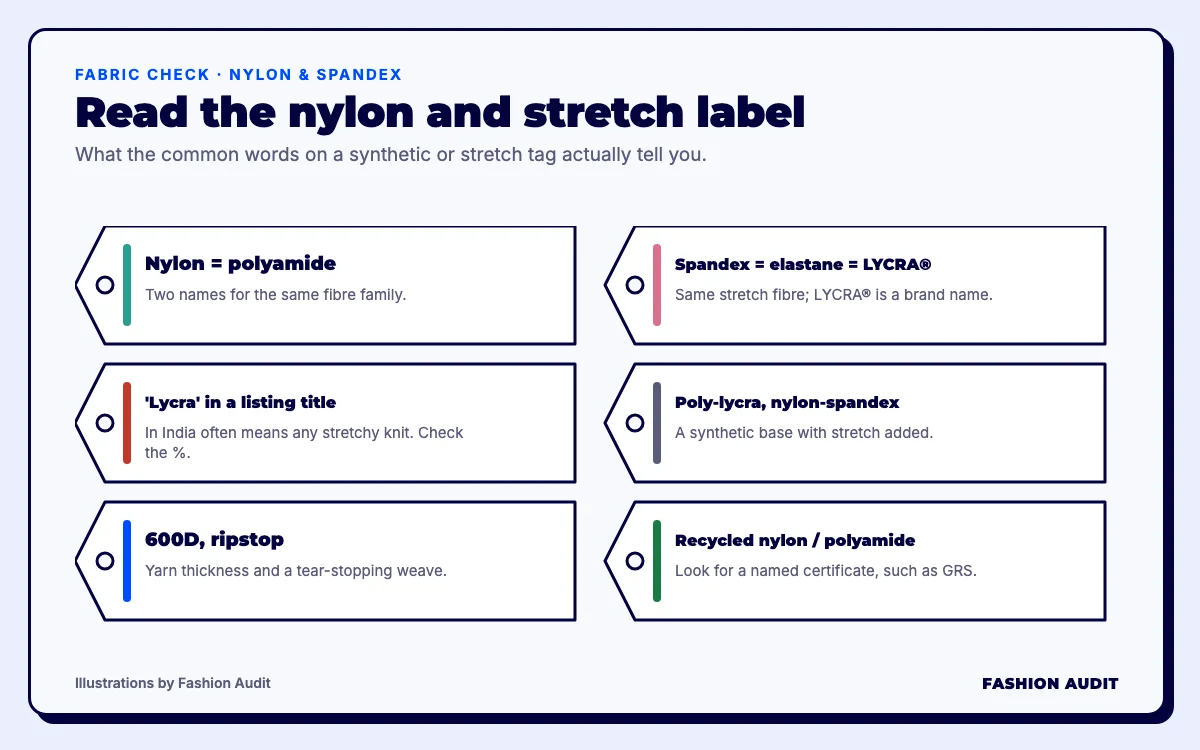
- “Nylon” and “polyamide” are the same fibre family.
- “Spandex”, “elastane” and “LYCRA®” are the same kind of stretch fibre.
- “Lycra” in an Indian listing title often just means a stretchy knit, not the branded fibre. Check the care label for the actual percentage.
- “Poly-lycra” or “nylon-spandex” means a synthetic base with stretch added.
- “600D” or “ripstop” on bags and jackets describes yarn thickness and a tear-resistant weave.
- “Recycled nylon” should carry a named certificate such as GRS.
Price check: what nylon and stretch cost in India
These are prices as listed in the Fashion Audit shop on 11 November 2026.
- Amul Comfy printed spandex trunk: ₹255 (MRP ₹357).
- SIRIL ribbed “Lycra” wide-leg trousers: ₹468 (MRP ₹1,999). Check the label for the actual spandex share.
- Greciilooks poly-lycra track pants: ₹499 (MRP ₹1,999).
- Kotty nylon puffer jacket: ₹912 (MRP ₹2,999).
- U.S. Polo Assn. nylon microfibre seamless trunks: ₹1,198 (MRP ₹1,199).
- Red Lemon nylon 25L water-resistant backpack: ₹1,998 (MRP ₹5,999).
- Mokobara nylon crossbody sling bag: ₹3,499 (MRP ₹5,999).
For bags, the price difference often reflects denier, coatings, zips and stitching more than the nylon itself. For stretch clothing, look at the spandex percentage and the fabric weight, not just the word “Lycra”.
Caring for nylon and stretch clothes
- Wash cold, ideally inside out, on a gentle cycle.
- No dryer, no hot iron. Heat is the biggest enemy of spandex and can melt nylon.
- Rinse swimwear in fresh water after every swim to remove chlorine.
- Skip fabric softener on activewear; it can block moisture wicking.
- Rotate leggings and stretch jeans so each pair recovers between wears.
- Dry in shade. Strong sun weakens nylon and fades colours.
Where the marketing misleads
- “Lycra” in a product title does not always mean branded LYCRA® fibre, or even a high spandex share.
- “4-way stretch” describes the fabric’s direction of stretch, not its quality or spandex content.
- “Waterproof” nylon often means water-resistant; check for sealed seams on rainwear.
- “Eco nylon” without a recycled-content certificate is a claim you cannot check.
What it means for you
- Pick nylon for toughness: bags, socks, swimwear, light rain jackets.
- Prefer a little spandex (about 1–5%) in daily clothes for comfort without trapping heat.
- Save high-spandex clothes for workouts and shapewear.
- Treat “Lycra” in a title as a hint, and check the care label.
- Keep stretch clothes away from heat: cold wash, no dryer, shade dry.
Common questions
Is spandex the same as Lycra?
Yes. Spandex (or elastane) is the fibre; LYCRA® is a brand name for it.
Why do my leggings go saggy?
Heat, chlorine, oils and age weaken spandex. Wash cold, dry in shade and avoid the dryer.
Is nylon better than polyester?
Nylon is tougher and softer; polyester is cheaper and handles sun better. Each suits different products.
What does 600D mean on a backpack?
It is the yarn thickness in denier. Higher numbers mean thicker, tougher fabric.
Is nylon good for Indian summer?
Not for everyday clothes; it does not breathe like cotton. It works well for bags, socks and quick-dry activewear.
The bottom line
Nylon and spandex are not everyday-comfort fibres; they are performance tools. Use nylon where you need toughness and spandex where you need stretch, in the smallest amount that does the job. Read the care label instead of trusting “Lycra” in a title, and keep heat away from anything stretchy.
Sources
- Wikipedia: Nylon
- National Inventors Hall of Fame: Joseph C. Shivers Jr.
- Textile Exchange: Materials Market Report 2026
Illustrations by Fashion Audit. Have a correction? Write to us through the contact page and we will update this guide with a dated note.