
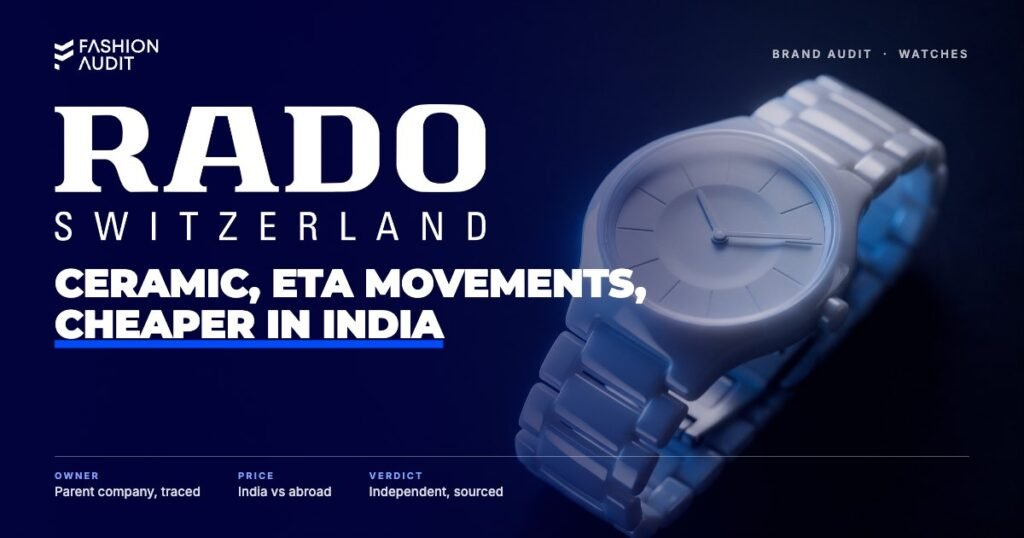
Walk into a watch shop in Delhi or Chennai and Rado is spoken of in the same breath as Omega and Rolex. Its own parent company does not agree. Swatch Group files Rado in its High Range, one tier below Omega and alongside Longines. That gap — between how Indian buyers rank Rado and how Switzerland ranks it — runs through everything else here: the ceramic, the movements and, more happily, the price.
Rado sits in Swatch Group’s High Range, one tier below Omega and two above Tissot. Every current mechanical Rado runs an ETA movement from the Powermatic 80 family, with no COSC or METAS certification. The Indian pricing, though, is genuinely good: across eight references India is 8.4% below the United States before tax, and about 3% above the Swiss shelf price. Prices checked 21 August 2026.
Snapshot
- Founded
- 1917 as Schlup & Co., Lengnau, Switzerland; sold as Rado from the 1950s
- Current owner
- The Swatch Group Ltd, Biel/Bienne, listed on the SIX Swiss Exchange
- Rank inside the group
- High Range, with Longines — below Omega, above Tissot
- Sold in India by
- Swatch Group (India) Private Limited, New Delhi
- Price band in India
- ₹61,000 to about ₹10.6 lakh; most sales ₹1 lakh to ₹5 lakh
- Movements
- ETA C07 family, badged R763, R734 and R808; a large quartz range too
- Certification
- None — no COSC, no METAS
- Warranty
- Five years, international, since 1 November 2023
- Prices checked
- 21 August 2026
How it started
The company is older than the name on the dial. Three brothers — Fritz, Ernst and Werner Schlup — founded a watchmaking factory called Schlup & Co. in Lengnau in 1917, in a converted part of their parents’ house. Watches only went out under the Rado name from the 1950s.
- Schlup & Co.Founded 1917 in Lengnau by three brothers
- RadoThe name goes on the watches in the 1950s
- Rado Watch Co. Ltd.Swatch Group’s High Range, still in Lengnau
“Rado, founded 1917” is fair, because the company is continuous. The accurate telling is Schlup & Co. from 1917, trading as Rado from the 1950s.
Rado still runs out of that same village, ten kilometres from Swatch Group’s head office at Biel/Bienne. The listed Swiss parent also owns Omega, Longines and Tissot, and sorts its sixteen watch brands into named ranges — which is where Rado’s real position shows.
What they actually make
Rado calls itself “The Master of Materials”, and the material is why the brand exists. It is also the most garbled thing written about it. Four different materials get flattened into the single word “ceramic”, and they are not the same thing.
| Material | What it actually is | First used |
|---|---|---|
| Hardmetal | Tungsten carbide with a metal binder | 1962, DiaStar 1 |
| High-tech ceramic | Zirconium oxide, moulded and sintered; 1,250 Vickers | 1986, Integral bracelet |
| Ceramos | About 90% titanium carbide plus a metal binder | 1993; injectable 2011 |
| Plasma high-tech ceramic | The same ceramic, carburised — no metal in it | 1998, Ceramica |
High-tech ceramic starts as zirconium oxide powder. Rado adds pigment and a polymer binder, injects it into a mould at 1,000 bar, removes the binder chemically, then sinters the part at 1,450°C — where it shrinks by 23%, so every mould is cut oversize by a calculated amount. The cycle runs at least two weeks, at Comadur, a sister company inside Swatch Group rather than a Rado factory.
Plasma high-tech ceramic is the one described wrongly most often. It is not a coating and there is no metal in it. Finished white ceramic is treated with gases activated by a plasma discharge at 20,000°C, which enriches it with carbon and turns it metallic grey. The colour is a change in the material rather than a layer on it, so it cannot wear through.
Ceramos is different again — about 90% titanium carbide bound with a metal alloy Rado does not disclose. Plasma gives a metallic look with pure ceramic properties; Ceramos puts real metal in the mix for extra toughness.
The DiaStar of 1962, still in the catalogue, had a hardmetal case and a sapphire crystal. It was not ceramic: high-tech ceramic arrived twenty-four years later, and Rado’s own materials page gives both dates. Nor did Rado invent the ceramic case — its 1986 Integral used the material in the bracelet, and IWC states it was the first to use hardened zirconium oxide for a case that same year.
Hard is not the same as tough
Hardness and toughness are different properties, and ceramics buy one by giving up the other. Rado’s ceramic measures 1,250 Vickers against about 152 for 316L stainless steel, which is a very large real difference in scratch resistance.
Fracture toughness is resistance to cracking rather than scratching. Zirconia scores 8 to 12 on the standard scale; hardened tool steel, at a quarter of the hardness, scores 20 to 50. Zirconia is the toughest technical ceramic, which is why Rado uses it — and steel is still two to five times tougher.
Our watches are hard but not indestructible. If you drop your Rado watch, it may break.
Rado’s own customer service FAQ.
So a Rado case will look new after years of desk work that would leave steel covered in hairlines. It can also crack in one fall onto a tiled floor that steel would have survived with a dent.
Rado is careful about “scratchproof” too. Its history sheet says the DiaStar 1 was “marketed as” the world’s first scratchproof watch; its Indian page says “hailed as”. Both keep the phrase in quotation marks, and the customer FAQ uses “scratch-resistant”, defined as withstanding normal everyday use. The brand is more careful than the people selling it.
The movements
Every current mechanical Rado runs an ETA movement under a Rado calibre number: R763 is the ETA C07.611, R734 the C07.631+, R808 the C07.901+. All belong to the Powermatic 80 family — 80 hours of reserve at a slowed 21,600 vibrations per hour, with a Nivachron antimagnetic hairspring.
The same family powers Tissot’s Powermatic 80 watches, which start under ₹50,000 here. Rado’s pages say only “a Swiss made automatic movement”, and the word ETA appears nowhere on its consumer site. ETA is a sister company and the arrangement is public, but Rado’s price band overlaps brands that do name their supplier.
No current Rado carries COSC or METAS certification and Rado claims none, so do not call one a chronometer. Much of the Indian range is quartz — the entire Florence collection, at ₹1,19,300 to ₹1,45,800.
What Rado costs in India
Rado publishes rupee prices on its own Indian pages, so these are its MRPs rather than a retailer’s quote, set against its American and Swiss prices for the same references in the same week.
- US list, Captain Cook Ceramic Diver
- $4,250 — about ₹4,06,725
- Indian MRP, same reference
- ₹4,37,500 including 18% GST
- Indian price before tax
- ₹3,70,763
- Gap
- 8.8% cheaper in India, pre-tax
- Checked on
- 21 August 2026
| Model | Indian MRP | India vs US, pre-tax |
|---|---|---|
| Captain Cook Ceramic Diver, R32129152 | ₹4,37,500 | 8.84% cheaper |
| Captain Cook Ceramic Diver, R32144202 | ₹4,37,500 | 8.84% cheaper |
| Captain Cook Chronograph, R32146208 | ₹5,63,500 | 8.44% cheaper |
| Captain Cook Hoermanseder, R32117708 | ₹3,64,600 | 9.05% cheaper |
| Captain Cook Bronze, R32504407 | ₹3,38,100 | 7.88% cheaper |
| DiaStar Original Automatic, R12160303 | ₹1,72,400 | 7.47% cheaper |
| DiaStar Original Skeleton, R12164153 | ₹2,78,400 | 8.69% cheaper |
| DiaStar Original Skeleton, R12162153 | ₹2,38,700 | 8.10% cheaper |
Rado’s own Indian, American and Swiss prices, checked 21 August 2026, converted at Federal Reserve H.10 rates for that date.
The mean is 8.4% cheaper in India before tax, with only 1.6 percentage points of spread across eight references. That is a pricing policy, not an exchange-rate accident. Against Switzerland the pre-tax gap is about 6% in India’s favour; on shelf prices — Indian MRP with 18% GST against Swiss retail with 8.1% VAT — India is roughly 3% dearer.
So the familiar complaint about Indian duty is wrong on this brand. The stack looks alarming: 20% basic customs duty on wristwatches, 4% of assessable value in cess, a surcharge, then 18% IGST — an indicative ₹49 on every ₹100 of assessable value.
Two things stop that reaching the shelf. Duty is levied on the landed transfer value, not on retail: a watch retailing at ₹4,37,500 might land nearer ₹1,20,000, and roughly 26% of non-creditable duty on that is about ₹32,000 — some 7% of the shelf price, not 49%. The IGST portion is input tax credit for the importer, and the full stack only bites an individual bringing one in personally. Since the Indian price already undercuts the American one before tax, the duty is not being passed on at all — it is absorbed in transfer price and margin, which is a decision rather than an accident.
The real band is wider than Rado’s own site suggests. Its lowest Indian listing was ₹1,19,300, but Ethos and Kapoor Watch Co., both authorised retailers, start at ₹61,000, with Kapoor’s highest an Anatom Automatic at ₹10,60,700. Neither showed a struck-through MRP on any Rado, so there is no evidence of routine discounting here.
Rado publishes service prices for a dozen countries and India is not among them. A full service falls due every five to seven years, and a cracked ceramic case is replaced rather than repaired. Ask the dealer for both figures before you buy.
Who Rado is actually for
India is Rado’s strongest market anywhere, and the reason is a seventy-year head start that has little to do with watchmaking.
- 1956First transactions, through a Mumbai retailer
- 1960sReaches Indian buyers via the Gulf diaspora; Dubai the gateway
- Mid-1970sCatalogues printed in Hindi and Bengali
- 1984Eighteen service centres, repairs promised within 15 days
- 1997First eight points of sale open in Mumbai and Delhi
- 2026About 210 points of sale, 34 franchise boutiques
Rado built its repair network thirteen years before it opened a shop.
Read that order again, because it is the answer. Through the licence-raj decades importing a Swiss watch legitimately was close to impossible, so Rado arrived in suitcases from the Gulf — as gifts, as the thing an uncle brought back. By 1984, seven years before liberalisation, eighteen places in the country could service one.
That is why a grey-market Rado from Dubai could be repaired here, and why the name was familiar long before the brand had a counter. No brand arriving after 1991 could buy that advantage.
The company says India overtook China as its largest market around 2023, and its chief executive said in February 2026 that the Indian community had become Rado’s largest customer base globally — a claim about customers rather than revenue, and not audited. Rado also claims about 60% of the Indian market in the $1,000 to $2,000 band, roughly ₹90,000 to ₹1.8 lakh.
The counterweight matters. Rado does not appear at all in Morgan Stanley and LuxeConsult’s ranking of the top 20 Swiss watch companies for 2026, a list carrying its sister brands Omega, Longines and Tissot. Those are outside estimates and Swatch Group has disputed the report, but the shape is clear enough: Rado’s Indian standing is a distribution and recognition achievement, not a horological one.
So Rado suits someone spending ₹1 lakh to ₹5 lakh who wants a case that stays unmarked and does not need a certified movement. It is not a Rolex substitute. Under ₹15,000, our guide to watches for college students and everyday use is the better start — Rado’s cheapest Indian listing at ₹61,000 is more than twenty times a typical Fastrack, and Sonata sits lower still.
Reputation and controversies
One matter has been decided, and it is instructive. On 9 April 2026 a commercial court at Saket, New Delhi dismissed with costs a trademark suit brought by Rado Uhren AG with Tissot, Omega and Longines against two traders in New Lajpat Rai Market.
The judgment records that the plaintiffs failed to establish infringement or any likelihood of confusion even on a preponderance of probabilities. Their sole witness had no first-hand knowledge of the inspection, no sale was documented, and the seized watches were never produced in court or compared with genuine articles.
Be precise about what that means. It is not a finding that the watches were genuine — nobody proved what they were — and not a finding that Rado has no counterfeit problem here. It is a finding that this case, on this evidence, failed. The courts will not solve this for you, so the channel you buy through is your only defence. Beyond that judgment we found no regulatory action, penalty or concluded settlement against Rado in India.
Rado also publishes no authentication tells — no serial checks, no engraving tells, no weight tests. Its guidance is simply to buy from an authorised seller and to get the warranty card stamped and signed on the date of purchase. The “real versus fake Rado” checklists online are written by sellers, and several disagree with each other.
Buying it in India
Start from the brand’s own list of sellers
Rado’s store locator names every authorised point of sale, of which there are about 210 in India. The 34 single-brand boutiques are franchises rather than company shops.
Know the price floor
₹61,000 was the lowest price on a new Rado at two authorised Indian dealers on 21 August 2026. Anything well below that is telling you what it is.
Get the card stamped and dated at the counter
The five-year international warranty, in force since 1 November 2023, is valid worldwide — but only on a card stamped and signed on the day you buy. A blank card is worth nothing anywhere.
Ask whether it is quartz or automatic
Rado’s pages say “Swiss made automatic movement” or “quality quartz movements” without a calibre number. The whole Florence line, ₹1,19,300 to ₹1,45,800, is quartz.
Budget for service and for accidents
A full service falls due every five to seven years, and Rado asks for an annual water-resistance check — advice that matters more in Mumbai humidity than in Switzerland.
The grey market deserves a word, because here it is not the bargain it looks. The duty-free baggage allowance is ₹75,000 for a passenger of Indian origin arriving other than by land, under the Baggage Rules 2026 in force from 2 February 2026. A Captain Cook at ₹4.37 lakh is far above that and dutiable on arrival.
And the saving barely exists. With the Indian shelf price only about 3% above the Swiss one, buying in Zurich saves roughly ₹13,000 before duty, risk and paperwork. On this brand the grey market is not an arbitrage — it is a way of ending up with an unstamped card. For where Rado sits against the rest, see our watch coverage.
Common questions
Is Rado a luxury brand?
It is a premium Swiss brand rather than a top-tier house. Swatch Group files it in the High Range with Longines, one tier below Omega and two above Tissot. In India it sells mostly between ₹1 lakh and ₹5 lakh.
Who makes Rado’s movements?
ETA, a Swatch Group production company. R763 is the ETA C07.611, R734 the C07.631+ and R808 the C07.901+, all from the Powermatic 80 family. Rado prints its own calibre number and never the ETA one.
Can a Rado ceramic watch break?
Yes, and Rado says so plainly in its own guidance. Ceramic resists scratching far better than steel and withstands impact considerably worse. A drop onto a hard floor is the failure mode to worry about.
Is a Rado cheaper in India or abroad?
In India. Across eight references the Indian price is 8.4% below the American one before tax, and the shelf price is about 3% above the Swiss one. Checked 21 August 2026.
Was the 1962 DiaStar really scratchproof?
Rado says it was “marketed as” the world’s first scratchproof watch, keeping the phrase in quotation marks. Its own FAQ uses “scratch-resistant” and defines it as withstanding normal everyday use. The case was hardmetal, not ceramic.
How we research and verify brand audits: our methodology.
References
- Swatch Group, Rado brand page — ownership, the Lengnau base, the “Master of Materials” positioning
- Swatch Group Annual Report 2020 (PDF) — the group’s brand ranges, placing Rado in the High Range with Longines
- Rado, brand history fact sheet (PDF) — Schlup & Co. 1917, the Golden Horse of 1957, the “marketed as” wording on the DiaStar
- Rado, Master of Materials — hardmetal, sapphire, Ceramos and plasma definitions and dates
- Rado, high-tech ceramic fact sheet (PDF) — the manufacturing sequence and the 1,250 Vickers figure
- Monochrome Watches, inside Rado and Comadur — the two-week production cycle and 152 Vickers for 316L steel
- Rado press room, plasma high-tech ceramic — the plasma carburising process and the absence of metal
- Revolution, getting to know Rado’s Ceramos — Ceramos as a titanium-carbide cermet, 1993 and 2011
- GGS Ceramic, zirconia fracture toughness — the toughness range for zirconia
- NOC Metals, tungsten carbide properties — hardness and toughness figures for carbide and hardened tool steel
- Rado customer service FAQ, Master of Material — the breakage and scratch-resistance statements quoted above
- IWC Schaffhausen, the ceramic watch case — IWC’s claim to the first zirconium oxide ceramic case, 1986
- Caliber Corner, Rado R763 — the ETA C07.611 base, Nivachron hairspring, 80-hour reserve
- Caliber Corner, Rado R808 — the ETA C07.901+ base and the Powermatic 80 family
- Rado India, Captain Cook — Indian rupee prices in the comparison table
- Rado India, DiaStar Original — Indian rupee prices in the comparison table
- Rado India, Florence — the quartz collection at ₹1,19,300 to ₹1,45,800
- Rado US, Captain Cook — the American list prices
- Rado Switzerland, Captain Cook — the Swiss franc retail prices
- Federal Reserve H.10, data for 21 August 2026 — the dollar and franc conversion rates used throughout
- EximPe, watch HSN code 9102 — the import duty stack on wristwatches
- Busy.in, GST on watches — the 18% rate used in the pre-tax calculations
- Ethos Watches, Rado — the ₹61,000 Indian price floor at an authorised dealer
- Kapoor Watch Co., Rado — the ₹61,000 floor and the ₹10,60,700 ceiling
- Europa Star, November 2025 — 1956, the Gulf route, Hindi and Bengali catalogues, 18 service centres by 1984
- Outlook Business, 6 February 2026 — the chief executive on customer base and about 210 points of sale
- Business Standard, 7 February 2025 — the claimed 60% share of the $1,000 to $2,000 band
- Professional Watches, Morgan Stanley top 20 for 2026 — the ranking Rado does not appear on
- Rado Uhren AG & Ors. v. Lalit Jain, CS (COMM) 621/23, judgment 9 April 2026 (PDF) — the dismissal with costs and the court’s reasoning
- Rado customer service FAQ, India — the service interval, water-resistance advice and the stamped warranty card
- Rado India, five-year international warranty — the warranty terms in force since 1 November 2023
- Rado, service prices by country — the country list, which does not include India
- Baggage Rules 2026, frequently asked questions — the ₹75,000 duty-free allowance in force from 2 February 2026
- ZaubaCorp, Swatch Group (India) Private Limited — the Indian selling entity, incorporated 25 April 2000
Two things about Rado are genuinely good and both are underrated. The material is real engineering rather than marketing: a case at 1,250 Vickers will look untouched after years that would leave steel dull with hairlines, and Rado’s own technical writing is more honest than its dealers’. The Indian pricing is better still — 8.4% under the American price before tax across eight references, and within about 3% of the Swiss shelf price.
What deserves scepticism is the tier. Every mechanical Rado runs an ETA movement from the Powermatic 80 family with no COSC or METAS certification, and that family starts inside Tissots costing under ₹50,000. At ₹4,37,500 for a Captain Cook Ceramic Diver you are paying close to nine times that entry price for the case material, the finishing and the warranty, not for the calibre. Brittleness is part of the deal too: ceramic that shrugs off a decade of desk edges can still crack on one tiled floor.
Buy a Rado for the case and buy it in India rather than abroad — but at ₹4.37 lakh, be clear you are buying a material, not a movement.