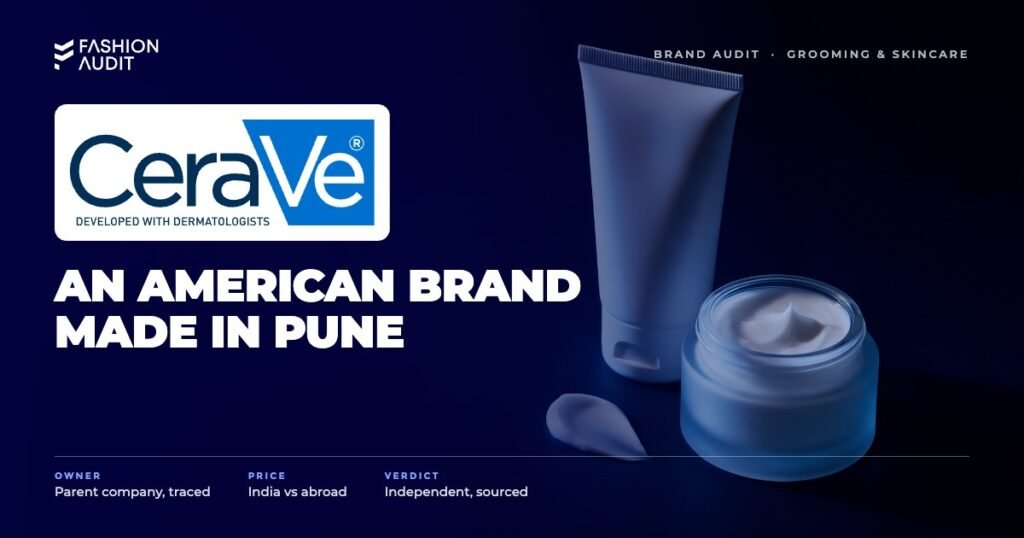
CeraVe arrived in India on 9 November 2023 as an American pharmacy brand — the plain white tub from the drugstore aisle, sold here through chemists, dermatology clinics and Nykaa. The jar on the Indian shelf tells a slightly different story. Turn it over and the declaration reads Chakan, Pune, licence M MH/105568, L’Oréal India Pvt Ltd. It is made here. Whether that makes it cheaper, and whether it is the same product you would buy in America, are two separate questions with two different answers.
The Moisturising Cream sold in India declares Chakan, Pune as its place of manufacture, and its ingredient list matches the American one exactly — all 24 items, in the same order. Being made here does not make it cheaper. The 454 g jar carries an MRP of ₹2,099, which is ₹4.62 a gram; the same size at one American retailer works out to ₹3.36. The sunscreen is the exception: same name, different formula, different SPF.
Snapshot
- Founded
- 2005, in the United States
- Current owner
- L’Oréal S.A., since early March 2017 — bought from Valeant with AcneFree and Ambi for $1.3 billion
- Indian company
- L’Oréal India Private Limited, CIN U85190MH1991PTC060363, incorporated 19 February 1991
- India launch
- 9 November 2023, at a Mumbai dermatology event
- Made where
- Chakan, Pune, under cosmetic manufacturing licence M MH/105568, on the Moisturising Cream declarations read
- Indian price band
- ₹359 to ₹2,099 MRP across twelve listings, checked 4 September 2026
- Sits inside
- L’Oréal’s Dermatological Beauty division — €7,204.1 million of sales in 2025
How it started
The brand’s own telling begins in 2005, when, as cerave.com puts it, experts noticed that acne, eczema, psoriasis and dry skin all shared a compromised skin barrier. The commercial origin is more prosaic. Cosmetics Business records that the Moisturising Cream “was really built for the exam room — it started as a utility product for dermatologists to utilise on the face and body”. Three products launched: the cream, the lotion and the hydrating cleanser.
By 2016 the brand sat inside Valeant Pharmaceuticals International. On 10 January 2017 L’Oréal agreed to buy CeraVe, AcneFree and Ambi for $1.3 billion — three brands with about $168 million of combined annualised 2016 sales, and, in L’Oréal’s own words, “average growth over the past two years exceeding 20%”. The deal closed in early March 2017; Valeant dated its completion announcement 3 March and L’Oréal dated its own 6 March.
- CeraVe founded2005, United States — three products at launch
- Valeant Pharmaceuticals InternationalHolds the brand through to 2016
- L’Oréal S.A.$1.3 billion for three brands, agreed 10 January 2017
- L’Oréal India Pvt LtdIndia launch 9 November 2023; makes the cream at Chakan
Neither cerave.com nor ceraveindia.com names L’Oréal on any page read on 4 September 2026. The parent’s name appears on the pack and in retailers’ declaration blocks instead.
What they actually make
Nykaa’s CeraVe brand page listed 34 products on 4 September 2026: the Moisturising Cream in three sizes, a body lotion, four cleansers, a hyaluronic acid water gel, a retinol serum, a PM facial moisturiser and the AM lotion at SPF 50. The Indian site, ceraveindia.com, publishes a full ingredient list for each — and no prices, and no manufacturer block.
The common assumption about a made-in-India version of a foreign brand is that the formula has been thinned. On this product it has not. The American Moisturizing Cream and the Indian Moisturising Cream declare the same 24 ingredients in the same order, from Aqua and Glycerin at the top to Xanthan Gum and Ethylhexylglycerin at the end. The three ceramides the brand advertises — Ceramide NP, Ceramide AP and Ceramide EOP — sit ninth, tenth and eleventh on both lists.
One honest limit on that. An ingredient list is a declaration of what is in the pack, ordered by concentration down to one per cent. Identical lists do not prove identical concentrations, identical raw-material grades or identical manufacture. They prove the declared composition matches, and on this shelf that is more than most brands let you check at all.
The sunscreen is where the two ranges genuinely part company.
| AM Facial Moisturising Lotion | United States | India |
|---|---|---|
| SPF | 30 | 50 |
| UV filters | Homosalate, Octinoxate, Octocrylene, Zinc Oxide | Bis-Ethylhexyloxyphenol Methoxyphenyl Triazine, Ethylhexyl Salicylate, Butyl Methoxydibenzoylmethane, Ethylhexyl Triazone |
| Percentages declared | Yes — 10%, 5%, 2% and 8% on the Drug Facts panel | No — the filters sit inside the ingredient list |
| PA rating for UVA | Not used in America | None published on the product page |
| Price | $19.99 on the brand’s own site | ₹1,500 MRP, selling at ₹1,425 on Nykaa |
cerave.com, ceraveindia.com and Nykaa, all read 4 September 2026.
The reason is regulatory rather than a judgement about quality. America treats sunscreen as an over-the-counter drug, so the pack lists actives with percentages. India treats it as a cosmetic under the Cosmetics Rules 2020, so the filters go into the ingredient list without them. Two of the Indian filters fall outside the American monograph, which is the ordinary reason a European-style formula cannot be sold there.
What the Indian buyer does not get is the working. CeraVe publishes the number 50 and nothing behind it — no test method, no laboratory, no report, and no PA grade for UVA. The page does carry one practical line: reapply every two hours.
Three other claims are worth reading closely, because they are what this shelf sells on. “Developed with dermatologists” sits in the logo lockup on both sites; the brand says it has worked with dermatologists since 2005, and no dermatologist is named and no number given on any of the pages read. “Patented MVE technology” appears on both sites with no patent number published on either; the Indian footer carries MVE trademark information, which is a different instrument. And the Amazon India listing carries “Efficacy clinically proven on Indian skin”, footnoted to a “Clinical Test on 120 Indian Consumers, June 2023” with the Moisturising Cream — a panel size, a country, a month and a named product, which is a good deal more than most of this aisle publishes. The study design, the investigator and the report itself are not public.
One claim settles itself on the label. “Fragrance-free” holds: no perfume, fragrance or fragrance-allergen entry appears in either the Moisturising Cream or the SPF 50 list.
What CeraVe costs in India
- Indian MRP, 454 g jar
- ₹2,099 — ₹4.62 a gram
- One US retailer, 16 oz
- $15.97, about ₹1,523 — ₹3.36 a gram
- Gap per gram
- +38%
- Checked on
- 4 September 2026
The two jars weigh the same to within a tenth of a per cent, and the Indian one is made in Pune, so there is no import duty anywhere in that chain. The street price narrows the gap without closing it: Apollo Pharmacy sold the 454 g jar at ₹1,847.10 on 4 September 2026, a 12% discount, which is ₹4.07 a gram.
One caution on the comparison, and it is a real one. America has no MRP, so $15.97 is a single retailer’s shelf price on a single day rather than a national figure. The conversion uses ₹95.38 to the dollar, from the US Federal Reserve’s H.10 release of 31 August 2026. An MRP that a shop knocks 12% off is the normal Indian arrangement, and it is the same arithmetic we work through in our Liberty audit.
| Product | MRP | Selling price |
|---|---|---|
| Hydrating Cleanser | ₹359 | ₹323 |
| Moisturising Cream, small | ₹469 | ₹422 |
| Foaming Cleanser | ₹559 | ₹503 |
| Moisturising Body Lotion | ₹579 | ₹521 |
| Blemish Control Cleanser | ₹599 | ₹539 |
| Hyaluronic Acid Water Gel | ₹999 | ₹899 |
| Moisturising Cream, 177 ml | ₹1,200 | ₹1,080 |
| SA Smoothing Cleanser | ₹1,299 | ₹1,208 |
| PM Facial Moisturiser | ₹1,300 | ₹1,235 |
| AM Moisturiser SPF 50 | ₹1,500 | ₹1,425 |
| Resurfacing Retinol Serum | ₹1,599 | ₹1,519 |
| Moisturising Cream, 454 g | ₹2,099 | ₹1,847.10 |
Nykaa and Apollo Pharmacy, checked 4 September 2026. Nykaa’s brand page does not display pack sizes, so only the two jars can be reduced to a per-unit figure.
Those two jars carry the sharpest lesson on the page. The 454 g jar is ₹4.62 a gram at MRP. The 177 ml tub is ₹6.76 a millilitre. Same declared formula, same plant, same licence number — and roughly a third more per unit for the smaller pot.
The formula is identical and the factory is in Pune. The Indian jar costs ₹4.62 a gram; the American one, ₹3.36.
Who CeraVe is actually for
It is for the buyer who wants a plain barrier cream with a label they can check, and who does not want to pay serum money for it. On price per unit CeraVe is the cheap end of the dermatology shelf: ₹4.62 a gram against ₹57.60 a millilitre for a Eucerin night cream and ₹20 a millilitre for a 30 ml Ordinary serum, all read on 4 September 2026. Much of that is pack size and product type — a half-kilo face-and-body cream is not a 30 ml serum — but the arithmetic is the arithmetic.
The marketer-and-manufacturer question is worth asking of any brand, and the answers differ more than the packaging suggests. Campus runs its own factories; Bata India is a listed Indian company distinct from the brand it sells. CeraVe is a third arrangement again — an American brand made in an Indian plant belonging to its French owner, and sold with an American brand story.
It is a poorer fit for two buyers. If you are buying on the dermatologist ranking, that claim is scoped to the United States by L’Oréal’s own annual report and does not appear on the Indian site. And if you want a sunscreen whose SPF has published working behind it, the AM lotion does not supply one.
Reputation and controversies
India’s advertising council has upheld one matter touching CeraVe. On 4 October 2023 it decided against L’Oréal India Private Limited over an influencer’s Instagram story promoting a CeraVe moisturiser (2309-CCC.17). The council took the matter up on its own motion through its monitoring service, and found the post in contravention of Chapter I of its code and of its guidelines for influencer advertising in digital media.
It is worth being precise about what that is. It is a disclosure finding — the post was not labelled as advertising. The published text quotes no efficacy claim, no dermatologist claim and no product claim of any kind. A bare count of advertising findings reads as findings against the product, and this one is not that.
The limits matter as much as the finding. The ruling was on one Instagram story as it stood in 2023. It is not a standing ban on a form of words, nobody has ruled on the brand’s pages as they read on 4 September 2026, and the council is a self-regulatory industry body rather than a statutory regulator. There is no product-claim finding against CeraVe on that record, which leaves the claims above untested by it rather than endorsed by it.
The claim most worth reading side by side is the ranking. cerave.com carries “CeraVe is the #1 dermatologist recommended skincare brand” with a superscript footnote marker; the footnote text does not render on the page as read on 4 September 2026. L’Oréal’s 2025 annual report puts a country on the same claim, describing CeraVe as “the number one dermatologist-recommended skincare brand in the United States”. The claim was not found on ceraveindia.com, whose pages carry “developed with dermatologists” instead. Two Nykaa listing titles do use the words “Dermatologist recommended” — those are a retailer’s words on a retailer’s page.
A search of Indian Kanoon, the public database of Indian judgments, on 4 September 2026 found no decision naming the CeraVe brand; three results carry the word and none of them concerns it. That database does not index every consumer commission and tribunal, so read it as a narrow finding rather than a clean bill.
On animal testing the brand’s owner and its loudest critic both have statements on the record. L’Oréal says: “Since 1989, we have not tested the safety of our products on animals, 14 years before regulations required us to do so.” PETA’s Beauty Without Bunnies directory lists CeraVe as “may not be cruelty-free”, on the ground that the company has not signed its statement of assurance, and lists L’Oréal USA under Companies to Avoid; both entries read 4 September 2026. Testing cosmetics on animals has been illegal in India since 2014, so the disagreement is about other markets. One point in the brand’s favour here: CeraVe makes no cruelty-free claim on its Indian site, so there is no badge to check.
Buying it in India
Almost everything above can be settled in a shop, on the box, in about a minute. Cosmetics sold here fall under the Drugs and Cosmetics Act 1940 and the Cosmetics Rules 2020, which is why the pack carries a licence number rather than an import registration number — a product made in India needs the first, not the second.
Read the declaration block
Country of origin, manufacturer and packer are mandatory on the pack and on the listing. On the Moisturising Cream they read India; L’Oréal India Pvt Ltd, Chakan, Pune; licence M MH/105568. Ask a seller to show you those lines on whatever you are actually buying.
Work out the price per gram
Divide the MRP by the net quantity printed on the pack. ₹2,099 over 454 g is ₹4.62 a gram; ₹1,200 over 177 ml is ₹6.76. The large jar is about a third cheaper per unit than the medium one.
Find the three ceramides yourself
Ceramide NP, Ceramide AP and Ceramide EOP are named in the ingredient list, ninth to eleventh of 24. That confirms they are present. No concentration is given for any of them, and the claim on the pack is “contains three”, not a percentage.
On sunscreen, look for the test, not the number
SPF 50 on the front is a claim. A stated test method, a named laboratory and a PA grade for UVA are the evidence. None of the three appears on the Indian page for the AM lotion, so buy it on the formula rather than on the figure.
Treat the MRP as a ceiling
CeraVe’s Indian listings ran 5% to 12% below MRP on 4 September 2026, and the deepest discount was on the biggest jar. The printed maximum is not the price you should pay.
Two declarations name Chakan, Pune, and both are for the Moisturising Cream. Nothing here establishes where the cleansers, the serum or the SPF 50 lotion are made. Turn the box over on whichever one you buy — the country of origin is printed on it.
Common questions
Is CeraVe made in India?
The Moisturising Cream sold here is. Two independent listings, Amazon India and Apollo Pharmacy, both read on 4 September 2026, declare country of origin India and name L’Oréal India Pvt Ltd at Chakan, Pune, under licence M MH/105568. That covers one product line; the rest of the range has not been checked against its packs.
Is the Indian Moisturising Cream the same as the American one?
The declared ingredient list is identical — all 24 items in the same order on both sides. That is a strong signal and not a guarantee: an ingredient list does not disclose concentrations or raw-material grades.
Is the CeraVe sunscreen sold in India the same product?
No. The American AM lotion is SPF 30 on four filters declared at 10%, 5%, 2% and 8%. The Indian one is SPF 50 on a different filter set, with no percentages and no PA rating published. Two of the Indian filters are not permitted under the American sunscreen monograph.
Is CeraVe cheaper in India because it is made here?
Not on the jar we could compare like for like. The 454 g jar is ₹2,099 at MRP, or ₹4.62 a gram, and ₹1,847.10 on the shelf at Apollo Pharmacy. The same 16 oz size was $15.97 at Walmart on 4 September 2026, about ₹1,523 or ₹3.36 a gram.
Who owns CeraVe?
L’Oréal S.A., which bought it from Valeant with two other brands for $1.3 billion in a deal agreed on 10 January 2017 and closed in early March that year. In India it is run by L’Oréal India Private Limited, one of 26 brands the company handles here.
Does CeraVe test on animals?
L’Oréal states it has not tested product safety on animals since 1989. PETA lists CeraVe as “may not be cruelty-free” because the company has not signed its statement of assurance, and lists L’Oréal USA under Companies to Avoid. Testing cosmetics on animals has been illegal in India since 2014. CeraVe makes no cruelty-free claim on its Indian site.
How we research and verify brand audits: our methodology.
References
- L’Oréal Finance, agreement to acquire CeraVe, 10 January 2017 — the $1.3 billion price, the $168 million sales figure and the growth line
- Valeant investor relations, sale announcement, 10 January 2017 — the seller’s side of the same deal
- L’Oréal Finance, completion release, 6 March 2017 — completion, dated 3 March by Valeant and 6 March by L’Oréal
- cerave.com, About CeraVe — the 2005 founding story and the “#1 dermatologist recommended” claim
- cerave.com, Developed with Dermatologists — the wording of the process claim
- Cosmetics Business, the story of the Moisturising Cream — the exam-room origin and the three launch products
- cerave.com, Moisturizing Cream — the American ingredient list
- ceraveindia.com, Moisturising Cream — the Indian ingredient list and the MVE and ceramide claims
- cerave.com, AM Facial Moisturizing Lotion — SPF 30 and the declared filter percentages
- ceraveindia.com, AM Facial Moisturising Lotion SPF 50 — the Indian filter set and the absence of a PA grade
- Apollo Pharmacy, Moisturising Cream 454 g, 4 September 2026 — the India declaration and the ₹2,099 / ₹1,847.10 prices
- Amazon India, Moisturising Cream 177 ml, 4 September 2026 — the second declaration, and the Indian clinical-test footnote
- Nykaa, CeraVe brand page, 4 September 2026 — the 34-product range and every Indian MRP in the table
- Walmart, Moisturizing Cream 16 oz, 4 September 2026 — the $15.97 American shelf price
- US Federal Reserve H.10 rates, released 31 August 2026 — the ₹95.38 to the dollar conversion
- PR Newswire India, CeraVe India launch, 9 November 2023 — the launch date and event
- CosmeticsDesign-Asia, 22 November 2023 — the launch channels and the June 2023 Indian study
- L’Oréal Annual Report 2025, Dermatological Beauty — divisional sales and the United States scope of the ranking claim
- ASCI Complaint Outcomes, read 4 September 2026 — the 4 October 2023 outcome, 2309-CCC.17
- Indian Kanoon, search for CeraVe, 4 September 2026 — three results, none about the brand
- PETA Beauty Without Bunnies, CeraVe — the “may not be cruelty-free” listing
- L’Oréal, For Beauty With No Animal Testing — the company’s own statement since 1989
- CDSCO, Frequently Asked Questions on cosmetics — state manufacturing licences and the Cosmetics Rules 2020
The good part is unusual on this shelf and deserves saying plainly. The Moisturising Cream sold in India is made in India, declares the same 24 ingredients as the American one in the same order, and names its three advertised ceramides where any buyer can find them. Fragrance-free holds up on the label too. That is more that a reader can verify for themselves than most of this aisle offers.
The scepticism belongs on price and on evidence. A half-kilo jar made in Pune carries ₹4.62 a gram at MRP against ₹3.36 for the same size at an American retailer, with no import duty anywhere in the chain. The dermatologist ranking is scoped to the United States by the parent’s own annual report and does not appear on the Indian site. And the SPF 50 lotion publishes a number with no method, no laboratory and no PA grade behind it.
Buy the 454 g jar and leave the small pots alone — at ₹4.62 a gram against ₹6.76, the pack size is worth more to you than anything printed on the front of it.