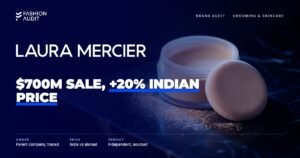
When Advent International bought Laura Mercier in 2021, its announcement said the terms were not disclosed. The next day, the seller published them anyway. Shiseido had to tell its own market what it got, and the number is in a notice dated 26 August 2021.
That single detail explains most of what an Indian buyer needs to know about this brand: who owns it, why nobody can size it, and why it is the dearest thing on the imported counter here.
Laura Mercier is owned by Orveon Global, a company Advent International assembled in December 2021 out of three brands it bought from Shiseido for US$700 million — $350 million in cash at closing and the rest deferred. The woman on the box never owned it and was out of the brand by 2011. In India it runs 10% to 20% above United States list price, checked 2 September 2026.
Snapshot
- Company founded
- Gurwitch Products, May 1995, by Janet Gurwitch, a former Neiman Marcus executive
- Brand launched
- March 1996, at Neiman Marcus and Henri Bendel
- Current owner
- Orveon Global, controlled by Advent International — private, with no published accounts
- Previous owners
- Alticor from 2006, Shiseido from July 2016, Advent from 6 December 2021
- Indian importer of record
- Indosing Distribution Private Limited, CIN U74990MH2018PTC317639, Bhiwandi
- Price band in India
- ₹1,800 to ₹5,700 across the listings read, 2 September 2026
- Animal testing
- Qualified statement; not certified by PETA; the brand says it uses lanolin and beeswax
How it started
Janet Gurwitch, who had run merchandising at Neiman Marcus, founded Gurwitch Products in May 1995. The brand launched in March 1996 under the name of Laura Mercier, a French make-up artist who lent her name and her craft to it. Advent’s own 2021 release still calls Gurwitch the founder of Laura Mercier.
The company was sold to Alticor, the Amway parent, in 2006. Shiseido Americas bought it from Alticor in July 2016, taking Laura Mercier and the skincare brand RéVive together; Shiseido never confirmed a price, and trade reporting put it at an estimated $260 million against 2015 combined net sales of $175 million.
Five years later Shiseido sold again. On 25 August 2021, Advent International agreed to buy bareMinerals, BUXOM and Laura Mercier from Shiseido Americas, saying the terms were not disclosed. On 26 August 2021, Shiseido’s notice to its own market stated them in one sentence: the transfer price was 700 million US dollars, of which 350 million was to be paid in cash on closing and the remainder deferred. The deal closed on 6 December 2021, and Advent launched Orveon Global to hold the three brands.
The buyer said the terms were not disclosed. The seller published them.
- Gurwitch ProductsFounded May 1995; brand launches March 1996
- Alticor IncThe Amway parent buys it in 2006
- Shiseido AmericasBuys it from Alticor, completed 12 July 2016
- Orveon Global, backed by Advent InternationalBought with two sister brands for $700m, closed 6 December 2021
The chain matters because of who was left behind. NARS was Shiseido’s other prestige makeup brand and was not part of the 2021 sale — it is still Shiseido’s today, one of five brands the group names for concentrated investment. Two brands that shared a Japanese owner until December 2021 now compete on the same Indian shelf.
Orveon is private. There is no ticker, no quarterly filing and no audited revenue in the public record. Other owners on this counter answer to a regulator somewhere — Shiseido to the Tokyo exchange, Estée Lauder to the American one. Laura Mercier’s owner answers to its investors and nobody else, which is why no honest article can tell you how big the brand is now. The last hard figure is Shiseido-era: net sales estimated at $160 million in 2015.
- December 2021Pascal Houdayer, founding CEO of Orveon
- January 2024Neela Montgomery, CEO effective 18 January, per Advent’s own release
- 2026Ginny Wright, CEO through the January 2026 Indian relaunch and still in post in April
Montgomery left after about thirteen months, to be closer to her family.
What they actually make
The brand is built on one product: the Translucent Loose Setting Powder, now sold in an Ultra-Blur talc-free version. Around it sit foundation, tinted moisturiser, primer, blush and a large lip range. The Real Flawless foundation carries 27 shades and the tinted moisturiser 19.
On substantiation the brand splits itself down the middle. The setting powder’s clinical claims are footnoted to 30 panelists at an independent laboratory, and its consumer figures to a three-day test with 71 women — so “100% said it’s the key to long-lasting makeup” means 71 out of 71 people said yes after three days. The laboratory is not named and no report is published.
The Real Flawless foundation is the opposite. Twelve hours of fade-proof wear, controls oil immediately, improves skin texture in six weeks, improves hydration for 24 hours — four quantified claims, and the page read on 2 September 2026 carries no panel, no study and no laboratory for any of them.
The mini’s page carries the line “#1 Setting Powder Brand in the US” with no measurement source, period or data provider named. A rival on the same shelf footnotes its own number-one claim to a named research firm and a stated twelve-month period. Laura Mercier simply asserts it.
The tinted moisturiser prints its sunscreen actives with percentages — octisalate 4.5%, octocrylene 5.0%, titanium dioxide 0.84%, zinc oxide 3.04% — because American law treats sunscreen as a drug. No SPF test method, laboratory or report is published with it.
Nobody’s name appears as the manufacturer. The Indian declaration read gives an importer, a marketer and a country of origin, and nothing about who made the powder — normal for imported prestige makeup, and a real difference from a brand like Campus, whose audit can name the plants because the company owns them.
What Laura Mercier costs in India
Every conversion uses one rate: ₹95.3800 to the US dollar, from the Federal Reserve H.10 release of 31 August 2026 carrying rates for 28 August 2026. Indian prices are from Sephora India, read 2 September 2026, against the brand’s United States list prices the same day.
- Translucent Loose Setting Powder Ultra-Blur, 20 g — US list
- $48, or ₹4,578
- Indian MRP
- ₹5,500
- Gap
- +20%
- Checked on
- 2 September 2026
The other three run the same way: the 6 g mini powder ₹2,950 against $26, the Real Flawless foundation ₹5,700 against $54, the tinted moisturiser ₹5,250 against $50 — 19%, 11% and 10% above American list. The brand’s most famous product carries the widest gap of the four.
Strip the tax and the picture changes usefully. Indian MRPs include 18% GST while American shelf prices exclude sales tax. Pre-tax, the same four sit at +2%, +1%, −6% and −7% against US list. The premium an Indian buyer pays is very nearly the GST itself, not a wildly higher underlying price — which means the customs duty on cosmetics is being absorbed in the pre-tax price rather than stacked on top.
That is where the comparison with the family it left becomes sharp. NARS, sold under the same Japanese roof until December 2021, runs 8% to 12% below American list in India. Laura Mercier runs 10% to 20% above it. Same origin, opposite pricing, and the reader pays the difference.
| Product | Size and Indian MRP | Cost per g or ml |
|---|---|---|
| High Vibe Lip Color | 1.4 g, ₹4,000 | ₹2,857 per g |
| Caviar Smoothing Matte Lipstick | 3.8 g, ₹4,850 | ₹1,276 per g |
| RoseGlow Blush Colour Infusion | 6 g, ₹3,900 | ₹650 per g |
| Setting Powder Ultra-Blur, mini | 6 g, ₹2,950 | ₹492 per g |
| Setting Powder Ultra-Blur, full size | 20 g, ₹5,500 | ₹275 per g |
| Translucent Hydrating Setting Spray | 100 ml, ₹4,200 | ₹42 per ml |
Sephora India listings, read 2 September 2026.
The mini powder costs ₹492 a gram against the full size’s ₹275 — 79% more per gram for the same powder in a smaller pot. Across the range the brand runs from ₹42 a millilitre to ₹2,857 a gram, a spread of nearly seventy times. This is the same MRP-against-real-cost arithmetic our Mochi audit sets out on the footwear side, and it decides more purchases than any claim on the box.
On Sephora India’s page for the 20 g setting powder, the statutory block calls it a 100 gram setting spray. A declaration on a listing is what the retailer typed. Read the carton in your hand, not the page you bought it from.
Who Laura Mercier is actually for
This is the dearest brand on the imported counter measured against its home price. On the makeup bands used across this site, the core line’s typical Indian MRP of about ₹4,200 puts it in the luxury tier, with the foundation at ₹5,700 and the setting powder at ₹5,500 well past that line.
It is worth the money to one buyer in particular: someone who knows the translucent powder suits them and wants the 20 g pot, which at ₹275 a gram is the only efficient purchase in the range. Everything else is priced above its American equivalent for no reason the brand explains.
It is a poor buy for someone shopping on claims. The foundation makes four measured promises and publishes nothing behind any of them, and the brand’s headline number-one claim names no source at all.
Who the name on the box belongs to
Laura Mercier the person did not found this company and has never owned it. By 2011, when Claudia Poccia took over as chief executive, she was not involved with the brand at all; Poccia’s stated priority was bringing her back, which she did, as a creative partner. Mercier put the division of labour plainly herself: “I am not driven by it. And I don’t want to be. That is not my thing.” A name on a box and the company behind it are different things, which is the same distinction our Bata audit draws between a brand founded in Europe and the separately listed Indian company that sells it here.
Her last recorded comment on ownership came in September 2018, about Shiseido — “I have new partners, the Shiseido group” — a company that sold the brand three years later. No source we could find records any role, stake or statement from her after the December 2021 sale. She has not walked away and she does not run it; the record simply stops in 2018.
Reputation and controversies
On animal testing the brand makes the standard qualified statement: it does not test on animals or ask others to do so on its behalf, except where required by law. Its FAQ adds something most brands leave out — that it uses animal by-products, naming lanolin and beeswax. So it is not vegan, and does not claim to be.
PETA’s directory does not list Laura Mercier. The entry says the company has not signed PETA’s statement of assurance and is therefore not in the database. That is a different finding from the one PETA makes about NARS, which it places under Companies to Avoid with the line that the company does test on animals. Absent from the directory is not the same as listed as testing. Animal testing of cosmetics has been illegal in India since 21 May 2014 in any case.
This audit makes no claim about how heavily the brand is counterfeited in India. The documented consumer problem is a smaller and duller one: the statutory block on an authorised retailer’s own page describes a different product.
Buying it in India
The brand entered India in March 2024 with a boutique at Phoenix Palladium, Mumbai, distributed by Baccarose Perfumes & Beauty Products. In January 2026 it relaunched here with LUXASIA India as distribution partner, across Nykaa, Tira, Sephora, Myntra and Shoppers Stop Beauty. What became of the first arrangement is not on the record, so this audit says only that the distributor changed inside two years.
The importer named on the listing read is Indosing Distribution Private Limited, of Bhiwandi, paid-up capital ₹5.71 lakh. Its board includes LUXASIA’s current group chief executive, appointed in May 2025, and a former one — consistent with the January 2026 announcement, though the register shows directorships, not a shareholding.
Read the carton, not the listing
On the 20 g setting powder, three of the four substantive fields in Sephora India’s declaration block describe a 100 gram setting spray. The name, size and price on the box are the ones that count.
Find the importer’s name
An Indian-channel pack carries an importer’s name and address — here, Indosing Distribution Private Limited, Bhiwandi, Thane. No importer line means the box did not come through an Indian import channel.
Buy the 20 g powder, not the 6 g
₹5,500 for 20 g is ₹275 a gram. ₹2,950 for 6 g is ₹492 a gram. The mini is 79% dearer per gram for identical powder, and the small ticket price is what hides it.
Ask what a claim rests on
The setting powder names its panels — 30 people for the clinical claim, 71 for the consumer one. The foundation names nothing for four measured promises, at similar money.
Treat a deep discount as a warning
Authorised Indian listings ran about 10% off on four lip products on 2 September 2026. A setting powder offered far below ₹5,500 is priced outside every authorised listing we read.
Common questions
Does Laura Mercier own Laura Mercier?
No, and she never did. Janet Gurwitch founded the company in May 1995 and launched the brand under Mercier’s name in March 1996. Mercier was out of the brand by 2011 and later returned as a creative partner. Nothing on the record places her in any role after the 2021 sale.
Who owns Laura Mercier now?
Orveon Global, formed by Advent International to hold bareMinerals, BUXOM and Laura Mercier after buying them from Shiseido. The deal closed on 6 December 2021. Orveon is private and publishes no accounts.
What did Advent pay for it?
US$700 million for the three brands together, with $350 million in cash at closing and the remainder deferred. Advent said the terms were not disclosed; Shiseido stated them in its notice of 26 August 2021. No price is on the record for Laura Mercier alone.
Is Laura Mercier cheaper in India?
No. On four hero products checked on 2 September 2026 the Indian MRP ran 10% to 20% above United States list at ₹95.3800 to the dollar. Pre-tax the gap almost disappears, so most of what you pay extra is the 18% GST.
Is Laura Mercier cruelty-free?
It is not certified. The brand says it does not test except where required by law, and PETA says only that it has not signed its assurance and is not in the database — which is not a finding that it tests. The brand also states that it uses lanolin and beeswax.
How we research and verify brand audits: our methodology.
References
- Shiseido, Notice of Transfer of Prestige Makeup Brands, 26 August 2021 — the US$700 million transfer price, $350 million cash on closing with the remainder deferred; bareMinerals and BUXOM acquired 2010, Laura Mercier 2016
- Businesswire, 25 August 2021 — Advent’s agreement to buy the three brands; “terms of the transaction were not disclosed”; Janet Gurwitch named as Laura Mercier founder
- PR Newswire, 7 December 2021 — the launch of Orveon Global, closing dated 6 December 2021, headquarters in New York
- Women’s Wear Daily, on Shiseido’s acquisition of Laura Mercier and RéVive — Gurwitch Products founded May 1995, brand launched March 1996, sold to Alticor 2006, estimated $260 million price, 2015 net sales of $175 million combined
- Shiseido news release, 13 July 2016 — completion of the Gurwitch Products acquisition from Alticor on 12 July 2016
- Shiseido, Brands — NARS named among the group’s prestige investment priorities, and not among the brands sold
- Advent International, 9 January 2024 — Neela Montgomery as chief executive effective 18 January 2024; Tricia Glynn as chair of Orveon
- Fast Company, 7 April 2026 — Ginny Wright as chief executive of Orveon Global; three brands founded about thirty years ago
- Forbes, 30 September 2018 — Laura Mercier on “my new partners, the Shiseido group”
- Women’s Wear Daily, “Bringing Laura Mercier Back to the Brand” — she was not involved with the brand when Claudia Poccia arrived as chief executive in 2011, and returned as a creative partner; undated in the version read
- PR Newswire India, 5 March 2024 — the Indian launch at Phoenix Palladium, Mumbai, distributed by Baccarose
- Indian Retailer, 19 January 2026 — the relaunch with LUXASIA India across Nykaa, Tira, Sephora, Myntra and Shoppers Stop Beauty
- Corporate register entry, Indosing Distribution Private Limited — CIN U74990MH2018PTC317639, incorporated 29 November 2018, Bhiwandi 421302, paid-up ₹5.71 lakh, directors including Satyaki Banerjee and Wolfgang Baier
- HPC Mag MEA, 10 May 2025 — Satyaki Banerjee appointed LUXASIA group chief executive
- Sephora India, Laura Mercier listings, 2 September 2026 — Indian MRPs, pack sizes, the discounts running that day and the statutory declaration block
- Laura Mercier, Translucent Loose Setting Powder Ultra-Blur — $48 for 20 g; clinical study of 30 panelists at an unnamed independent laboratory; three-day consumer test with 71 women
- Laura Mercier, Setting Powder Ultra-Blur Mini — $26 for 6 g; the unsourced “#1 Setting Powder Brand in the US” claim
- Laura Mercier, Real Flawless Weightless Perfecting Waterproof Foundation — $54 for 30 ml, 27 shades, four quantified claims with no substantiation published
- Laura Mercier, Tinted Moisturizer Natural Dewy SPF 30 — $50 for 45 ml, 19 shades, sunscreen actives with percentages, consumer figures on 30 panelists
- Laura Mercier, frequently asked questions — the animal-testing statement and the lanolin and beeswax disclosure
- PETA, Beauty Without Bunnies, accessed 2 September 2026 — the company has not signed PETA’s statement of assurance and is not in the database
- Federal Reserve H.10 release, 31 August 2026 — ₹95.3800 to the US dollar, rate for 28 August 2026
One product here is worth the money and the rest are not. The 20 g translucent setting powder at ₹5,500 works out at ₹275 a gram, and it is the thing the brand has been good at for thirty years. Everything around it is priced 10% to 20% above American list on the day we checked, while NARS — under the same Japanese owner until December 2021 — sits 8% to 12% below. Same parentage, opposite pricing, and nobody has explained the difference.
The transparency is uneven in a way that should bother anyone paying ₹5,700 for foundation. The setting powder names its panels; the foundation makes four measured promises and publishes nothing. The owner files accounts with no regulator anywhere. And the retailer’s own declaration on the flagship product describes a different item entirely.
Buy the big pot of powder, ignore the mini, and treat the foundation’s four promises as marketing until someone publishes the study.