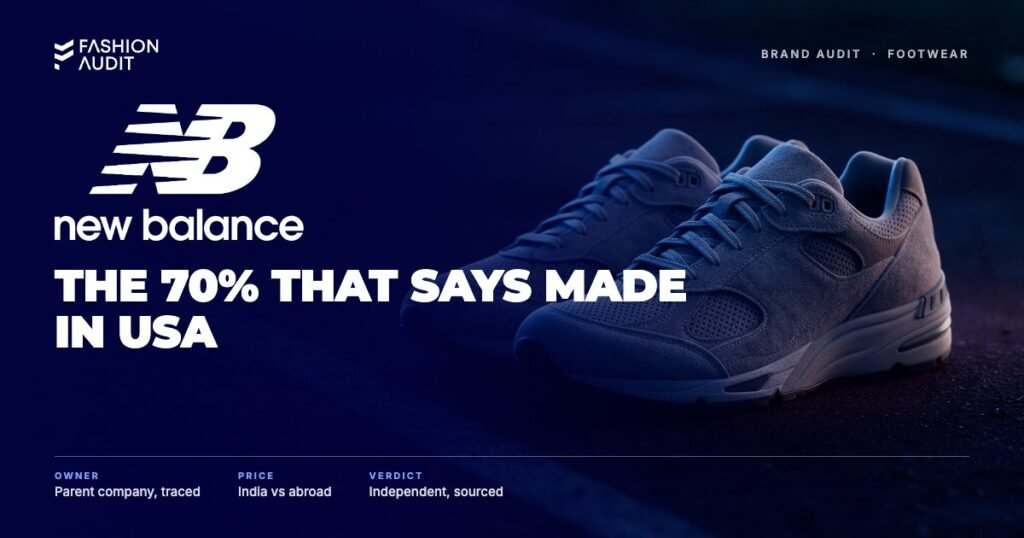
New Balance is an American athletic footwear company that is still owned by one family, that did $9.2 billion in 2025, and that has built its entire premium identity on a label reading Made in USA. That label is real. It is also qualified: New Balance’s own disclosure says those shoes contain “a domestic value of 70% or more” and that Made in USA “makes up a limited portion of New Balance’s US sales.” In India, where the brand now sells through a franchise partner and a growing number of company stores, none of that line appears to be available at all.
New Balance is the only major sneaker brand still owned by one family, and the only one whose Indian prices sit within about 5% of American list — the 574 is actually cheaper here, at ₹10,999. The catch is what it does not sell here: the Made in USA line that the brand’s whole premium identity rests on has no authorised Indian channel. Counterfeit risk is high and court-documented, so buy from BrandMan Retail, VegNonVeg or an official storefront.
Snapshot
- Founded
- 1906, Boston, Massachusetts, USA — as an arch-support maker, not a shoe company
- Founder
- William J. Riley, an English immigrant (per New Balance’s own company history — see the note below)
- Owned by
- The Davis family, privately, since April 1972. Jim Davis is Chairman; Anne Davis is Vice Chairman. Joe Preston is President and CEO
- Listed
- No. “There’s no way that New Balance will be going public in the near future” — Joe Preston
- Global revenue
- $9.2 billion in 2025, up 19% — a fifth consecutive year of double-digit growth
- Made where
- Five factories in New England and one in Flimby, Cumbria. Everything else is contract-manufactured in Asia
- In India since
- Early 2000s (exited), re-entered June 2016, restructured under BrandMan Retail from November 2021. Own entity incorporated 17 January 2022
- India price band
- About ₹10,999 to ₹18,999 for the models actually stocked here
- Counterfeit risk
- High, and court-documented. Three Delhi High Court judgments and a manufacturing raid in the last three years
Where New Balance actually came from
The company was founded in 1906 and did not make a shoe for thirty-two years. Its first product was a flexible three-point arch support, and the company’s own account says the three-point design came from watching chickens balance in a yard. Riley made New Balance’s first athletic shoes in 1938, for a Boston running club called the Brown Bag Harriers, in kangaroo leather.
One caution, because this site does not pretend company history is neutral. The International Directory of Company Histories gives a materially different account — founding in Belmont rather than Boston, under the name “The New Balance Arch Company,” with no mention of Riley and a pre-1972 owner named Paul Kidd. Both versions are on the record. The Riley version is New Balance’s own and is the one everybody repeats; it is also, therefore, self-reported.
What is not disputed is the 1960 Trackster, which offered a running shoe in multiple widths from AA to EEEE. That is the single most defensible technical contribution in this whole audit, and we will come back to it.
The purchase that made the company. On the day of the Boston Marathon in April 1972, James S. Davis bought New Balance for $100,000 — a sum equal to its entire annual sales. What he bought was a Watertown garage with five workers making about thirty pairs a day. Revenue the following year was $221,583. Fifty-three years later it was $9.2 billion, the family still owns roughly 95% of it, and Davis was worth $6.4 billion as of July 2026.
- 1906Founded in Boston making arch supports, not shoes
- 1938First athletic shoes, in kangaroo leather
- 1960The Trackster, in widths AA to EEEE
- 1972Jim Davis buys the company for $100,000
- 2025$9.2 billion in sales, up 19%
Davis paid a year’s sales for five workers and thirty pairs a day.
The turning points
1976, the 320. The first New Balance running shoe with the “N” on the side, and rated best running shoe in the world by Runner’s World. Sales passed $1 million that year. The letter on the side was not a logo decision so much as an accident of what became the brand’s whole visual identity.
1982, the 990. Development had started in 1978. The 990 arrived as a Made in USA flagship at a price nobody in running had attempted. Trade press has converged on $100 and the original advertising line was “Out of 1000, this shoe is a 990” — though it is worth noting that New Balance’s own press releases have never stated the 1982 price, so treat the hundred-dollar figure as consensus rather than established fact. The point stands either way: New Balance decided that a running shoe could be a luxury object.
1988, the 574. Launched as a running shoe and became the volume icon, the model that put New Balance on more feet than anything else it has made.
1989, the P550 Basketball Oxford. It failed. New Balance had neither the endorsed athletes nor the marketable cushioning technology — this was the era of the Reebok Pump and Nike Air — and the shoe disappeared. Remember it, because it comes back.
2013, NB Numeric. The skate line, and the first serious admission that New Balance’s customers were not only runners.
2019, Aimé Leon Dore. The first collaboration with Teddy Santis’s New York label, in April, on a 997 pack. Santis then went looking through the archive, found an image of the dead 1989 basketball shoe, and put it through somewhere between eight and ten revisions. The 550 relaunched in September 2020 and became the defining sneaker of the next three years.
April 2021, Santis hired. New Balance made him Creative Director of Made in USA — the collaborator became the custodian of the company’s most valuable line. His own framing was pointed: he was drawn to a business “founded on values such as integrity and authenticity, rather than passing hype.”
2020 to 2025, the numbers. Revenue went from $3.3 billion to $9.2 billion. Apparel crossed $1 billion for the first time in 2025, and so did company-owned retail. The dad shoe stopped being a joke and became an industry.
Made in USA: what the label actually means
This is the claim New Balance is built on and it deserves to be read carefully, because the company is more honest about it than its customers generally are.
New Balance runs five athletic footwear factories in New England — Skowhegan and Norway in Maine, Lawrence and Methuen in Massachusetts, and Londonderry in New Hampshire, which opened in early 2026 — plus one in Flimby, Cumbria, which has made the Made in UK line since it moved there in 1991. Around 1,200 people work in the American Made operations, out of more than 5,000 US employees and about 14,000 worldwide. In 2017 the company told Senator Susan Collins that it was “the only major company to make or assemble more than 4 million pairs of athletic footwear per year in the USA.”
Now the qualifier. Here is the disclosure as it appears on a Made in USA 990v6 product page on newbalance.com, checked on 20 August 2026:
New Balance Made in USA footwear contains a domestic value of 70% or more. Made in USA makes up a limited portion of New Balance’s US sales.
The Federal Trade Commission’s standard for an unqualified “Made in USA” claim is that final assembly happens in the United States, all significant processing happens in the United States, and all or virtually all components are made and sourced there. Qualified claims — “70% domestic value” — are permitted where a product does not meet that bar, provided they are truthful and substantiated.
So New Balance’s claim is legal and disclosed. It is simply not what most buyers hear. A shoe that is 70% American by value is a shoe that is up to 30% not, and soles in particular have been sourced overseas.
One more thing worth noticing, which nobody writes about: the Made in UK line carries no published domestic-content percentage at all. The Flimby marketing speaks of craftsmanship since 1982 and stops there.
Does the marketing claim more than that? Not in the letter, and the company’s own wording — “a limited portion of New Balance’s US sales” — is unusually candid. But the overwhelming majority of New Balance shoes sold anywhere in the world are made in Asia by contract manufacturers, and New Balance does not publish a domestic share of global unit output. In India, as far as we can establish, the Made in USA and Made in UK lines are not officially sold at all.
Made in USA is the brand’s whole identity, and it is the one thing you cannot buy here.
How New Balance came to India, and who actually sells it
There have been three separate arrangements and most coverage collapses them into one. They are worth keeping apart, because the story is a brand that failed here once and came back differently.
The first attempt, early 2000s — and the exit. New Balance entered India in the early 2000s and closed after a few years. The company’s own explanation, from VP Darren Tucker: “We were ahead of time. We did not have such a wide brand presence globally that time.” That is a rare thing for a brand to admit and it happens to be true.
June 2016, the re-entry. A 1,100 square foot first store at DLF Mall of India in Noida, distributed by Mumbai’s Major Brands Group, with Jabong online. The stated plan was around fifty stores in two to three years. It did not happen at that pace.
November 2021, BrandMan Retail. New Balance appointed BrandMan Retail as its retail solutions provider for India, targeting thirty-five points of sale by March 2022, with online through Nykaa and Tata Cliq and offline also through Shoppers Stop. BrandMan is still the partner today, and it also distributes Saucony, On Running, Timberland, Rockport and Sperry — which tells you exactly which shelf New Balance sits on in India. It is competing with Asics and Skechers for the premium import buyer, not with Campus or Sparx.
January 2022, its own entity. New Balance India Private Limited was incorporated on 17 January 2022, with paid-up capital of ₹40.74 crore and Joe Preston and Kevin Doyle on the board alongside India country manager Radeshwer Davar. The first company-operated store opened in Hyderabad in February 2023, followed by Pune in March and Mumbai’s Linking Road in May.
How many stores? Nobody agrees, and we are not going to pick. Reuters reported in June 2026 that BrandMan operates fourteen New Balance stores. BrandMan’s own store locator listed ten when we checked it on 20 August 2026. Neither figure counts New Balance’s own directly operated stores. What is clear is the direction: BrandMan reported FY2026 revenue of ₹1.62 billion, up 20%, and says it is targeting forty-five locations by April 2027 and 116 by 2028.
One oddity for the record, because this site would rather show its working than tidy it away: two different corporate identity numbers exist for a New Balance India Private Limited with the same incorporation date and the same paid-up capital — one registered in Delhi, one in Pune. The most plausible reading is a registered-office move from Maharashtra to Delhi, which changes the state code in the CIN. The register does not say so, so treat that as our reading rather than a documented move. And no free registry source publishes the entity’s revenue, so unlike Nike, adidas or Puma, we cannot tell you what New Balance sells in India. Anyone who quotes you a figure should be asked where it came from.
- Early 2000sFirst entry, later abandoned
- June 2016Re-enters the market
- November 2021Restructured under BrandMan Retail
- January 2022Own Indian entity incorporated
The current structure is only four years old, which is why the range here is still narrow.
The models that matter
| Model | Year | What it changed |
|---|---|---|
| Trackster | 1960 | A running shoe offered in widths AA to EEEE. The most defensible technical contribution New Balance has ever made |
| 320 | 1976 | First with the side “N”, and Runner’s World‘s best running shoe. The identity begins here |
| 990 | 1982 | Made in USA, priced at roughly $100 when nothing in running cost that. Now on its sixth generation at $199.99 |
| 574 | 1988 | The volume icon. More New Balance customers have owned this than anything else |
| P550 | 1989 | A basketball shoe that failed for want of an athlete and a cushioning story — then came back thirty-one years later as the 550 |
| 991 | 2001 | The Made in UK flagship out of Flimby, still the connoisseur’s pick |
| Fresh Foam | 2014 | Midsole geometry designed from runner strike data rather than by hand. A genuine engineering step |
| FuelCell | 2019 | The high-rebound performance foam, and New Balance’s entry into the modern racing-shoe arms race |
| 9060 | July 2022 | The 990 lineage crossed with the early-2000s 860, at $150. The shoe that carried the dad-shoe boom past the 550 |
Of these, the models an Indian buyer can actually walk in and buy are the 530, 574, 327, 550, 1906, 2002, 9060, 1080 and the running line. The 990v6 and the 993 — the Made in USA shoes — appear on no authorised Indian listing we could find on 20 August 2026, neither at VegNonVeg nor on BrandMan’s own site. They turn up only on resale platforms. Absence of a listing is not proof that nobody imports them, but if you want the shoes the brand’s whole identity rests on, India is not currently where you buy them.
What New Balance costs in India
Prices checked 20 August 2026. A note on method first, because it matters: New Balance publishes no UK prices this audit could verify, so there are no sterling prices here and we have not converted euros into pounds to fake them. Indian prices come from VegNonVeg and from BrandMan Retail, New Balance’s own India partner. US prices come from newbalance.com product pages and Hibbett. European prices come from New Balance’s own EU storefront and include VAT.
| Model | India (incl. GST) | US list (ex sales tax) | EU list (incl. VAT) |
|---|---|---|---|
| 574 | ₹10,999 (some colourways ₹9,999) | $110 | €125 |
| 327 | ₹10,999 | Not obtained | €140 |
| 530 | ₹11,999 | — | — |
| BB550 | ₹12,999 black; ₹17,999 white | $109.99 | €150 |
| Ellipse | ₹15,999 | $140 | — |
| 2002 | ₹16,999 | $144.99 | €160 |
| 1906 | ₹16,999 | — | — |
| 9060 | ₹18,999 | $160 | €200 |
| 990v6 (Made in USA) | No authorised India listing found | $199.99 | €250 |
Now the part that surprised us. An imported sneaker into India pays 20% basic customs duty plus 18.5% agriculture infrastructure cess — 38.5%, none of it recoverable — and since 22 September 2025 every pair above ₹2,500 carries 18% GST, which is all of these. On the arithmetic of the last four audits you would expect Indian New Balance to be brutally expensive.
It is not. Indian MRPs include GST; American list prices exclude sales tax. Strip the 18% out and compare like for like:
| Model | India ex-GST | US list converted | Difference |
|---|---|---|---|
| 9060 | ₹16,101 | ₹15,279 | +5.4% |
| 2002 | ₹14,406 | ₹13,846 | +4.0% |
| BB550 black | ₹11,016 | ₹10,504 | +4.9% |
| 574 | ₹9,321 | ₹10,505 | −11.3% |
| BB550 white | ₹15,253 | ₹10,504 | +45% |
At an exchange rate of about ₹95.5 to the dollar on 19 August 2026, most New Balance models sit within roughly five percent of American list on a tax-excluded basis, and the 574 is genuinely cheaper in India than in the United States. Indian prices also run consistently below New Balance’s own European list. The 9060 is ₹18,999 here against €200 in Europe, which is about ₹22,300.
The mechanism is simple and worth understanding, because it applies to every imported brand on this site: customs duty is levied on the landed transfer value, not on the retail price. Thirty-eight and a half percent of a wholesale cost that is a fraction of MRP adds far less than thirty-eight and a half percent to the shelf. Whether a brand’s Indian price looks punitive is therefore a decision about margin, not an inevitability of tax. Nike passes the duty through. adidas absorbs it. New Balance mostly prices to global parity. Same tax, three different answers.
The one price that does not fit is the white BB550 at ₹17,999 — 45% above US list after stripping tax, and ₹5,000 more than the same shoe in black. If you want a 550, buy a colour.
- 574 in the US, list price
- $110, about ₹10,505
- 574 in India, stripped of GST
- about ₹9,321
- Gap
- 11.3% cheaper in India
- Checked on
- 20 August 2026
Who New Balance is actually for
Two quite different people, and it is worth being honest that they barely overlap.
The first is anyone with a foot that does not fit standard sizing. New Balance has offered multiple widths since 1960 and still does it better than anyone. If you have a wide foot, a narrow heel, or you have spent years buying shoes that nearly fit, this is the brand where that problem has an answer. That is not marketing; it is a sixty-six-year-old product decision.
The second is the buyer who wants a sneaker that is not Nike or adidas and is willing to pay ₹11,000 to ₹19,000 for it. On price-to-global-parity, that buyer is being treated better here than by most imported brands.
Skip New Balance if what you actually want is the Made in USA object. It has no confirmed authorised route into India, and buying it grey means paying resale prices for the one part of the range where authenticity matters most.
Reputation and controversies
The military boot fight, and what it was really about. The Berry Amendment obliges the US Defense Department to buy American-made clothing, but athletic footwear was excluded — recruits got a $75 to $90 allowance and bought whatever they liked, on about 250,000 pairs a year. New Balance, then making around a quarter of its US products domestically, submitted an American-made shoe. Two models passed the Pentagon’s wear and durability testing and failed on cost. The Obama administration opposed extending Berry to recruit footwear on the grounds that “only one company could benefit disproportionately.” Maine’s congressional delegation put it in the FY2017 defence bill anyway, and in March 2018 the Defense Logistics Agency awarded New Balance a $17.3 million contract. Critics called it cronyism. New Balance called it domestic manufacturing. Both descriptions fit.
November 2016, and the worst week in the company’s history. The sequence matters, because it is almost always told wrong.
New Balance’s VP of public affairs told the Wall Street Journal: “The Obama administration turned a deaf ear to us, and frankly, with President-elect Trump, we feel things are going to move in the right direction.” He was talking about the Trans-Pacific Partnership, which New Balance opposed because it would have removed the tariffs protecting its American factories. Within days customers were filming themselves burning their shoes. Then, on 12 November, the neo-Nazi publisher of The Daily Stormer wrote that New Balance should be “the official shoes of White people.”
New Balance responded that it has zero tolerance for “bigotry or hate in any form” and pointed out that before the election it had publicly supported the trade positions of Hillary Clinton, Bernie Sanders and Donald Trump — all three of whom opposed the TPP. Snopes characterised the neo-Nazi line as a troll hoax amplified from a single blog post rather than any organised movement.
The honest verdict is that New Balance said something narrow about tariffs in a week when nothing could be heard narrowly, and a company with domestic factories to defend discovered that trade policy had stopped being a trade question.
The toning shoes. In 2012 New Balance settled a Massachusetts class action over its True Balance and Rock & Tone lines, which had been advertised as delivering “29 percent more muscle activation” and letting wearers “burn up to 10 percent more calories with every step.” The settlement was $2.3 million, up to $100 a pair for class members — and, more importantly, New Balance was barred from claiming muscle-strengthening benefits without clinical study support. That is the correct outcome and it is the reason the brand’s current claims are modest.
The Liverpool case, which New Balance lost. New Balance had a matching-rights clause on Liverpool’s kit contract and tried to exercise it against Nike’s offer. It matched the money — £30 million a season plus a revenue share — and matched Nike’s promise of “not less than three non-football global superstar athletes”, but omitted Nike’s named examples: LeBron James, Serena Williams, Drake. The Commercial Court held in late 2019 that the names supplied measurable calibre, that dropping them was material, and that New Balance had therefore not matched. Liverpool went to Nike. It is a small, precise lesson in what a brand’s roster is actually worth in contract terms.
Labour and supply chain. New Balance’s own 2023 report is more forthcoming than most: 162 Tier 1 suppliers across 28 countries, 83% of Tier 1 factories audited with a 95% pass rate, and the most common violations being excessive working hours (16%), machinery and electrical safety (10%) and fire safety (10%). The number that should give anyone pause is buried: six zero-tolerance violations were found, and only three were remediated. A 50% corrective-action rate on the worst category is not a good number, and New Balance printed it anyway.
Environment. New Balance’s 2019 baseline splits almost perfectly: Scope 1 and 2 emissions — its own operations — are under 2% of its footprint, and Scope 3, the supply chain, is nearly 99%. Its targets are a 60% cut in Scope 1 and 2 by 2030 and 50% in the main Scope 3 categories, approved as 1.5°C-aligned in 2023. By 2023 it had achieved −59% on Scope 1 and 2 and −3% on Scope 3, which its own report flags as needing attention. Read plainly: the company has all but hit the target on the 2% it controls and moved three percent on the 99% it does not. That is the honest state of environmental progress across this entire industry, and New Balance is one of the few that publishes it in a form that lets you see it.
What it gave footwear
Width. The Trackster in 1960 offered a running shoe from AA to EEEE, and New Balance has never stopped. Every other technical claim in this audit is contestable; this one is not, and it is the reason a certain kind of customer has been loyal for decades.
Design from data. Fresh Foam in 2014 built midsole sidewall geometry from runner strike and impact data rather than from a designer’s judgement. FuelCell followed in 2019 off biomechanical analysis measured in tenths of a second. These are real engineering contributions, if less dramatic than the marketing around carbon plates suggests.
Permission to be unfashionable. This is the cultural one, and it was not New Balance’s doing. Aimé Leon Dore, a New York label, reframed the ugly American running shoe as a design object, dug a failed 1989 basketball model out of the archive, and made it the sneaker of 2021. New Balance’s actual contribution was to recognise what had happened and hire the man who did it. There is a real lesson there about heritage brands: the archive is only worth what someone outside the company can see in it.
And it stayed private. Fifty-four years of family ownership, no shareholders to answer to, and six factories in high-wage countries that no listed competitor would keep open. Whatever you think of the 70% figure, no public company would run those factories at all.
Buying it in India
Buy from a New Balance store — in practice one operated by BrandMan Retail — from brandmanretail.com, from VegNonVeg, or from the official brand storefronts on the marketplaces. Those are the channels with a chain of custody.
Counterfeit risk here is high and it is documented in court. The Delhi High Court has decided three New Balance cases in three years: an injunction over counterfeit garments sold through IndiaMART and Myntra in 2023; ₹7 lakh in costs and damages in November 2024 against a shoe company using the “N” device and the 550 mark across its own site, Amazon, Flipkart, IndiaMART and JustDial; and ₹14 lakh in exemplary costs against a website that openly advertised its goods as replicas. In January 2026 Delhi Police raided a manufacturing unit in Sonia Vihar making fakes of New Balance, Nike, adidas and Skechers and seized 9,616 shoe upper parts and 131 logo dies.
The clearest live risk is IndiaMART, where a listing for “Men New Balance 550 Sneakers” at ₹3,399 a pair carries the description “100% Same As Original. Pure Leather.” Against an official Indian price of ₹12,999, that is not a discount. It is a different shoe.
The tells on a 550, the most-faked model: the “new balance” script on the midsole should be thick, raised and visibly three-dimensional — fakes render it thin and flat. Stitching on a genuine pair is boxier, shorter and denser; fakes stitch long and thin. On the size tag, every letter is fully filled with paint, and a scratched or broken “B” in the NB logo is a fake. The toe box above the “N” is bulkier than it looks in photographs. Five checks are worth doing before you pay.
The midsole script
On a genuine 550 the “new balance” script is thick, raised and clearly three-dimensional. Fakes render it thin and flat against the foam.
The stitching
Real stitching is boxy, short and dense. Long, thin stitches with visible gaps are the commonest fault on copies.
The size tag
Every letter should be fully filled with paint. A scratched or broken “B” in the NB logo means the shoe is fake.
The toe box
The volume above the “N” is bulkier in the hand than photographs suggest. A flat, shallow toe box is wrong.
The price floor
Treat any 550, 9060 or 2002 offered below about ₹8,000 on a marketplace as counterfeit until proven otherwise. The official 550 is ₹12,999.
The higher-risk category is the one the brand is proudest of. Since the Made in USA line has no confirmed authorised Indian channel, every 990 and 993 in the country arrived some other way.
Common questions
Is New Balance really made in the USA?
Some of it. New Balance runs five factories in New England and one in Cumbria and makes more than four million pairs a year in America. But its own disclosure says Made in USA footwear “contains a domestic value of 70% or more” and that the line is “a limited portion of New Balance’s US sales.” The FTC’s standard for an unqualified Made in USA claim is that all or virtually all components are American. New Balance’s claim is a qualified one, and legal.
Who owns New Balance?
The Davis family, privately, since Jim Davis bought the company on the day of the Boston Marathon in April 1972 for $100,000. The family is estimated to hold about 95%. It is not listed and its CEO has said it will not be going public in the near future.
Why is New Balance expensive in India?
By the standards of imported sneakers, it mostly isn’t. Strip the 18% GST out of the Indian MRP and most models sit within about 5% of US list, and the 574 is actually cheaper here. Indian prices are also below New Balance’s own European list. The exception is the white BB550 at ₹17,999.
Can I buy the 990 or 993 in India?
Not through any authorised channel we could find on 20 August 2026. Neither VegNonVeg nor BrandMan Retail, New Balance’s India partner, listed the Made in USA models. They appear only on resale sites, at resale prices.
Who runs New Balance stores in India?
BrandMan Retail, appointed in November 2021, alongside a small number of company-operated stores that began with Hyderabad in February 2023. Store counts differ by source: Reuters said fourteen BrandMan stores in June 2026; BrandMan’s own locator listed ten in August 2026.
How do I spot a fake New Balance 550?
Check the midsole script — genuine is thick, raised and three-dimensional, fakes are thin and flat. Genuine stitching is short, dense and boxy. On the size tag, letters are fully painted and the “B” in NB is clean. And check the price: anything under about ₹8,000 on a marketplace should be assumed counterfeit.
References
- New Balance 2025 business update — $9.2 billion revenue, up 19%, apparel and owned retail past $1 billion, five New England factories plus Flimby, 14,000 associates
- New Balance 990v6 product page — the “domestic value of 70% or more” disclosure and the $199.99 US list price, checked 20 August 2026
- Federal Trade Commission, Complying with the Made in USA Standard — the “all or virtually all” test for an unqualified claim, and the rules on qualified claims
- New Balance MADE in USA Economic and Social Footprint Report — the five factory locations, 1,200 MADE associates and the US GDP contribution
- Office of Senator Susan Collins, December 2017 — New Balance’s claim to make or assemble more than four million pairs a year in the USA
- International Directory of Company Histories — the $100,000 purchase on Boston Marathon day 1972, the Watertown garage, early revenue, and the conflicting founding account
- Forbes, Jim Davis profile — the Davis family’s estimated 95% ownership and $6.4 billion net worth as at 21 July 2026
- New Balance, April 2022 — CEO Joe Preston dating the Davis purchase to April 1972, and the opening of The TRACK
- FashionNetwork — 2021 and 2022 revenue, and Preston on not going public
- SGB Media — 2020 and 2023 revenue figures
- Endurance Sportswire — 2024 revenue of $7.8 billion
- New Balance company profile — the 1906 arch support, the 1938 Brown Bag Harriers shoes, the 1960 Trackster, the 1976 320 and the 1988 574
- Sneaker Freaker, the 990 series — the $100 shelf price, the 997 as the first model made in both the US and UK, and the 99X generations
- Highsnobiety — 990 development from 1978 and the “Out of 1000, this shoe is a 990” campaign
- SneakerNews, history of the 550 — the 1989 P550 Basketball Oxford, why it failed, and the September 2020 Aimé Leon Dore revival
- New Balance, 5 April 2021 — Teddy Santis appointed Creative Director of MADE in USA
- Hypebeast, July 2022 — the 9060 launch at $150
- New Balance, Fresh Foam — midsole geometry built from runner strike and impact data
- New Balance, 16 May 2019 — the FuelCell platform launch
- New Balance Flimby, 30 years of UK manufacturing — the 1982 Workington opening and the 1991 move to Flimby
- Shoes & Accessories — the early-2000s India exit, Darren Tucker’s “we were ahead of time”, and the June 2016 re-entry with Major Brands at DLF Mall of India
- Indian Retailer, 15 November 2021 — BrandMan Retail appointed as India retail solutions provider
- New Balance India Private Limited, registry record — incorporation 17 January 2022, ₹40.74 crore paid-up capital, directors and registered office
- Forbes India — the first company-operated stores in Hyderabad, Pune and Mumbai in 2023
- Reuters, June 2026 — fourteen New Balance stores, FY2026 revenue of ₹1.62 billion, and the 45-by-2027 and 116-by-2028 targets
- BrandMan Retail store locator — ten New Balance stores listed, and the other brands BrandMan distributes, checked 20 August 2026
- VegNonVeg — Indian prices for the 574, 327, 530, 1906, 2002, 9060, 1080 and Rebel, checked 20 August 2026
- BrandMan Retail, New Balance collection — Indian prices for the BB550 and the running line, checked 20 August 2026
- Hibbett — US list prices for the 9060 and other models, checked 20 August 2026
- New Balance EU storefront — European list prices including VAT for the 550, 574, 327, 9060, 2002 and 990, checked 20 August 2026
- Notification No. 06/2025-Customs, 1 February 2025 — 18.5% agriculture infrastructure cess on footwear headings 6401 to 6405
- Footwear GST rates from 22 September 2025 — 5% up to ₹2,500 a pair, 18% above
- Congressional Research Service — the Berry Amendment footwear exclusion, the recruit allowance, the DoD testing outcome and the administration’s objection
- Portland Press Herald, 16 March 2018 — the $17.3 million Defense Logistics Agency contract
- NPR, 19 November 2016 — the exact quotation, New Balance’s clarification, and its pre-election support for Clinton, Sanders and Trump on trade
- Boston Globe, 14 November 2016 — the Daily Stormer post and New Balance’s zero-tolerance statement
- Snopes, 16 November 2016 — the “official shoes of white people” line assessed as a troll hoax from a single blog post
- Top Class Actions — the $2.3 million toning-shoe settlement, the advertising claims at issue, and the bar on unsupported muscle-strengthening claims
- New Balance Athletics v Liverpool FC [2019] EWHC 2837 (Comm) — the matching-rights clause, the omitted named athletes, and why the match failed
- New Balance Sustainability and Impact Report 2023 — supplier counts, audit coverage and pass rates, the violation breakdown, the six zero-tolerance findings and three remediations, and Scope 1, 2 and 3 progress
- New Balance climate action — the 2019 baseline split, the 2030 targets and SBTi approval
- LiveLaw, New Balance Athletics v Salman Khan — counterfeit garments sold via IndiaMART and Myntra; permanent injunction
- LiveLaw, 5 November 2024 — ₹7 lakh in costs and damages over the “N” device and the 550 mark
- The Legal Affair, December 2024 — ₹14 lakh in exemplary costs against a site advertising its goods as replicas
- ThePrint, 30 January 2026 — the Sonia Vihar raid and what was seized
- LegitCheck, New Balance 550 real versus fake — the midsole script, stitching, size tag and toe box tells
How we research and verify brand audits:
our methodology.
New Balance is the most quietly interesting company among the global sneaker brands. It is still owned by the family that bought it for $100,000 in a garage, it has grown from $3.3 billion to $9.2 billion in five years without listing, and it keeps six factories running in America and Britain when every competitor has moved everything to Asia. Its best product decision is sixty-six years old and has nothing to do with fashion: it makes shoes in widths.
What deserves scrutiny is the label. “Made in USA” on a New Balance box means 70% or more domestic value, not the FTC’s “all or virtually all”, and the company knows it — the disclosure is printed on the product page, below the buy button. That is legal, and more candid than most, and it is still not what the buyer paying the premium believes they are getting.
For an Indian buyer the verdict is unusually favourable. New Balance prices close to global parity here, the 574 is cheaper in India than in America, and the range is priced below Europe. The catch is that the shoes the brand’s identity actually rests on are the ones you cannot buy here through an authorised channel.
A family-owned company that tells the truth in small print, priced more fairly in India than most — selling us everything except the shoes it is famous for.