
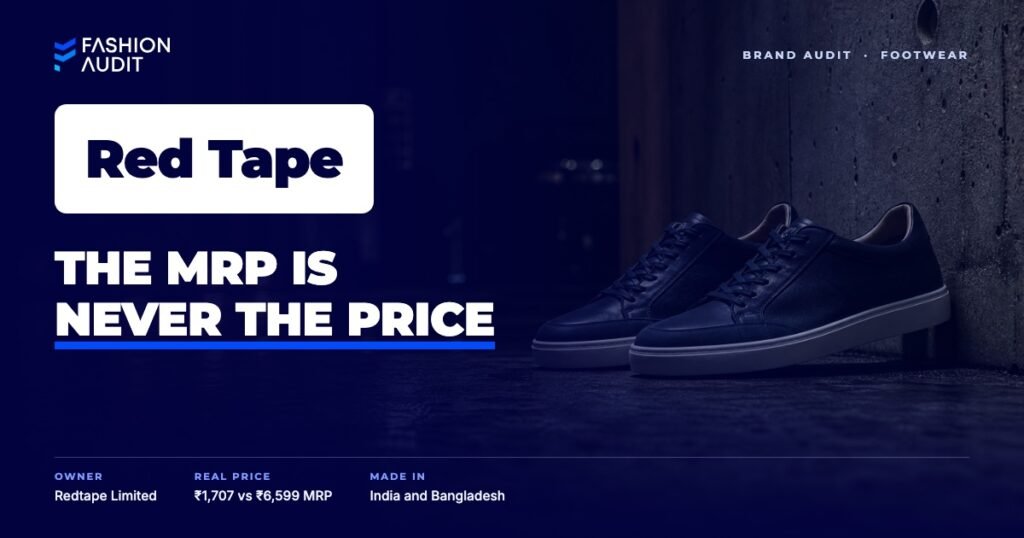
Red Tape is an Indian footwear and clothing brand run by Redtape Limited, a Noida company listed on the NSE and BSE. It sells sneakers, formal shoes, sports shoes, T-shirts and jackets, mostly to men, through about 700 stores and every big marketplace.
The one thing to know before you buy: almost nothing sells at the printed MRP. Across the 234 Red Tape products we track, the typical shoe carries a ₹6,599 MRP and sells for about ₹1,700.
Red Tape is a genuine, listed Indian company with ₹2,415 crore of revenue in FY26, and its shoes are fair value at their real selling price of roughly ₹1,200 to ₹2,600. Ignore the MRP: 92% of the listings we checked sold at 70% or more below it, including on Red Tape’s own website. Judge a Red Tape shoe as a ₹1,700 shoe, never as a ₹6,599 one.
Snapshot
- Founded
- Brand conceived in London in 1994, launched in India in 1996. The family leather business behind it, Mirza Tanners, dates to 1979
- Founder
- The Mirza family. Rashid Ahmed Mirza is chairman and Shuja Mirza is managing director
- Headquarters
- Noida, Uttar Pradesh, India
- Current owner
- Redtape Limited, listed on the NSE and BSE since 11 August 2023. The promoter family holds about 72%
- Category
- Footwear first (56% of sales), then apparel (39%) and accessories (5%)
- Price band in India
- MRPs of ₹3,599 to ₹12,299, but real selling prices of about ₹900 to ₹2,600. Mid-range on what you actually pay
- Available in India
- Official: 702 stores in 330 cities, redtape.com, Flipkart, Myntra, Ajio, Amazon and others
How it started
Red Tape grew out of leather. Mirza Tanners was incorporated in September 1979 and became Mirza International, an exporter of leather and shoes with plants around Kanpur and Unnao. In 1994 the family conceived a branded line in London, and in 1996 they brought Red Tape to India. The first Indian store opened in Pitampura, Delhi, in 2001.
For most of its life Red Tape was a division inside an export company. Apparel and accessories arrived in 2006, and the Bond Street label followed in 2015. Over the same years the brand moved away from leather towards non-leather sneakers and casual shoes, which is where the volume was.
The turning point came in 2023, when the branded business was split out into its own listed company. Like Red Chief, another brand from the same Kanpur leather belt, Red Tape now trades on its own name rather than on its exports.
- Mirza TannersIncorporated 5 September 1979
- Mirza InternationalLeather exporter; owns Red Tape as a division
- Demerger sanctionedNCLT Allahabad order, 21 February 2023
- Redtape LimitedListed on BSE and NSE, 11 August 2023
Mirza International kept the leather export business; every Mirza shareholder got one Redtape share for each Mirza share.
What they actually make
Red Tape is footwear-led: sneakers, formal and casual shoes, sports shoes, sliders and boots. Clothing is the second leg, mainly T-shirts, sweatshirts, jackets and denim. Red Tape itself brings in 95% of the company’s sales; Bond Street, Mode and the outdoor label Ozark are small.
Quarterly revenue of ₹480 crore. Source: Redtape investor presentation, August 2026.
The company does not make most of what it sells. Its own investor presentation says footwear and apparel are “sourced primarily through vendor partners”, with Red Tape controlling the design. That shows up on the labels. On 30 October 2026, one sports shoe on redtape.com listed India as the country of origin, while a women’s sneaker on the same site, and a walking shoe on Nykaa Fashion, listed Bangladesh. Redtape Limited is named as the importer on the Bangladesh pairs.
So “Indian brand” is accurate, but “made in India” depends on the pair. The declaration on the product page or the box tells you which one you are holding.
What Red Tape costs in India
This is where Red Tape differs from almost every brand we audit. An MRP is the legal ceiling on what a seller may charge, not a promise of value. Red Tape prints high ceilings and then sells far below them, all the time.
We looked at all 234 Red Tape products listed on FashionAudit on 30 October 2026. The median MRP was ₹6,599. The median selling price was ₹1,707, a 70% discount.
- Typical MRP
- ₹6,599
- Typical selling price
- ₹1,707
- Gap
- 70% below MRP
- Checked on
- 30 October 2026
216 of 234 listings, or 92%, sold at 70% or more below MRP. Not one sold between 30% and 49% off.
It is not a marketplace quirk. On Red Tape’s own website the same day, an athleisure sports shoe with a ₹7,499 MRP sold for ₹1,200, and a women’s sneaker marked ₹6,399 sold for ₹1,088. Both were tagged “Save 83%” or more.
Median prices per category, FashionAudit listings, 30 October 2026. The blue part is what you pay; the striped part is MRP you never pay.
The MRP on a Red Tape box tells you the most anyone may charge. The price tag tells you what the shoe is worth.
Red Tape’s own investor presentation agrees. It puts its core footwear at ₹1,500 to ₹3,000 and its apparel at ₹500 to ₹2,500, which matches the selling prices above, not the MRPs. There is no import-duty story here either: much of the range is made in India, and the rest comes from Bangladesh.
Other Indian shoe brands discount too, but not like this. On the same day, the 97 Campus products we track sold at a median 40% below MRP, and the 12 Bata products at 30%.
Number of products in brackets. FashionAudit listings.
Judged on what you actually pay, a ₹1,700 Red Tape sneaker competes with a ₹1,200 Campus pair, not with a ₹6,000 shoe.
Who Red Tape is actually for
Red Tape suits a man in his twenties or thirties who wants a smart-looking sneaker or a formal shoe for office wear at about ₹1,500 to ₹2,000. Men are the company’s main customers, and it is now adding women’s ranges and the Mode label.
It is a weak choice if you want a running shoe built for distance or a leather formal shoe meant to last years. The company describes itself as a non-leather lifestyle business, and at ₹1,500 to ₹3,000 its shoes sit below the specialist running and leather ranges.
Smart casual sneakers at ₹1,200 to ₹2,000
Huge size and style range, in 702 stores and online
A listed company that publishes audited results
MRPs bear no relation to the real price
A non-leather range, not built for running
Country of origin changes pair to pair
Reputation and controversies
Red Tape’s business is growing fast. Revenue rose from ₹1,838 crore in FY24 to ₹2,415 crore in FY26, and profit grew faster than sales.
Source: Redtape investor presentation, August 2026.
The main question over Red Tape is its pricing, not its products. A brand that sells almost everything at 70% to 85% off its MRP invites the question of what the MRP means. In its April to June 2026 results, the company itself said it chose not to raise MRPs and “consciously avoided excessive marketplace-led discounting”. Its online sales fell 26% that quarter as a result.
About two-thirds of its stores are run by franchisees, while Red Tape keeps ownership of the stock. That model explains the fast store growth, from 480 stores in 2025 to 702 by mid-2026.
Buying it in India
Ignore the discount percentage
“80% off” is normal for Red Tape, not a special deal. Compare the selling price with other shoes you are considering, not with the MRP.
Know the real price band
Most Red Tape sneakers and formal shoes sell for ₹1,200 to ₹2,000. Paying ₹3,000 or more for an everyday pair means you missed a better price elsewhere.
Read the country of origin
Look for the declaration on the product page or box. India and Bangladesh are both normal for genuine pairs, with Redtape Limited, Noida, named as maker or importer.
Buy from Red Tape or a big marketplace
Red Tape stores, redtape.com, Myntra, Flipkart, Ajio and Amazon all carry genuine stock. On marketplaces, prefer listings sold by Redtape Limited or a seller with long ratings history.
Try the store, buy where it is cheaper
Sizing varies between models. Try a pair in one of the 702 stores, then compare the in-store price with the online price for the same model code.
You can compare current Red Tape prices on our Red Tape shop page.
Common questions
Is Red Tape an Indian brand?
Yes. Red Tape is owned by Redtape Limited, headquartered in Noida, Uttar Pradesh, and listed on the NSE and BSE. The brand was first conceived in London in 1994 by the Mirza family, but it launched in India in 1996 and has always been an Indian-owned business.
Why is Red Tape always 70% off?
Red Tape prints high MRPs and sells far below them on its own site, in marketplaces and in sales. In our check, 92% of 234 listings sold at 70% or more off. Treat the selling price as the real price and the MRP as a ceiling.
Where are Red Tape shoes made?
It depends on the pair. Red Tape sources mostly through vendor partners. In October 2026 we found genuine pairs labelled made in India and others labelled made in Bangladesh, with Redtape Limited named as importer. Check the declaration on the box.
Is Red Tape a good brand for shoes?
For smart casual sneakers and office shoes at ₹1,200 to ₹2,000, it is good value. It is not built for serious running or long-life leather shoes. Judge it at the selling price, where it competes with Campus and Bata, not at the MRP.
Who owns Red Tape?
Redtape Limited, a listed company controlled by the Mirza family, which holds about 72%. Until 2023 Red Tape was a division of Mirza International; the branded business was demerged and listed on its own on 11 August 2023.
How we research and verify brand audits: our methodology.
References
- Redtape Limited, Investor Presentation, August 2026 — 1994 London concept, 1979 Mirza Tanners, 1996 India launch, 2001 first store, milestones, board, 702 stores in 330 cities, category, channel and brand mix, vendor-partner sourcing, franchise model, price bands, FY24–FY26 revenue, promoter holding, demerger details, Q1 FY27 commentary
- Angel One, August 2023 — Redtape listing after the demerger from Mirza International
- Goodreturns, Mirza International company history — incorporation of Mirza Tanners on 5 September 1979
- Red Tape official website, checked 30 October 2026 — MRPs, selling prices and country-of-origin declarations on two shoes
- Nykaa Fashion, Red Tape walking shoes, checked 30 October 2026 — MRP ₹6,599, selling price ₹1,979, country of origin Bangladesh, Redtape Limited as importer
- FashionAudit Red Tape listings, 30 October 2026 — MRP and selling-price analysis of 234 products
Red Tape is a real, growing, listed Indian company, and at ₹1,200 to ₹2,000 its sneakers and office shoes are fair value. The range is wide, the stores are everywhere, and you can read its audited numbers.
The MRP is the problem. When 92% of listings sell at 70% or more below it, including on the brand’s own site, the printed price tells a buyer nothing. A ₹6,599 MRP shoe sold at ₹1,700 is a ₹1,700 shoe, and should be compared with other ₹1,700 shoes.
Buy Red Tape for what it is at the till, a decent mid-range shoe, and never for the discount printed above it.