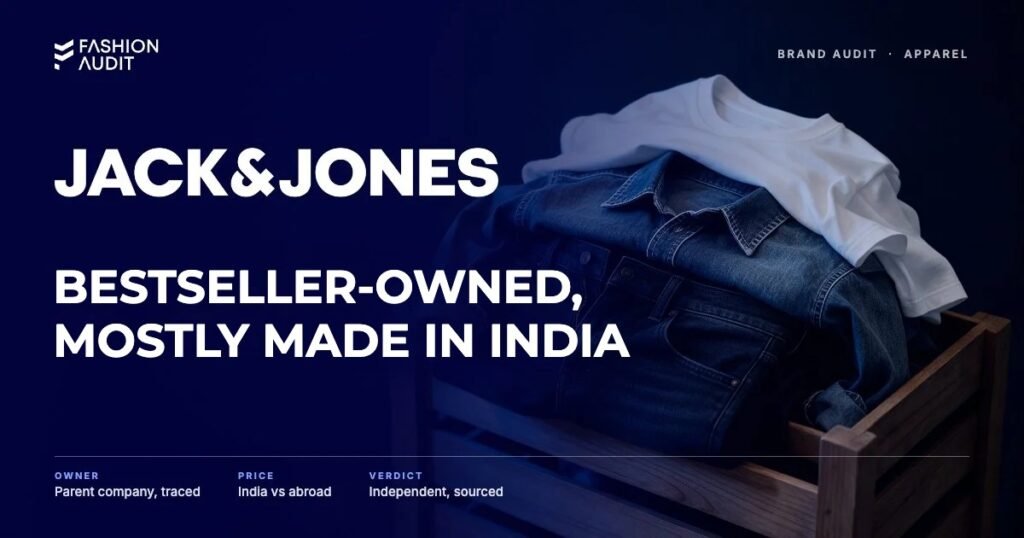
Jack & Jones is a Danish menswear label — jeans first, then shirts, jackets and knitwear — sold in India through its own outlets, hundreds of department-store counters and every large marketplace. Denim is the bulk of it: 64 of 100 listings read on its Myntra shelf on 15 September 2026 were jeans, at a median listed MRP of ₹2,499. The brand belongs to Bestseller, the family-owned Danish group behind Only and Vero Moda, and most of what it sells in India is made in India.
Jack & Jones is owned outright by BESTSELLER A/S of Denmark, through a Singapore company that bought 100% of the Indian operating business with the Indian government’s approval in October 2014. India is the declared country of origin on 30 of 40 marketplace records read on 15 September 2026, so customs duty explains nothing about the price here. A register mirror shows the Indian company’s revenue at ₹809.92 crore for the year to 31 March 2025, up 71%.
Snapshot
- Founded
- 1990, launched in Norway as a BESTSELLER brand
- Founder
- Not separately published; BESTSELLER was founded in 1975 by Troels Holch Povlsen and Merete Bech Povlsen
- Headquarters
- Denmark; the Indian company is registered at Andheri East, Mumbai
- Current owner
- BESTSELLER A/S, owned by the Holch Povlsen family; the Indian company has been held through Bestseller United (Singapore) Pte. Ltd. since 2014
- Indian operator
- Best United India Comforts Private Limited, CIN U52390MH2009PTC190686, incorporated 4 March 2009
- Category
- Apparel — menswear, mostly denim
- Price band in India
- ₹1,299 to ₹3,999 on the products read; median listed MRP ₹2,499 (15 September 2026)
- Available in India
- Officially — jackjones.in, its own outlets and shop-in-shops, and the large marketplaces
How it started
BESTSELLER was founded in Denmark in 1975 by Troels Holch Povlsen and Merete Bech Povlsen. It still describes itself as a family-owned fashion company owned by the Holch Povlsen family, with their son Anders Holch Povlsen as chief executive and second-generation owner. Jack & Jones was launched in 1990, in Norway.
The brand reached India in 2008 and grew there under a local franchise partner. That arrangement ended in January 2014, when Bestseller moved to take the business over directly: the Indian company applied to the Department of Industrial Policy and Promotion for foreign investment under the single-brand retail route, which allows up to 100% foreign ownership. At the time the brand had roughly 100 shop-in-shops and 50 exclusive outlets here.
The Foreign Investment Promotion Board met on 29 August 2014, and the Ministry of Finance published the approvals on 14 October 2014. Entry 24 on that list records approval for Bestseller United (Singapore) Pte. Ltd. to acquire 100% of the equity of Best United India Comforts Private Limited, an investment of about ₹30.13 crore. The same release carries the two sister approvals, for the wholly owned subsidiaries that became Only and Vero Moda in India.
- Jack & Jones arrives in India2008, sold through a local franchise partner
- Best United India Comforts Pvt LtdIncorporated 4 March 2009 in Mumbai
- Government approval, 14 October 2014100% of the equity, about ₹30.13 crore
- Bestseller United (Singapore) Pte. Ltd.Holds the Indian company today
One caution about that government record, because it matters. The approval names the Indian company and does not name the brand. The link between the two is established elsewhere: the corporate register describes Best United India Comforts as the retail business in readymade garments sold under the Jack & Jones name and as the operator of jackjones.in; the website’s own terms say a buyer is transacting with Best United India Comforts and that the marks belong to BESTSELLER A/S; and the same company is named as seller of record on 15 of 40 Myntra listings read on 15 September 2026. Three separate records, one answer.
What they actually make
The Indian shelf is denim-led. Myntra’s Jack & Jones facet carried 5,145 listings on 15 September 2026, with a separate facet again for Jack & Jones Junior, and jeans made up 64 of the 100 listings read. Shirts, sweatshirts, jackets and knitwear fill out the rest, along with accessories.
Where it is made is the more interesting question, and here the declaration on the listing does real work. Indian law requires a packaged garment to carry the MRP inclusive of taxes, the country of origin and the name of the manufacturer, importer or packer. That block names who is legally answerable for the goods, not necessarily who sewed them — a brand may lawfully list several entities — but it is still the most reliable manufacturing source a shopper has.
Across 40 records read in full on 15 September 2026, Jack & Jones declared 23 different manufacturer or importer strings and left the line blank on none of them. India was the declared origin on 30 records here, Bangladesh on 7. Net quantity was declared on 23 of the 40. Every named manufacturer was an Indian garment exporter, among them Indaco Jeans, Sree Santhosh Garments and Shell Apparels.
The factory list, and what it confirms
Bestseller publishes a public factory list and says on the page that it is updated six times a year. The list covers Tier 1 factories — the units that finish garments — with the address, the supplier they sit under, the product type, and the number of workers and the male-female split at the time each was brought on. It carries some Tier 2 materials suppliers too, and the group also publishes its supplier data through Open Supply Hub.
All three manufacturers named on the Indian listings appear on it.
| Named on the Indian listing | On Bestseller’s published factory list | Versions checked |
|---|---|---|
| Indaco Jeans | Yes, as Indaco Jeans Pvt. Ltd. | May 2021, December 2022, April 2024, April 2025 |
| Sree Santhosh Garments | Yes, under that name | December 2019, December 2022, April 2025 |
| Shell Apparels | Yes, as Shell Apparels Units 1 and 3 | December 2019, April 2024 |
Two further checks line up with it. The address the May 2021 list gives for Indaco Jeans — G-21, MIDC Tarapur, Boisar West — is the address Indaco publishes for itself. And Indaco’s own website lists BESTSELLER among its customers, marked “Audited by”, alongside Spykar, Celio, Pepe Jeans and others, with SEDEX and SA-8000 named as its certifications.
The brand’s own Indian site confirms the third. Its PROTECT White Low Rise Ben Skinny Jeans page declares “Made In India”, names Shell Apparels Pvt Ltd. of Bangalore as the manufacturer, and names Best United India Comforts as the importer and packer. A beanie on the same site names a different Bangalore factory, Jasmine Apparels.
What the Indian site links to
The Indian site does not link to that list. The footer of jackjones.in carries three links: About Us, terms and conditions, and the privacy policy. There is no supply-chain page, no factory list, and no pointer to the group’s own supply-chain pages. A search across the site for sustainability, factory list, supply chain and authorised sellers surfaces the terms page, the PROTECT collection page and product pages, and nothing else.
Bestseller says it updates its factory list six times a year; the jackjones.in footer does not link to it.
The versions of the factory list checked here run from December 2019 to April 2025, not the current one. The three matches are solid to that date; whether they still hold today is a question for the newest list.
What Jack & Jones costs in India
Read across 100 listings on 15 September 2026, Jack & Jones charged 65.7% of MRP, and 88 of those 100 listings were reduced. The catalogue prices off a short ladder — 22 distinct MRPs and 26 discount rungs across the whole sample — which is a grid rather than a price per garment.
- Median listed MRP
- ₹2,499
- Share of MRP actually charged
- 65.7%
- Listings reduced
- 88 of 100
- Checked on
- 15 September 2026
The brand’s own site tells the same story at a garment level. The PROTECT Ben Skinny Jeans carried an MRP of ₹3,999 and a selling price of ₹2,199, a 45% reduction, on 15 September 2026. The organic cotton beanie carried ₹1,299 against ₹1,039. On this shelf the MRP is where the conversation starts, not what anybody pays.
Why duty does not explain it
The usual defence of a foreign brand’s Indian price is import duty. It does not apply here. A garment made in Bangalore or Tirupur and sold in Mumbai crosses no customs frontier and attracts no basic customs duty at all, and India was the declared origin on 30 of the 40 records read. The 7 declaring Bangladesh have their own answer: the customs notification of 9 November 2011 that exempts imports from South Asia’s least-developed members excludes only alcoholic drinks, spirits and tobacco, so clothing is not on the excluded list.
That puts Jack & Jones alongside Levi’s, which declared India on 37 of 40 records read the same day; for another foreign label read on that shelf, see the Tommy Hilfiger audit. Both are foreign names selling largely Indian-made clothes at Indian prices, and for both the price is a margin decision rather than a tax outcome. There is no useful like-for-like comparison with a foreign shelf to make here, because most of what sells in India under this name was not imported in the first place.
Who Jack & Jones is actually for
This is a jeans brand for men in their twenties who want a European label at an Indian mid-market price. The real spend is ₹1,500 to ₹2,500 on a pair of jeans, which sits between the mass Indian denim brands and the imported premium names.
It is a reasonable choice for anyone who wants to know where a garment came from. The factory is named on the product page and can be traced to a published supplier list, which is uncommon at this price.
Skip it if you would rather buy where the shelf price sits at MRP. With 88 of 100 listings reduced and 26 different discount rungs in one sounding, the shelf charged 65.7% of MRP. Skip it too if you are buying the PROTECT line for its environmental claims specifically, because nothing published lets you check them.
Reputation and controversies
The brand has published two different store counts. Its own About page, which carries no date, says Jack & Jones India has 69 exclusive brand outlets and 221 shop-in-shops. Its own press release of 15 April 2026 says 82 and 477. Both were live on 15 September 2026.
| Indian presence | Brand’s About page (undated) | Brand’s press release, 15 April 2026 |
|---|---|---|
| Exclusive brand outlets | 69 | 82 |
| Shop-in-shops | 221 | 477 |
The undated About page gives 13 fewer outlets and 256 fewer counters than the April 2026 press release; neither page explains the difference, and the About page may simply predate the release.
The money is half-published. What the corporate register carries — as a mirror of the company’s filing, not the filing itself — is revenue of ₹809.92 crore for the year ended 31 March 2025, up 71%. A second data service puts operating revenue growth at 70.63% for the same year, which agrees to rounding. No profit or loss figure was found in the sources read. Anders Holch Povlsen has sat on the Indian company’s board since 6 February 2016.
The claims, and what stands behind them
The PROTECT collection page states that the brand is committed to ethical sourcing, recycled materials, water conservation and transparency. It carries seven icons captioned with ideas — recycled bottles, cotton sourcing, no fresh water used, green chemistry. It names no standard, no certification body, no third-party verifier, no percentage of recycled content, no litres of water saved and no mill. The product pages go the same way: one PROTECT jeans page promises responsibly sourced cotton, vegetable-tanned leather and polyester from recycled plastic; another says sustainable solutions were sought for fibre, fabric and finishing. No test is published. A beanie is described as “100% Cotton – Organic” with no certifier named anywhere on the page.
One composition line totals less than 100%. The PROTECT White Ben Skinny Jeans declares its composition as 92% cotton and 2% elastane — 94%, with 6% of the garment unaccounted for on the brand’s own Indian website, read on 15 September 2026.
None of that makes any of the claims false. It means a buyer has no way to check them, which is a different and more useful thing to know. We found no decided consumer, product-quality or labelling matter against Best United India Comforts. Nobody has ruled on any of the claims described above.
Buying it in India
The brand’s own site is jackjones.in, and its terms name Best United India Comforts as the company you are contracting with. On Myntra the sellers of record across the 40 records read were Best United India Comforts on 15 and RetailNet on 17 — which makes this one of the few imported names on the shelf whose own Indian company sells directly on the marketplace. Ajio and Tata CLiQ Fashion carry the brand too.
Read the declaration before the description
Every listing must carry the MRP inclusive of taxes, the country of origin and the manufacturer or importer. On this brand that block is filled in — it was blank on none of the 40 records read — so use it.
Look at who is selling, as well as who made it
The seller of record is printed on the listing and is a different field from the manufacturer. On the brand’s own website the seller is the Indian company itself.
Treat the channel as your only check
No authentication method is published — no code, hologram, serial or verification page on either the Indian site or the group’s. Neither is a list of authorised sellers for India. Buying through the brand’s own site or a large marketplace’s own fulfilment is the practical answer.
Know the ordinary price before you call it a deal
Two-thirds of MRP is the normal Indian price on this brand, not a sale. A pair of jeans at around ₹1,650 against a ₹2,499 MRP is the market, and a listing far below that is worth a second look.
Add up the composition line
Fibre percentages should total 100. At least one PROTECT jeans page on the brand’s own site totals 94. It takes five seconds to check.
Common questions
Who owns Jack & Jones?
BESTSELLER A/S of Denmark, owned by the Holch Povlsen family. In India the operating company is Best United India Comforts Private Limited, 100% of which was acquired by Bestseller United (Singapore) Pte. Ltd. with the Indian government’s approval published on 14 October 2014. It is a group-owned business, not a licence to an Indian partner.
Is Jack & Jones made in India?
Mostly, yes. India was the declared country of origin on 30 of 40 marketplace records read on 15 September 2026, and Bangladesh on 7. The manufacturers named are Indian garment exporters, and the brand’s own product pages declare “Made In India” with a Bangalore factory named.
Why is Jack & Jones always discounted?
Because the MRP is a starting point. Across 100 listings read on 15 September 2026 the brand charged 65.7% of MRP and 88 listings were reduced, off a ladder of only 22 distinct MRPs. Roughly two-thirds of MRP is the ordinary Indian price on this brand rather than a sale event.
How do I check a Jack & Jones product is genuine?
You cannot check it against anything the brand publishes. No authentication method is published — no code, hologram or serial check on jackjones.in or on bestseller.com — and no list of authorised Indian sellers is published either. The channel you buy through is the only control available.
Is Jack & Jones the same company as Only and Vero Moda?
Same group, different Indian companies. All three are BESTSELLER brands, and all three Indian vehicles were approved by the Foreign Investment Promotion Board in the same release of 14 October 2014 — but Only and Vero Moda were new wholly owned subsidiaries, while the Jack & Jones business was an existing Indian company bought outright.
How we research and verify brand audits: our methodology.
References
- Press Information Bureau, Ministry of Finance, 14 October 2014 — the approval to acquire 100% of Best United India Comforts, and the Only and Vero Moda approvals in the same release
- Business Standard, 31 January 2014 — the end of the franchise arrangement, the single-brand retail application, and the store count at the time
- FashionNetwork India, 8 February 2018 — the 1990 Norwegian launch and the 2008 India entry
- BESTSELLER, Corporate Governance — family ownership, the 1975 founding, Anders Holch Povlsen as chief executive
- CredenceData company profile — the register’s description of the company as the Jack & Jones retail business and operator of jackjones.in
- Jack & Jones India, Terms and Conditions — Best United India Comforts as the contracting party, BESTSELLER A/S as the owner of the marks
- ZaubaCorp register mirror — CIN, incorporation date, registered office, and Anders Holch Povlsen’s appointment of 6 February 2016
- BESTSELLER, Public Factory List — “updated six times a year”, and what the Tier 1 and Tier 2 entries carry
- BESTSELLER, Transparency reporting — publication through Open Supply Hub and the reporting set
- BESTSELLER Public Factory List, April 2025 (third-party copy) — Sree Santhosh Garments and Indaco Jeans Pvt. Ltd.
- BESTSELLER Public Factory List, 1 April 2024 (third-party copy) — Shell Apparels Units 1 and 3, and Indaco Jeans Pvt. Ltd.
- BESTSELLER Public Factory List, December 2022 (third-party copy) — Sree Santhosh Garments and Indaco Jeans Pvt. Ltd.
- BESTSELLER Public Factory List, May 2021 (third-party copy) — the Indaco Jeans entry carrying the Tarapur address
- BESTSELLER Public Factory List, December 2019 (third-party copy) — Shell Apparels Unit 1 and Sree Santhosh Garments
- Indaco Jeans — the Tarapur address, BESTSELLER named as a customer and marked “Audited by”, SEDEX and SA-8000
- Jack & Jones India, PROTECT White Ben Skinny Jeans — “Made In India”, Shell Apparels as manufacturer, the ₹3,999 MRP against ₹2,199, and the composition totalling 94%
- Jack & Jones India, homepage and footer — the three footer links, and the absence of any supply-chain or authenticity page
- Notification 99/2011-Customs, 9 November 2011, as reproduced by IBCCI — the exemption for South Asian least-developed members and the goods excluded from it
- Jack & Jones India, About Us — 69 exclusive brand outlets and 221 shop-in-shops
- PR Newswire India, 15 April 2026 — 82 exclusive brand outlets and 477 shop-in-shops
- TheCompanyCheck register mirror — revenue of ₹809.92 crore for the year to 31 March 2025, up 71%, and the Singapore parent
- EMIS company profile — operating revenue growth of 70.63% for 2025
- Jack & Jones India, PROTECT collection — the ethical sourcing, recycled materials, water conservation and transparency claims
- Jack & Jones India, FAQ — returns and support, with no authenticity or authorised-seller content
The supply chain is the best thing on this brand and it is better than most of the shelf. Every Indian manufacturer named on its listings turns up on the group’s own published factory list, the manufacturer line was blank on none of the 40 records read, and the brand’s own product page names the Bangalore factory that made the jeans. At ₹1,500 to ₹2,500 a pair, that is a real advantage.
The scepticism belongs to the claims and the numbers. PROTECT promises ethical sourcing, recycled materials, water conservation and transparency, and names no standard, no certifier, no percentage and no mill — no test is published, and one of its jeans pages declares a composition that adds up to 94%. The undated About page gives lower store counts than the April 2026 press release. Revenue of ₹809.92 crore appears on a register mirror, and no profit figure was found in the sources read. And at 65.7% of MRP across 100 listings, the sale price, not the MRP, is the one to judge it by.
Good jeans, made here, from a group that publishes its factory list — worth buying at the sale price, not the tag.