
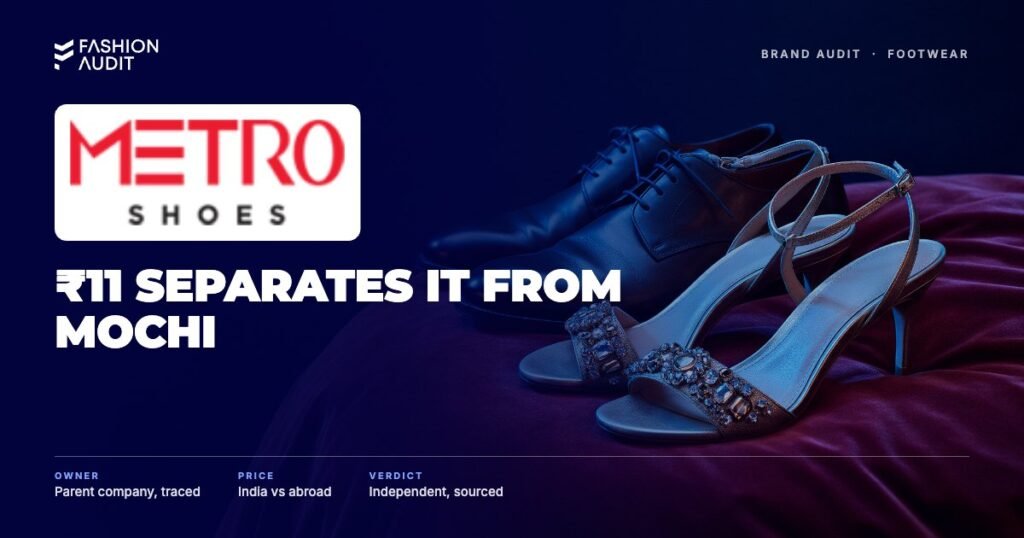
Metro Shoes is an Indian footwear chain run out of Mumbai by Metro Brands Limited, with 375 stores as of 30 June 2026. The company publishes a price band of ₹1,000 to ₹10,000 for the format. It owns no factories and makes nothing — every pair comes from an outside vendor. It also runs Mochi, a second chain that, on the company’s own disclosures, is almost impossible to tell apart from this one.
Metro Shoes and Mochi are one business wearing two signs. Metro Brands gives both the same segment, the same ₹1,000 to ₹10,000 band and the same 1,600 sq ft store. The last brand-wise figures it disclosed put realisation at ₹1,482 a pair for Metro against ₹1,471 for Mochi — a gap of ₹11. It owns no factory, and roughly ₹1 in every ₹4 spent in its stores goes on somebody else’s brand.
Snapshot
- Founded
- 1955, Mumbai, India, per every filing; the retail site says 1947
- Founder
- Malik Tejani
- Headquarters
- Kurla (West), Mumbai, Maharashtra, India
- Current owner
- Metro Brands Limited, incorporated 1977, listed on the BSE and NSE since 22 December 2021
- Category
- Footwear and accessories, sold through multi-brand stores
- Price band in India
- ₹1,000 to ₹10,000, as published in the FY25 annual report
- Available in India
- Official — 375 Metro stores and metroshoes.com, at 30 June 2026
How it started
Malik Tejani sold shoes on Grant Road for someone else before opening his own store in Colaba. He named it after the cinema, because a cinema signalled luxury in that Bombay. The shop grew on Parsi weddings, film stars and a contract for Air India’s uniform shoes.
The year depends on which Metro page you read. The prospectus and the FY25 annual report date the first store to 1955. The retail site says “established in the year of freedom, 1947”, and the corporate site runs “Since 1947” beside “IN 1955 WE TOOK THE FIRST STEP”.
The family trade plausibly dates to 1947. The store dates to 1955 in every document filed with a regulator, and 1947 has never appeared in a filing.
- Metro Shoes Private LimitedIncorporated 19 January 1977 in Mumbai
- Metro Shoes LimitedRenamed 1992
- Metro Shoes Private LimitedBack to private in 2002
- Metro Shoes LimitedRenamed again in 2007
- Metro Brands LimitedRenamed 2018; listed December 2021
“Metro Shoes” is the sign above the shop; “Metro Brands” is the listed company, and that name is seven years old.
What they actually make
Nothing. The prospectus states it flatly: “We are dependent on third-parties for the manufacturing of all the products we sell.” It sources from over 250 footwear vendor partners, many of those relationships more than 20 years old, and owns no plant.
The proof sits on Metro’s own product page. A Metro-branded formal lace-up, SKU 19-5537-11-40, carries a Legal Metrology declaration naming the manufacturer as Boots India, Sikandara, Agra. Metro Brands appears only as marketer, at a warehouse in Bhiwandi.
It was a decision, not a limitation. Chairman Rafique Malik tried manufacturing and stopped.
Manufacturing and retailing are conflicts of interest. — Rafique Malik, chairman, Metro Brands
The shelf is not all Metro’s either. Own brands were 73% of store revenue in FY26 and 71% by June 2026, so about a quarter of the till is somebody else’s label.
- 2015Crocs tie-up begins
- 2021FitFlop exclusive tie-up
- 2022Buys Cravatex Brands; FILA licence and Proline come with it
- 2023Foot Locker pact; first store at Select Citywalk
- 2025Clarks returns to India through Metro Brands
Own-brand share of store revenue slipped from 73% in FY26 to 71% by June 2026.
Sources: Business Standard; Metro Brands FY26 and Q1 FY27 presentations.
What Metro Shoes costs in India
The FY25 annual report gives the format a range of ₹1,000 to ₹10,000 and calls it “Mid and Premium Segment”. That band is honest only at the bottom. Checked on 22 August 2026, own-label stock carried MRPs of ₹1,690 to ₹4,990 and sold well below them.
| Metro-branded product | MRP | Selling price |
|---|---|---|
| Men Brown Casual Slippers | ₹2,290 | ₹1,030 |
| Men Black Casual Moccasin | ₹4,990 | ₹3,243 |
| Men Black Formal Lace Up | ₹3,290 | ₹2,927 |
From the metroshoes.com sale listing, checked 22 August 2026; discounts there ran from 11% to 55%.
- MRP, Men Brown Casual Slippers
- ₹2,290
- Actual selling price
- ₹1,030
- Gap
- 55% below MRP
- Checked on
- 22 August 2026
Full price does exist: the same site sold a Metro lace-up at ₹3,690 against an MRP of ₹3,690 that day. House labels get marked down hard and third-party brands do not. On mochishoes.com, Clarks and Skechers sat at full MRP while every Mochi pair was discounted. Blended average selling price group-wide was ₹1,600 in FY26.
Metro or Mochi: the ₹11 difference
Shoppers are told that one of these chains is the upmarket one. On every dimension Metro Brands discloses, Mochi and Metro are the same shop.
| Disclosed by the company | Metro | Mochi |
|---|---|---|
| Segment, in its own words | Mid and Premium | Mid and Premium |
| Advertised price range | ₹1,000 – ₹10,000 | ₹1,000 – ₹10,000 |
| Typical store size | 1,600 sq ft | 1,600 sq ft |
| Realisation per unit, H1 FY22 | ₹1,482 | ₹1,471 |
| Stores, 30 June 2026 | 375 | 289 |
| Own factories | None | None |
Eleven rupees, or 0.7%, separated them on the last brand-wise figures published. This is the same shoe money sold under two signs, from stores of identical footprint and one vendor pool. What differs is a younger window at Mochi and a partly different third-party rack.
Those figures cover the six months ended 30 September 2021, and Metro Brands stopped disclosing brand-wise realisation after its IPO. They are nearly five years old and still the most recent split on record. We read them in an Axis Capital IPO note reproducing the prospectus table, because that chapter would not render for us. No post-IPO filing we found splits the two.
Who Metro Shoes is actually for
This is a family occasion-wear shop. Women’s footwear was 41% of store sales in the June 2026 quarter, men 34% and kids 3%. The buyer wants a wedding sandal or a work loafer, wants to try it on, and would rather not gamble online. In-store was 85% of FY26 revenue against 9% online.
It suits you if staff, a return counter and 222 cities of coverage are worth paying for, less so if you want performance footwear or shop on price alone. Campus and Relaxo own their plants and compete lower down; Metro competes on shelf, service and location.
Reputation and controversies
We found no regulatory action, labour finding, consumer order or recall against Metro Brands. The litigation on record has the company as plaintiff, twice, winning at interim stage. In November 2024 the Bombay High Court restrained ‘DESIMOCHI’ and declared ‘MOCHI’ well-known. In April 2025 it injuncted ‘METBRANDS’, a firm that traded as “METRENDS” until Metro Brands went public.
The structural risk is in its own prospectus. A retailer dependent on outsiders for everything it sells has no direct sight of conditions at 250-plus vendors, and it publishes no supplier list. Compare Bata, which manufactures too: Metro Brands earned ₹416 crore of FY26 profit against Bata’s ₹134 crore, on ₹2,864 crore of revenue against ₹3,516 crore.
One ownership claim gets repeated wrongly. Rakesh Jhunjhunwala was never a named promoter — the prospectus names five, all Malik family entities. He held shares from 2007 and did not sell in the IPO. At the March 2026 quarter, 3,91,53,600 shares, or 14.37%, sat in three discretionary trusts named for his children, not in Rekha Jhunjhunwala’s own name.
We could not establish whether those trusts count as Promoter Group or Public in the filed shareholding pattern. Trendlyne’s March 2025 breakdown puts the holding under Public and lists only Malik entities as Promoter Group. The BSE pages returned errors and the NSE version renders only in a browser, so we are flagging it unresolved.
Buying it in India
Metro Brands publishes no authentication guide, hologram scheme or serial check, and we found no seizures over fake Metro-branded stock. The exposure to manage is the third-party rack.
Buy from the chain itself
Metro-branded stock sells through 375 Metro stores and metroshoes.com. No independent wholesale channel needs to exist.
Read the label, not the logo
Genuine stock names a manufacturer and country of origin, gives MRP inclusive of taxes, and says “Marketed by Metro Brands Limited” at the Bhiwandi address. A listing missing those is not carrying what Indian law requires.
Do not pay MRP on a house label
Discounts of 30% to 55% on Metro and Mochi own-brand stock were live on 22 August 2026. Wait for the sale page, and take the extra 5% both sites give on prepaid orders above ₹1,000.
Treat the third-party rack differently
Crocs, Skechers, Puma, Adidas, Clarks and Fila have real counterfeit markets in India. Buy those in the store or from the brand.
Know the floor
Own-label pairs transacted between roughly ₹1,000 and ₹3,500 on 22 August 2026. A “Metro” shoe offered well under ₹1,000 is a question, not a bargain.
Common questions
Does Metro Shoes make its own shoes?
No. Metro Brands owns no factory and sources from over 250 vendors. The Legal Metrology label on a Metro-branded formal shoe names Boots India of Sikandara, Agra as manufacturer, with Metro Brands only as marketer.
Is Metro Shoes more expensive than Mochi?
Not on the company’s own numbers. The FY25 annual report gives both the same segment, the same ₹1,000 to ₹10,000 band and the same 1,600 sq ft store. Last disclosed realisation was ₹1,482 for Metro against ₹1,471 for Mochi, for the six months to 30 September 2021.
Does Rekha Jhunjhunwala own Metro Shoes?
No. The Malik family controls Metro Brands, with promoter holding at 71.80% in June 2026. As of the March 2026 quarter, 14.37% sits in three discretionary trusts named for Rakesh Jhunjhunwala’s children. He was never a named promoter.
Is Metro Shoes worth it in India?
On discount, yes. Own-label pairs bought at 40% off or better price well against anything with a comparable store network. At full MRP you pay a retailer’s margin for a shoe an outside vendor made.
How we research and verify brand audits: our methodology.
References
- Metro Brands, Q1 FY27 investor presentation, 4 August 2026 — store counts at 30 June 2026, category mix, own-brand share, average selling price
- Metro Brands, Annual Report 2024–25, Store Formats — the ₹1,000 to ₹10,000 band, segment and 1,600 sq ft store size for both Metro and Mochi
- Metro Brands Limited, IPO Prospectus, December 2021 — incorporation, name changes, the 1955 first store, dependence on third-party manufacturing, named promoters
- metroshoes.com homepage and footer — the 1947 founding claim and the prepaid discount
- metrobrands.com corporate site — “Since 1947” and “IN 1955 WE TOOK THE FIRST STEP” on the same site
- Forbes India, “Metro Brands: Big shoes to fill” — Malik Tejani, the Colaba store, Air India uniform shoes, and Rafique Malik on manufacturing
- metroshoes.com product page, SKU 19-5537-11-40, checked 22 August 2026 — Legal Metrology declaration naming Boots India, Agra, and the ₹3,690 full price
- Metro Brands, Annual Report 2024–25, About Metro Brands — 250-plus vendor partners
- Axis Capital, Metro Brands IPO note — brand-wise realisation of ₹1,482 and ₹1,471 for the six months to 30 September 2021, reproducing the prospectus table
- Metro Brands, FY26 earnings presentation, 20 May 2026 — own-brand share of 73%, channel mix and blended selling price
- metroshoes.com sale listing, checked 22 August 2026 — MRPs and selling prices in the price table
- mochishoes.com women’s heels listing, checked 22 August 2026 — third-party brands at full MRP alongside discounted own-label stock
- Business Standard, 19 October 2022 — the Cravatex Brands acquisition, bringing the FILA licence and Proline
- Business Standard, 30 November 2023 — the Foot Locker licensing pact
- Business Standard, 24 June 2025 — the exclusive Clarks distribution agreement
- Bar & Bench, Metro Brands v Nice Shoes LLP, order of 28 November 2024 — the ‘DESIMOCHI’ injunction and ‘MOCHI’ as a well-known mark
- SCC Online, Metro Brands v MetBrands, order of 30 April 2025 — the injunction restraining ‘METBRANDS’
- Business Today, 12 May 2026 — 3,91,53,600 shares, or 14.37%, in three discretionary trusts at the March 2026 quarter
- Trendlyne, Metro Brands shareholding pattern — Rekha Jhunjhunwala’s 9.58% personal holding at March 2025 and its classification under Public
- Screener.in, Metro Brands and Bata India — FY26 revenue and profit for both companies, and promoter holding of 71.80%
Metro Brands is one of the best-run retailers in Indian footwear, and it is a retailer, not a shoemaker. It turned ₹416 crore of profit in FY26 owning no factory, on gross margin near 58%. That margin buys the shelf, the fitting stool and the return counter — real services, but not craftsmanship.
The two-brand story deserves scepticism. Metro and Mochi share a segment, a price band, a store size and a vendor pool, and the last realisation figures differed by ₹11. Buy on the sale page, and treat ₹3,500 as the ceiling for an own-brand pair.
At 40% off it is fair value; at full MRP you are paying Mumbai retail margin for a shoe someone else made in Agra.