Ritu Kumar is one of the oldest designer names in Indian womenswear, sold today as two lines — Ritu Kumar and RI.Ritu Kumar — on its own website and on Myntra, Nykaa Fashion, Ajio and Tata CLiQ. The clothes are ethnic, occasion and bridal wear, and they are priced accordingly: the median MRP on its Myntra catalogue on 11 September 2026 was ₹9,500.
The most useful thing an Indian shopper can learn about this brand is not on the brand’s website. It is on a marketplace listing, where the statutory declaration names the company that answers for the garment. On ritukumar.com, no company is named anywhere.
Reliance Ritu Kumar Private Limited is the seller of record on 40 of 40 Myntra records read on 11 September 2026. The homepage, terms and privacy policy of ritukumar.com, read the same day, name no company at all.
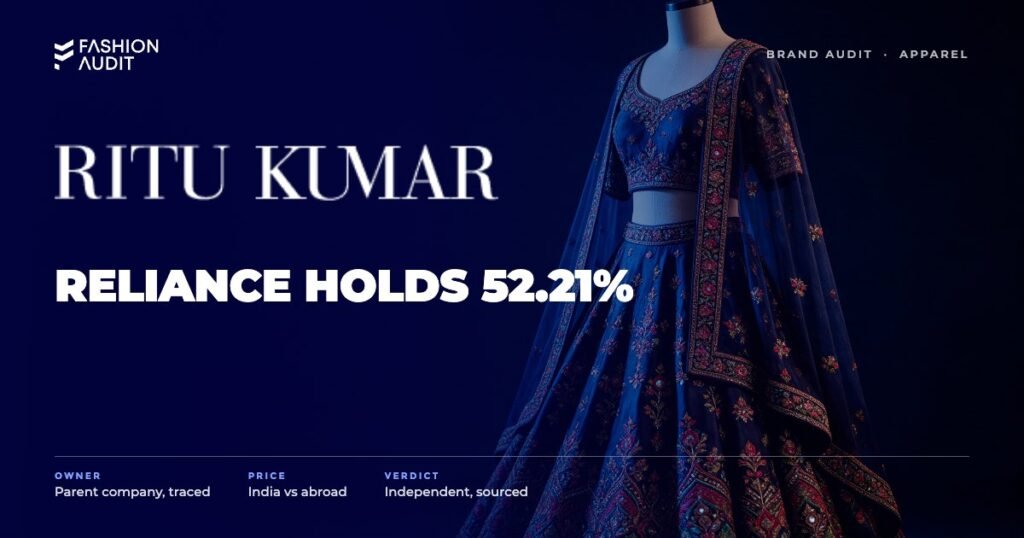
Reliance Retail Ventures Limited holds 52.21% of that company and has been its holding company since 14 October 2021, having bought the previous private-equity holder out in full. Ritu Kumar holds 11.55% and her two sons 15.83% each.
Price: 535 Myntra listings; across 200 read one at a time the catalogue charged 78.9% of MRP, with a median MRP of ₹9,500.
Snapshot
- Founded
- The label dates to the 1970s; the company was incorporated on 30 July 1976 as Ritika Private Limited
- Founder
- Ritu Kumar
- Headquarters
- Registered office in Mumbai; operating address at Udyog Vihar, Gurgaon
- Current owner
- Reliance Retail Ventures Limited, 52.21%, holding company since 14 October 2021
- Category
- Womenswear — ethnic, occasion and bridal
- Price band in India
- Median MRP ₹9,500 on Myntra; the Label line runs ₹1,715 to ₹9,900 on Nykaa Fashion — premium on this site’s apparel bands
- Available in India
- Officially — own website and stores, Myntra, Nykaa Fashion, Ajio, Ajio Luxe and Tata CLiQ
Who answers for a Ritu Kumar garment
Every garment sold in India carries a declaration: the maximum retail price inclusive of taxes, the country of origin, and the manufacturer or packer. On a marketplace it sits on the product page; in a shop it is printed on the label. It names the company legally answerable for the goods — not necessarily the factory that sewed them — and it is the most useful line a shopper can read.
Forty Ritu Kumar records were read in full on Myntra on 11 September 2026. The seller of record on all forty is Reliance Ritu Kumar Private Limited. The manufacturer line carries eight name variants across those forty, most of them that same company. Two of them read Ritika Private Limited — the company’s own former name, which the register mirrors show it carried before it was renamed. They are one entity either side of a rename, not two firms. Country of origin reads India on all forty. Net quantity appears on eleven.
Now the brand’s own website. Read the same day, the homepage, the terms and conditions page and the privacy policy of ritukumar.com name no company at all — no legal name, no corporate identity number, no tax registration, no registered address, no grievance officer. The only identifier on those pages is a footer line reading “Copyright ©2026 ritukumar.com”.
For a buyer that cuts one way. The marketplace listing shows you, before you pay, which company stands behind the garment and where to go if it fails. The brand’s own pages name nobody.
Who owns Ritu Kumar
The ownership is on the record because the parent publishes it: Reliance Industries Limited puts its subsidiaries’ statutory accounts on its own website. The shareholding is identical in all five sets read, from FY2021-22 to FY2025-26.
Reliance Retail Ventures Limited holds 1,04,868 of the 2,00,858 shares — 52.21%. Amrish Prakash Kumar and Ashvin Prakash Kumar hold 15.83% each, and Ritu Kumar holds 11.55%, so the founder and her two sons hold 43.21% between them. The accounts name Reliance Retail Ventures Limited as the immediate holding company and Reliance Industries Limited as the ultimate holding company, with the relationship effective from 14 October 2021 — five days before the deal was announced.
Private equity was the earlier state and it is gone. Everstone Capital put ₹100 crore into the company in 2014 for what Business Standard then described as an undisclosed minority stake. Reliance’s own release of 19 October 2021 says the acquisition “included completely acquiring Everstone’s ≈35% stake in the company”. A page calling this brand private-equity owned would be describing 2014 to 2021, not today.
- Ritika Private LimitedIncorporated 30 July 1976, per register mirrors
- Everstone Capital invests₹100 crore in 2014, for a minority stake
- Reliance Retail Ventures LimitedHolding company from 14 October 2021; buys Everstone out
- Reliance Ritu Kumar Private LimitedSame company, renamed; RRVL holds 52.21%
That is why two company names turn up on the marketplace declarations: they are one company’s old and new names, sitting side by side on the same catalogue.
Seven directors signed the FY2025-26 accounts on 17 April 2026. Amrish Prakash Kumar signs as Whole-time Director, and Suresh Chander Kumar is the other director from the founding family. The remaining five — Prateek Mathur, Geeta Kalyandas Fulwadaya, Samirbhai Rameshbhai Sheth, Chandrakant Shripad Gokhale and Dinesh Taluja — were appointed on or after 14 October 2021, the date the holding relationship began. Ritu Kumar is not on the board. She is a shareholder.
How it started
Ritu Kumar’s account of how the work began is on the record, in an interview published on 24 May 2023 by the Nita Mukesh Ambani Cultural Centre — a venue belonging to the group that now holds the majority of her company.
She says she came to Indian textiles through block printing, and describes finding out-of-work craftsmen in Serampore, in West Bengal, who “specialised in hand-block printing with a repertoire of Indian designs that were already appropriated by England”. She lists zardozi, phulkari, amli, kalabattun, folk embroidery and chikankari among the crafts she has worked with. That account is about the 1960s and 1970s. It is not a statement about where clothes sold today are made.
Reliance’s 2021 release describes the main line as “rooted in India’s textile legacy since the 1970s” and dates Label Ritu Kumar, the younger western ready-to-wear line, to 2002. It names three more: RI Ritu Kumar for bridal couture, aarké, and Ritu Kumar Home & Living.
What the accounts show
The parent publishes these accounts, which makes this company far easier to check than most private Indian clothing firms. Six years, with every overlapping year matching across two separate filings.
- FY2020-21₹175.26 crore revenue; loss of ₹37.67 crore
- FY2021-22₹250.00 crore; loss of ₹34.74 crore
- FY2022-23₹327.43 crore; profit of ₹4.63 crore
- FY2023-24₹283.93 crore; loss of ₹11.51 crore
- FY2024-25₹269.19 crore; loss of ₹48.94 crore
- FY2025-26₹267.17 crore; loss of ₹34.47 crore
One profitable year in six, and revenue now below where it stood in FY2021-22.
Statutory accounts of Reliance Ritu Kumar Private Limited, published by Reliance Industries Limited.
Revenue peaked at ₹327.43 crore in FY2022-23 and has fallen in each of the three years since, to ₹267.17 crore. FY2022-23 is the only profitable year of the six; FY2024-25 carries the largest loss, ₹48.94 crore. The accounts describe the business plainly as “manufacturing and retailing of garments” — no craft, handloom or revival language in the description at all.
Total equity stands at ₹21.03 crore, and the company carries ₹99.67 crore of unsecured borrowing from a related party at 9.4%, repayable within three years. No cause for the fall is stated in the filings and none is offered here. What the series does establish is the size of the thing: a business of roughly ₹270 crore, small by the standards of the group that owns it.
What Ritu Kumar costs in India
This is an Indian brand making in India — origin reads India on all forty records read — so the import-duty argument that inflates foreign labels does not apply. A Ritu Kumar price is a margin decision, not a customs line.
Two hundred of the 535 Myntra listings were read one at a time on 11 September 2026. In aggregate they charged 78.9% of MRP: 112 were reduced and 88 sat at full MRP, across 52 distinct MRPs with a median of ₹9,500.
- Median MRP on Myntra
- ₹9,500
- Share of MRP actually charged
- 78.9%
- Listings reduced
- 112 of 200
- Checked on
- 11 September 2026
The discounting is unusually plain. Those 200 listings used five distinct discount rungs. Biba’s Myntra catalogue ran 47 distinct discount percentages on 7 September 2026 and Soch’s ran 60, so a Ritu Kumar price is either MRP or one of a handful of standard reductions — closer to a price list than to the sliding grids the mass rail uses.
| Where it sells | What is listed | Prices, 11 September 2026 |
|---|---|---|
| Myntra | 535 listings under one brand facet | Median MRP ₹9,500; 78.9% of MRP charged across 200 read; five discount rungs |
| Nykaa Fashion | 1,061 items, filed as Label Ritu Kumar | ₹1,715 to ₹9,900, with reductions of 20% to 65% |
| Ajio and Ajio Luxe | Label Ritu Kumar on Ajio; Ritu Kumar on Ajio Luxe | The two lines are merchandised separately, under different names |
What the craft claims rest on
The reputation of this brand rests on Indian craft — block print, zardozi, chikankari. So the fair question is what the brand itself publishes about that today, and the answer is close to nothing.
The pages of ritukumar.com read on 11 September 2026 carry no hand-block-printing, zardozi, chikankari, handloom, karigar or artisan claim. The statutory accounts call the business manufacturing and retailing of garments. The founder’s own words about crafts come from the 2023 interview, and they describe her own history rather than a current supply chain.
The strongest craft language on any page selling this brand sits in Nykaa Fashion’s own copy on its Label Ritu Kumar page, which says the label is “beautifully hand crafted by the best skilled artisans of the country”. That is a retailer writing about a brand. Ajio’s brand copy for the same line makes no craft claim at all.
The boldest claim about hand craftsmanship on any page selling this brand belongs to a retailer’s copywriter, not to the brand.
Behind any of it, no test, standard, certification or audit is published. Searches on 11 September 2026 for the brand and the company against Craftmark, GoodWeave, the Handloom Mark, the Silk Mark, Fairtrade and geographical-indication registers showed nothing naming either, while the same searches returned certifications held by other Indian sellers. That does not make a craft claim false. It means a buyer cannot check one.
Nothing is published on where the clothes are made or by whom — no supplier, workshop or artisan count, from the brand or in the accounts. The declaration says India and names the company itself, which is more than many labels manage and less than the story implies.
Who Ritu Kumar is actually for
At a median MRP of ₹9,500, with the catalogue holding close to four-fifths of MRP, this is occasion buying rather than wardrobe buying. It suits a shopper who wants a designer name on a wedding-season outfit and is comfortable paying near the ticket price.
It is a poor fit for anyone who shops the ethnic rail on discount. Biba charged a median ₹1,749 on Myntra on 7 September 2026 and Soch a median ₹2,089 the same day, both from companies you can name on the listing. A buyer choosing on price will not find Ritu Kumar competitive here.
One more thing sits usefully on the record. The group holding the majority of this company also runs the mass end of the same market: Reliance Trends, operated by Reliance Retail Limited, charged a median ₹599 on Ajio on 6 September 2026. Ajio and Ajio Luxe, two of the shops carrying Ritu Kumar, are Reliance Retail platforms. Both facts are on the record; what a shopper makes of them is their own call.
Reputation and record
One court matter is on the record and it was decided. In Ritika Private Limited v. Biba Apparels Private Limited, the Delhi High Court dismissed the suit on 23 March 2016, on an application for judgment on admissions. It turned on section 15(2) of the Copyright Act 1957: copyright in a design capable of registration under the Designs Act 2000, but left unregistered, ceases once the design has been applied to more than fifty articles by an industrial process.
The plaintiff was Ritika Private Limited — the same company now named Reliance Ritu Kumar Private Limited — and the judgment predates the Reliance acquisition by more than five years. It is widely written up as a landmark decision in Indian fashion law. No appeal was found in the judgment databases searched on 11 September 2026.
On advertising, no adjudication naming Ritu Kumar, Ritika Private Limited or Reliance Ritu Kumar Private Limited was found in the Advertising Standards Council of India’s record on 11 September 2026, on a search that returned findings against other advertisers the same day. The council is a self-regulatory body rather than a statutory regulator, and its findings are not law.
The weaker spot is what the brand publishes about itself. The store locator on ritukumar.com listed no stores at all on 11 September 2026. The separate locators for Label and Aarke do list stores — across Delhi, Gurugram, Noida, Jaipur, Jalandhar, Ludhiana, Chandigarh and Rajkot — but neither prints a total, so there is no current figure for how many showrooms the brand runs.
Buying Ritu Kumar in India
Read the seller line, not only the brand name
On all forty Myntra records read, the seller of record was Reliance Ritu Kumar Private Limited itself. A listing sold by a trading firm you cannot place is a different proposition.
Know which line you are buying
Label Ritu Kumar starts at ₹1,715 on Nykaa Fashion, where it is filed under its own name; the main line’s median MRP on Myntra is ₹9,500. Read the product title, not the brand name, before you judge a price.
Expect a short discount ladder
The catalogue runs five standard reductions and holds full MRP on many listings, so an advertised 70% or 80% off sits outside everything it does. Check who is selling before you believe it.
Look for the net quantity
Only eleven of the forty records read carried it. In a showroom the same block is on the garment label, so ask to see it before you pay.
Phone the showroom before you travel
The brand’s own locator listed nothing on 11 September 2026. Ring the number on a store page and confirm it is trading and stocks the line you want.
The last store count the company published is 151 points of sale worldwide, dated 19 October 2021. Nothing newer has been published since, so treat any figure quoted today as nearly five years old.
Common questions
Who owns Ritu Kumar?
Reliance Retail Ventures Limited holds 52.21% of Reliance Ritu Kumar Private Limited, and has been its holding company since 14 October 2021. Ritu Kumar holds 11.55% and her sons Amrish and Ashvin 15.83% each. Reliance Industries Limited is named in the accounts as the ultimate holding company.
Is Ritu Kumar still run by Ritu Kumar?
She is a shareholder, not a director. Her son Amrish Prakash Kumar signs the accounts as Whole-time Director, and five of the seven directors who signed the FY2025-26 accounts were appointed on or after the date Reliance Retail Ventures became the holding company.
Is Ritu Kumar made in India?
Country of origin reads India on all forty Myntra records read on 11 September 2026, and the declared manufacturer is the brand’s own company. Where in India, and by which workshops or clusters, is not published by the brand or in its accounts.
What is the difference between Ritu Kumar, Label Ritu Kumar and RI.Ritu Kumar?
Reliance’s 2021 release named five lines. The website’s navigation today shows two: Ritu Kumar, the main ethnic line, and RI.Ritu Kumar, the bridal and occasion line. Label is the younger western ready-to-wear line and is sold under its own name on Nykaa Fashion and Ajio, from ₹1,715.
Are Ritu Kumar clothes discounted on Myntra?
Some are. Of 200 listings read on 11 September 2026, 112 were reduced and 88 sat at full MRP, and the whole set charged 78.9% of MRP. The reductions came in only five distinct sizes, so the discounting is narrow and predictable rather than deep.
Is Ritu Kumar worth the price in India?
For an occasion garment, the company behind it is visible and answers for its own goods, which is more than much of the rail offers. What is not established is the craft sourcing the reputation rests on, so pay for the clothes and the design rather than for an artisan story you cannot verify.
How we research and verify brand audits: our methodology.
References
- Ritu Kumar brand catalogue, Myntra — read 11 September 2026: the 535-listing facet count; 200 listings read one at a time for MRP, price charged and discount, giving 78.9% of MRP, 112 reduced, a ₹9,500 median MRP, 52 distinct MRPs and five discount rungs; and 40 product records read in full for the declared manufacturer, the seller of record, country of origin and net quantity.
- ritukumar.com, homepage, terms and conditions and privacy policy — read 11 September 2026: the two-line navigation; the absence of any company name, corporate identity number, tax registration, registered address or grievance officer; and the footer line “Copyright ©2026 ritukumar.com”.
- ritukumar.com, store locator — read 11 September 2026: no stores listed.
- Reliance Ritu Kumar Private Limited, statutory accounts FY2025-26, signed 17 April 2026 — the 52.21% / 15.83% / 15.83% / 11.55% shareholding; the holding and ultimate holding company statements; the Mumbai registered office; the seven signing directors; FY2025-26 and FY2024-25 revenue and results; total equity and related-party borrowing; and the description of the business as manufacturing and retailing of garments.
- Reliance Ritu Kumar Private Limited, statutory accounts FY2021-22 — the former name Ritika Private Limited; Reliance Retail Ventures Limited as holding company effective 14 October 2021; FY2021-22 and FY2020-21 figures.
- Reliance Ritu Kumar Private Limited, statutory accounts FY2023-24 — FY2023-24 and FY2022-23 revenue and results.
- Reliance Ritu Kumar Private Limited, statutory accounts FY2024-25 — FY2024-25 and FY2023-24 revenue and results, and the Kolkata registered office before the move.
- Reliance Retail Ventures Limited, media release, 19 October 2021 — the approximately 52% acquisition; the complete buyout of Everstone’s roughly 35% stake; the five brand lines and their descriptions; and the figure of 151 points of sale globally.
- Business Standard, 1 April 2014 — the ₹100 crore Everstone investment, described as an undisclosed minority stake.
- Company register mirror, read 11 September 2026 — the 30 July 1976 incorporation date, the previous company name Ritika Private Limited, and director appointment dates. Cited as a mirror of the register, not as the register itself.
- Label Ritu Kumar designer page, Nykaa Fashion — read 11 September 2026: 1,061 items priced ₹1,715 to ₹9,900 with reductions of 20% to 65%, and the retailer’s own “hand crafted by the best skilled artisans” copy.
- Label Ritu Kumar brand store, Ajio — read 11 September 2026: the brand copy carrying no craft claim.
- Nita Mukesh Ambani Cultural Centre, interview with Ritu Kumar, 24 May 2023 — block printing, the craftsmen of Serampore, and the list of crafts she has worked with.
- Ritika Private Limited v. Biba Apparels Private Limited, Delhi High Court, 23 March 2016 — the dismissal of the suit on an application for judgment on admissions, and the holding under section 15(2) of the Copyright Act 1957.
On the thing that matters most to a buyer, this brand does better than most of the rail: one company is the seller of record on every marketplace record read, origin is India on all of them, and six years of audited numbers are public because the parent publishes them. You can see exactly who answers for a ₹9,500 outfit.
What does not hold up is the part doing the pricing work. The craft reputation is carried by a 2023 interview about the 1960s and by a retailer’s copywriting, while the brand’s own pages carry no craft claim, no cluster, no artisan count and no test, standard, certification or audit. And a customer who buys on ritukumar.com is reading pages that name no company at all, while the marketplace listing names one on every record.
Buy it for the clothes and the cut; do not pay a premium for an artisan story the brand itself does not publish.