
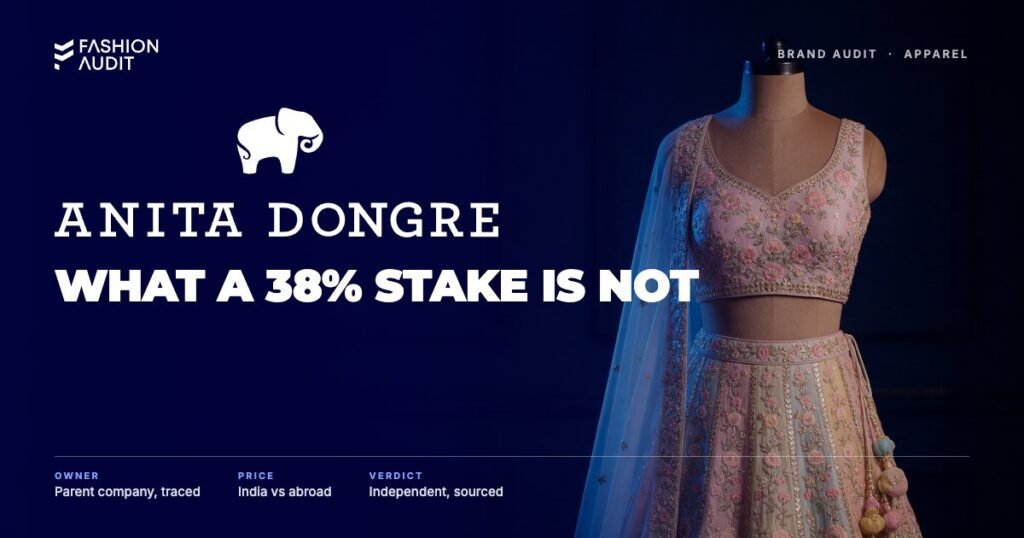
Anita Dongre is the couture, bridal, menswear and jewellery label of House of Anita Dongre Private Limited, an unlisted Mumbai company. Read on its own shop on 11 September 2026, the womenswear catalogue listed 951 items priced from ₹99,000 to ₹450,000 — the highest apparel band this site has recorded.
It is also the clearest case we have found of a brand story repeated wrongly. A large American investor held a big piece of this house for a decade. A big piece is not ownership.
General Atlantic’s holding peaked at around 38% to 40%, against about 62% held by the founding family, with two nominee directors of six. The founders were never displaced, and the most recent statement on the record — the rating agency ICRA, 25 June 2026 — calls the group “wholly owned by the promoters, their relatives and family members”.
Group revenue fell three years running — ₹601 crore in FY2023, ₹438.9 crore in FY2024 with a ₹90.4 crore loss after tax, then ₹346.9 crore in FY2025 — while group exclusive stores went 209, then 124, then 81.
One certification is published and it is brand-level. For the building, no certificate is published.
Snapshot
- Founded
- Company incorporated 14 March 1995; the label carries the founder’s name
- Founders
- Anita Dongre, with Meena Sehra and Mukesh Sawlani, per the brand’s own About page
- Headquarters
- Design headquarters at Rabale, Navi Mumbai. Register mirrors give two different registered offices — one in Bandra, Mumbai, one at Rabale
- Current owner
- The promoter family. ICRA, 25 June 2026: the group is “wholly owned by the promoters, their relatives and family members”
- Group revenue
- ₹346.9 crore in FY2025, per ICRA — all brands, and the last figure published anywhere
- Category
- Couture, bridal and occasion wear, menswear, jewellery
- Price band in India
- ₹20,000 to ₹450,000 on the couture lines and ₹10,900 to ₹52,900 on Grassroot — luxury on this site’s apparel bands, which put luxury above ₹12,000 an item
- Available in India
- The brand’s own shop and nine Indian stores. Not listed on Myntra
Who owns Anita Dongre
General Atlantic, a large American growth investor, came in during 2013 or 2015 — the reports disagree and no filing was read to settle it. At its largest the holding is described as “almost 38 per cent”, and was being bought back as “a nearly 40 per cent stake”, against a family residual reported at about 62%.
Why a big stake is not control
Three tests decide whether an investor owns a company: one holder past 50%, board control, or the founders out. This house fails all three, and the last two fail on the record rather than for want of evidence.
Every published figure puts General Atlantic in a minority — over 30% in 2014, 23%, almost 38%, never past half. The only director list read that names its people shows Sandeep Achyut Naik and Shantanu Rastogi, appointed 12 November 2013, on a board of six; ICRA called them “nominated directors”. Anita Dongre’s own directorship runs from 14 March 1995 without a break on every register mirror read.
Then the sentence that would have settled it the other way. ICRA’s rationale of 31 January 2024 says the ratings “derive comfort from the Group’s experienced promoters along with significant ownership by a large private equity firm”. Significant is the agency’s own word. Every rationale since says the opposite, identically on 5 February 2025, 9 January 2026 and 25 June 2026: “The Group is wholly owned by the promoters, their relatives and family members.”
The best sentence available to anyone arguing this is a private-equity house says significant ownership, and significant is not control.
The one reading that points the other way
A register mirror read on 11 September 2026 lists Anand Agarwal as a current nominee director of the company from 16 August 2024. The same mirror’s page for that director lists him, separately, as an additional director of General Atlantic Private Limited from 26 August 2024.
Two rows, no verb joining them. Neither says whose nomination he sits on, and this page draws nothing from the pair. Against them, ICRA called the group wholly promoter-owned ten months after that appointment, and trade press reported the buy-back as a plan in November 2024 with no price and no completion date. No share purchase agreement was read. So this page does not say General Atlantic has exited, and it does not say it is still in.
Four brands, two companies
The four-brand description belongs to the group, not to one company. On 28 March 2019 the board transferred the AND and Global Desi businesses to a wholly owned subsidiary, Ochre and Black Private Limited, keeping Anita Dongre and Grassroot.
So Global Desi sits in a different company from the lehenga on the couture page — same founder, same group, separate accounts. AND, launched in 1999, moved with it.
The company itself has been renamed three times — Masque Clothing Company Private Limited, then AND Designs India Limited, then House of Anita Dongre Limited in July 2015 — and became a private limited company in January 2020, though the older public form still appears on its own pages. Grassroot launched in August 2015. Pinkcity, the jadau jewellery line, is dated to August 2013 by one report and February 2015 by another, and no longer appears on the shop.
The numbers, and the window that just closed
This company is unlisted and publishes no annual report, shareholding pattern or investor page, so every figure below comes from a rating agency’s published rationales. A credit rating is an opinion about debt, not about clothes.
- FY2023₹601 crore revenue; 209 exclusive stores at 30 September 2023
- FY2024₹438.9 crore, down 27%; loss after tax ₹90.4 crore; 124 stores
- FY2025₹346.9 crore, down about 21%; loss after tax ₹10.3 crore; 81 stores
- 25 June 2026ICRA withdraws its ratings, at the company’s request
Revenue down 42% in two years, and store numbers down by more than half.
ICRA rationales of 31 January 2024, 5 February 2025, 9 January 2026 and 25 June 2026. Group figures, all brands.
The closures are recorded alongside the counts: 236 shut in the first half of FY2024, then 503 across the year and 82 more by November 2025. Large-format doors fell from 798 to 365. None of it is the couture label alone.
The withdrawal matters. ICRA withdrew at the company’s request, on a no-dues certificate from its bankers — an ordinary way for a rating to end. The consequence is that the best public window into these accounts closed on 25 June 2026, and FY2025 is the last group figure anyone can quote. A register mirror gives the company FY2025 revenue of ₹367.55 crore against ICRA’s ₹346.9 crore for the group — different bases, neither of them the filing.
What Anita Dongre costs in India
These clothes are made in India, so the import-duty arithmetic that inflates foreign labels here does not apply. The Indian price is the base price, and a margin decision sets it. Counts below are the shop’s own; the ranges are a sounding from the first page of each category, read 11 September 2026.
| Line | Items listed | Price range read |
|---|---|---|
| Anita Dongre womenswear | 951 | ₹99,000 – ₹450,000 |
| Anita Dongre menswear | 356 | ₹20,000 – ₹190,000 |
| Anita Dongre jewellery | 147 | ₹6,500 – ₹44,500 |
| Grassroot by Anita Dongre | 64 | ₹10,900 – ₹52,900 |
| AND, in the sibling company | Not counted | ₹1,990 – ₹5,990 |
Three things the shop does not print, on every category page read: the word MRP, the phrase “inclusive of all taxes”, and any struck-through price on the Anita Dongre or Grassroot lines — zero of 24 tiles on each. So nothing here is a percentage off MRP, and the couture line was not on discount on its own shop that day. On the group’s AND site, accessories do carry struck-through prices and a 30% off label, so the mechanism exists in the group and is simply not used on the expensive lines.
The span is the striking part: roughly 226 times, from a ₹1,990 AND shirt to a ₹450,000 anarkali set. Against the ethnic rail most Indian shoppers buy from — Biba at a median ₹1,749 and Soch at ₹2,089 in early September 2026 — a Grassroot kurta set at ₹21,900 is a different purchase, not a dearer version of the same one.
The same lehenga set reads ₹430,000 in India, $5,970 in the United States and 26,880 AED in the Emirates on the brand’s own storefronts, all read within an hour on 11 September 2026. We print the three and convert nothing, because any rate between them would be ours, not the company’s.
What the claims rest on
The certification, and the building
This house markets on sustainability, craft revival, artisan livelihoods and vegan materials, and one certification is published behind it. The sustainability page carries a Butterfly Mark panel whose score page states that “this certification is awarded to label Anita Dongre as a brand” — brand-level, not product-level and not facility-level. It publishes a score of 83 against a stated 50% threshold, and no certificate number, no issue date and no named assessor.
The Butterfly Mark is Positive Luxury’s certification — that organisation describes it as an independent sustainability certification for luxury brands. The brand’s own sentence attributes the mark to “The Naraai Project”, which describes itself publicly as a consultancy providing “Impact-as-a-Service”. Whether that consultancy certifies, assesses or resells another body’s mark is not established, and this page asserts no relationship between the two.
For the manufacturing or design facility, no certificate is published. The Rabale headquarters is described by the brand as “an eco-conscious building, which has been equipped to conserve energy and reduce our carbon footprint”, and a 2020 industry report records waste-water recycling there. Nothing in those descriptions names a certifying body, a scheme, a certificate, a level or a date. No LEED, IGBC or GRIHA certificate is named anywhere on the brand’s own pages, and searches found none. No facility called SPOT was found on any source read.
The house has been fur-free and leather-free from the start and sells an eight-item Vegan Accessories edit priced ₹18,500 to ₹50,000. No material is published: no fibre or material name appears on any tile, and no certification is printed against any item. No test is published behind any of it. That does not make the claim false. It means a buyer cannot check it.
The artisans, and the two numbers
The Anita Dongre Foundation, established 2015, publishes figures for five community tailoring units in Palghar district, Maharashtra. Added up, its own five numbers come to 297 women in training and 159 women working; the site prints no total, so the addition is ours. A different page of the same site says the Foundation has trained “over 15,000 rural women”. Both numbers are the brand’s, the bases are not stated anywhere, and until the brand says so the two sit side by side unexplained.
On pay, the only published statement is that the centres are supplied with fabrics, tools and “organized buy-back of the tailored garments at fair per piece rates”. No rate is published: no per-piece figure, no wage, no comparison to a statutory minimum, no outside audit. “Fair” here is the company’s own description of its own rates. Nor is it published whether these women are employees or piece-rate suppliers.
Buying Anita Dongre in India
Searched on 11 September 2026, Myntra showed nothing for “anita dongre” and nothing for “dongre”, while a control search for a mass Indian label showed 10,117 listings the same minute. The group’s presence there is AND, at 1,097 listings, and Global Desi. The couture line sells through the brand’s own site and stores, so it sets its own shelf price with no marketplace in between — which still does not tell you who answers for the goods.
The brand’s own locators list nine Indian stores, plus two in the United States and two in the Emirates — thirteen in all, matching the “13th location worldwide” description at the Beverly Hills opening of 3 November 2025.
Check which company the shop belongs to
AND and Global Desi are sold by Ochre and Black Private Limited; Anita Dongre and Grassroot by House of Anita Dongre Private Limited — two companies, one founder’s name over both.
Treat a heavy discount as a warning
Not one couture or Grassroot listing read on the brand’s own shop carried a struck-through price. A site advertising 60% off a Benarasi lehenga is not doing what the brand does.
Ring the store before you travel
The group closed more than 700 doors between FY2024 and November 2025. A phone call beats a drive across a city.
Ask what the vegan accessories are made of
The edit is sold as vegan from ₹18,500 and no material is named on the category page. Ask what the fibre is.
No product declaration was read for this brand, so this page cannot tell you which company is legally answerable for an Anita Dongre garment. The label on the piece can. Ask to see it before you pay.
Who Anita Dongre is actually for
At ₹99,000 to ₹450,000 for womenswear, this is wedding buying — the outfit at the centre of the wedding. It suits a buyer who wants a named Indian designer, and values handwoven Benarasi silk and hand embroidery over trend turnover. Grassroot, from ₹10,900 across 64 items, is the reachable version of the same aesthetic.
It is a poor fit for anyone shopping on price, and for anyone buying on the sustainability story alone. The craft and the design are visible on the garment; the claims behind them are statements rather than anything a buyer can check.
Reputation and record
Two matters have been decided. The Income Tax Appellate Tribunal in Mumbai ruled in the company’s favour on 11 April 2025. The tax department had argued the company should have deducted tax at source on its dealings with franchisees and large-format stores, treating them as commission and rent. The tribunal held these were sales on a principal-to-principal basis and dismissed all three departmental appeals, covering assessment years 2016-17 to 2018-19. Whether the department appealed further is not established.
The second is a design-infringement suit the company itself brought in the Delhi High Court, which ended in mediation rather than judgment. The order records a settlement agreement dated 26 February 2024, received from the High Court’s Mediation and Conciliation Centre and kept in a sealed cover. The terms are not public, and nothing on the record says who was right. Nobody has ruled on an Anita Dongre garment or on any claim this page reports.
The brand’s own About page, carrying a 2025 copyright line, still says General Atlantic “has made an investment” and still uses a company name the register shows was superseded in 2020. That is not a finding against the brand, only a reminder that a brand’s own pages go stale.
Common questions
Who owns Anita Dongre?
The founding family. House of Anita Dongre Private Limited is an unlisted Indian company, and the most recent statement of ownership on the record — ICRA, 25 June 2026 — is that the group is “wholly owned by the promoters, their relatives and family members”. No shareholding pattern is published, because the company is not required to publish one.
Is Anita Dongre owned by private equity?
No, on every test that matters. General Atlantic’s holding peaked at around 38% to 40% against about 62% with the family, it had two nominee directors on a board of six, and the founders were never displaced. ICRA’s January 2024 wording was “significant ownership by a large private equity firm”, and three later rationales describe the group as wholly promoter-owned.
What does an Anita Dongre lehenga cost?
On the brand’s own India shop on 11 September 2026, womenswear ran from ₹99,000 to ₹450,000 across 951 listed items, with lehenga sets at ₹199,000 and ₹430,000 among the examples read. Menswear ran ₹20,000 to ₹190,000, and jewellery ₹6,500 to ₹44,500.
Is Anita Dongre on Myntra?
Not under that name. A search on 11 September 2026 showed nothing for “anita dongre” or “dongre”, while a control search for a mass label showed 10,117 listings the same minute. The sibling brands AND and Global Desi are on the platform; the couture line sells through the brand’s own site and nine Indian stores.
Is Anita Dongre actually sustainable?
One certification is published, the Butterfly Mark, and it is brand-level with no certificate number, issue date or named assessor on the page. For the building, no certificate is published — no LEED, IGBC or GRIHA is named anywhere. The vegan accessories name no material. The claims are statements, not checks a buyer can run.
What is the difference between Anita Dongre, Grassroot, AND and Global Desi?
Anita Dongre is the couture and bridal line and Grassroot the craft-led prêt line, both inside House of Anita Dongre Private Limited. AND, the western-wear line, and Global Desi, the fusion line, were transferred to a subsidiary, Ochre and Black Private Limited, on 28 March 2019. One founder, two companies, prices from ₹1,990 to ₹450,000.
How we research and verify brand audits: our methodology.
References
- ICRA, House of Anita Dongre Private Limited, ratings withdrawn, 25 June 2026 — the withdrawal and its stated reason; the sentence that the group is “wholly owned by the promoters, their relatives and family members”; the brand split between the two companies.
- ICRA, rating rationale, 9 January 2026 — FY2024 and FY2025 revenue and results; 81 exclusive stores and 365 large-format doors at 30 November 2025; the closure counts; the same ownership sentence.
- ICRA, rating rationale, 5 February 2025 — FY2024 revenue of ₹438.9 crore and the ₹90.4 crore loss; 124 stores at 31 December 2024; AND Girl, Global Desi Girl and ITSE discontinued.
- ICRA, rating rationale, 31 January 2024 — “significant ownership by a large private equity firm”; “General Atlantic PE has nominated directors on the board of HOADPL”; the July 2015 rename and January 2020 conversion; FY2022 and FY2023 figures; 209 stores at 30 September 2023.
- Company register mirror, read 11 September 2026 — incorporation on 14 March 1995; the Bandra registered office; the three previous company names; Anita Dongre’s directorship from 1995; Anand Agarwal listed as a current nominee director from 16 August 2024. Cited as a mirror of the register, not as the register itself.
- Company register mirror, director page, read 11 September 2026 — the same director listed as an additional director of General Atlantic Private Limited from 26 August 2024.
- Company register mirror, read 11 September 2026 — the Rabale registered office, against the Bandra address on the mirror above; FY2025 revenue of ₹367.55 crore for the company alone.
- Company register mirror, stale public-limited snapshot, read 11 September 2026 — the board of six before the 2020 conversion, including Sandeep Achyut Naik and Shantanu Rastogi, both appointed 12 November 2013.
- anitadongre.com, India storefront — read 11 September 2026: 951 womenswear, 356 menswear, 64 Grassroot and 147 jewellery listings; the price ranges quoted; the absence of MRP wording, “inclusive of all taxes” and any comparison price on the couture and Grassroot tiles; the India store locator’s nine stores.
- anitadongre.com, sustainability page — read 11 September 2026: the Butterfly Mark panel and its attribution to The Naraai Project; the “eco-conscious building” description; the fur-free and leather-free claim.
- Anita Dongre climate score microsite — read 11 September 2026: the certification’s brand-level scope, the 50% threshold, the two-year renewal and the score of 83, with no certificate number, issue date or named assessor.
- Positive Luxury, Butterfly Mark — read 11 September 2026: what the Butterfly Mark is and which organisation awards it.
- Anita Dongre, About page — read 11 September 2026: the founders; “over 15,000 rural women”; the leather-and-fur statement; the 2025 copyright line alongside the General Atlantic sentence and the superseded company name.
- Anita Dongre Foundation — read 11 September 2026: established 2015; the five Palghar villages and their training and working counts; “organized buy-back of the tailored garments at fair per piece rates”.
- Apparel Resources India, 19 November 2024 — “almost 38 per cent” and “a nearly 40 per cent stake”; the 2015 purchase of 23% from Future Lifestyle Fashions.
- FashionNetwork India, 20 November 2024 — the reported buy-back plan; about ₹150 crore in 2015; the family at about 62%.
- Forbes India, 18 July 2014 — General Atlantic at “over 30%” including 23% from Future Ventures; Pinkcity dated to August 2013.
- Business Today, 20 September 2015 — Grassroot launched August 2015; Pinkcity dated to February 2015 in Dubai.
- WWD via Yahoo, 3 November 2025 — the Beverly Hills opening, described as the 13th location worldwide and the second in the United States.
- The Voice of Fashion, India Sustainability Report 2020 — the Rabale building’s 67% waste-water recycling; the five tailoring units; “fair per-piece rates”.
- Income Tax Appellate Tribunal, Mumbai, 11 April 2025 — the dismissal of three departmental appeals on sections 194H and 194-I for assessment years 2016-17 to 2018-19.
- High Court of Delhi, order of 24 May 2024 — the settlement agreement dated 26 February 2024, received from the Mediation and Conciliation Centre and directed to be kept in a sealed cover.
- andindia.com — read 11 September 2026: the ₹1,990 to ₹5,990 apparel prices, the struck-through accessory prices, and the Ochre and Black Private Limited footer.
The clothes are what the price is for: handwoven Benarasi silk, hand embroidery, a design language nobody else in India owns in quite this way. On the brand’s own shop that price is the price — not one couture or Grassroot listing read on 11 September 2026 carried a reduction.
The ownership story is the most useful thing here: a 38% investor with two seats on a board of six is a shareholder, not an owner. What does not hold up is the ethical scaffolding. The one certification published is brand-level, with no number, no date and no assessor, and the brand credits it to a consultancy rather than to the body that owns the mark. For the building, no certificate is published. The vegan accessories name no material. The Foundation publishes 297 women in training on one page and “over 15,000” trained on another, and pays “fair per piece rates” it does not publish.
Buy it for the craft on the garment, not for the claims stacked behind it — and treat the private-equity story you have read elsewhere as the mistake it is.