
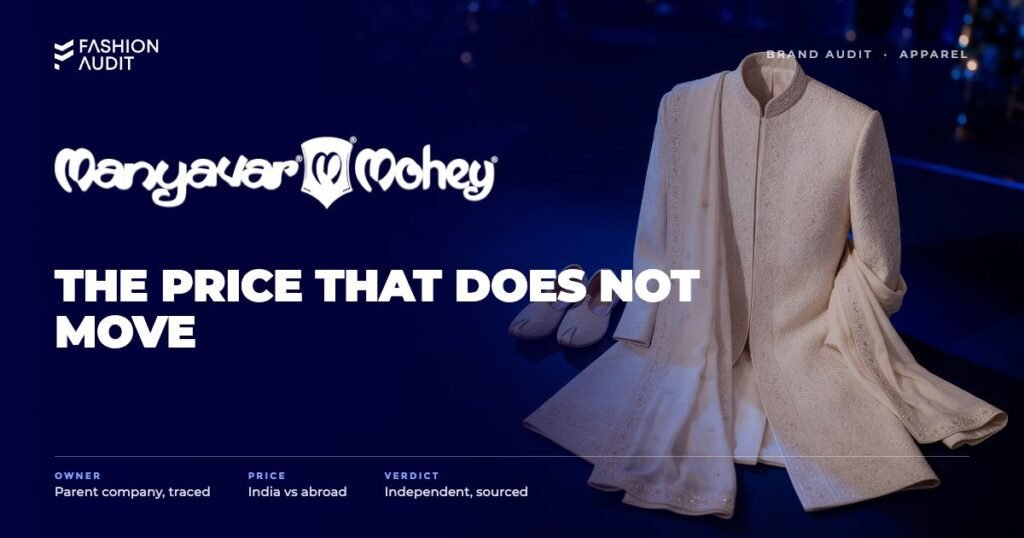
Manyavar sells Indian wedding and celebration wear for men, and it has been doing it since 1999. The company behind it, Vedant Fashions Limited, is listed on both Indian exchanges and is still controlled by the family that started it. On the shelf, the brand’s median price on Myntra on 11 September 2026 was ₹2,624.
That median is also the MRP. Two hundred Manyavar listings were read on Myntra that day and not one of them was reduced — 100% of MRP charged, on a single discount rung. Only one other brand read that day came back the same way. And Manyavar’s own investor presentations and annual report state the pricing policy in writing.
The second reading is about who answers for the garment. Forty Manyavar product records read in full the same day carried one declared manufacturer between them, on all forty: Vedant Fashions Limited, Paridhan Garment Park. That is the company’s own registered office.
Manyavar belongs to Vedant Fashions Limited of Kolkata, incorporated on 24 May 2002 and 74.94% held by the Modi promoter family at 30 June 2026. Of 200 Myntra listings read on 11 September 2026, zero were reduced and the shelf charged 100% of MRP, median ₹2,624 — consistent with a discount policy the company states in writing. Its statutory declaration is the tightest read here: one manufacturer name on 40 of 40 records.
Who owns Manyavar
The brand is sold by Vedant Fashions Limited, CIN L51311WB2002PLC094677, incorporated on 24 May 2002 and registered at Paridhan Garment Park, 19 Canal South Road, Kolkata. Two separate mirrors of the corporate register agree on the number, the date and the address.
- Brand launched
- 1999, as the men’s celebration-wear line
- Operating company
- Vedant Fashions Limited, CIN L51311WB2002PLC094677, incorporated 24 May 2002, Kolkata
- Ownership
- Promoter family 74.94% at 30 June 2026; Ravi Modi is Chairman and Managing Director, Shilpi Modi is Whole Time Director
- Listed
- NSE MANYAVAR, BSE 543463, since February 2022
- Other brands in the group
- Mohey, Twamev, Diwas, Mebaz
- Typical price charged
- ₹2,624 median across 200 Myntra listings; 5,387 listings on the Manyavar facet, plus 1,593 under Diwas by Manyavar
- Shops
- 501 exclusive outlets in 205 Indian cities at 30 June 2026, plus 136 shop-in-shop counters and 14 international
- Checked on
- 11 September 2026
The promoter block is five holders: the Ravi Modi Family Trust at 57.15%, Ravi Modi HUF at 16.00%, Shilpi Modi at 1.09%, Ravi Modi at 0.69% and a fifth promoter holding of two shares. The shareholding filing for the quarter to 30 June 2026 answers “No” to whether any promoter shares are pledged. The public holds the remaining 25.06% across 83,011 holders, the largest category being mutual funds at 10.71% — nowhere near control.
The listing is worth reading slowly, because a 2022 flotation of this size sounds like money raised for the business and it was not. The offer was 3.64 crore shares at ₹866, worth about ₹3,149 crore, and the prospectus dated 9 February 2022 describes it as an offer for sale with no fresh issue at all. Every rupee went to the three selling shareholders — Rhine Holdings Limited, a Kedaara Capital fund and the Ravi Modi Family Trust. Not a rupee went to the company.
What Manyavar costs in India
Two hundred Manyavar listings were read on Myntra on 11 September 2026. A read of that size is a sounding rather than the whole catalogue, which carried 5,387 listings on the brand facet that day. None of the 200 was reduced, the shelf charged 100% of MRP in aggregate, and 27 distinct MRPs produced exactly one discount rung.
- Median MRP across the 200 listings
- ₹2,624
- Median price actually charged
- ₹2,624
- Listings reduced below MRP
- 0 of 200
- Checked on
- 11 September 2026
The company states its position in writing, and has done so for years. The same two lines appear on a slide in its investor presentations dated 10 May 2022, 1 May 2024, 7 May 2025, 10 May 2026 and 27 July 2026: “No discounts/ end-of-season sales for Manyavar brand” and “Uniform pricing across online & offline channels in India”. The annual report for the year to March 2026, published on 9 September 2026, puts it in prose: “Manyavar maintains its brand value with no end-of-season sales or discounts”, and “Our flagship Manyavar brand continued to remain undiscounted, a distinctive position in a retail environment where extensive discounting became commonplace.”
That is what the company published. The reading of 11 September is consistent with it.
How that sits against the rest of the shelf
Seven brands were sounded on Myntra the same day, 200 listings each. The spread is wide.
| Read 11 September 2026 | Share of MRP charged | Listings reduced |
|---|---|---|
| Manyavar | 100% | 0 of 200 |
| Jockey | 100% | 0 of 200 |
| Fabindia | 90.4% | 88 of 200 |
| Chumbak | 79.3% | 156 of 200 |
| Ritu Kumar | 78.9% | 112 of 200 |
| Roadster | 37.4% | 195 of 200 |
| Killer | 30.3% | 190 of 200 |
Against the ethnic-wear shelf read four days earlier the gap is larger still, though the bases differ — those were whole-catalogue reads rather than soundings. Soch charged 71.6% of MRP across 7,662 Myntra listings on 7 September 2026, Biba 65.6% across 4,064, and Libas 43.1% across 10,451, with 96% of its catalogue marked down. A shopper who has learned to wait for the sale on that shelf will wait a long time on this one.
On what the price does next, Vedant Modi told the earnings call of 11 May 2026 that “we will not be taking any price hikes in existing products, but the goal would be to upgrade our collection”, adding that the “best kurtas exist today at INR4,000, some of the new collection that we make will be in the INR4,500 bracket”. The cheaper line is Diwas, launched in 2024 and described in the annual report as value-to-mid premium, sold on Myntra under its own facet with 1,593 listings.
Who answers for the garment
Forty Manyavar records were read in full on Myntra on 11 September 2026. The declared manufacturer is the same string on every one of them: Vedant Fashions Limited, Paridhan Garment Park. Country of origin is India on 40 of 40. Two sellers appear across the forty, with Vedant on 35 of them. A net-quantity declaration appears on 33 of the 40.
A declaration under the packaged commodities rules names the entity legally answerable for the goods, not the workshop that cut and sewed them. The difference matters here, because the company has said in its own documents that it does not make everything itself. The prospectus of 9 February 2022 carries the risk factor: “Other than designing of our products, we rely on outsourcing a significant proportion of our production processes and activities to third-parties, without exclusivity arrangements.” The May 2022 investor presentation says the company manufactures “a) in-house & b) via 3rd party jobbers”. Both statements sit beside the declaration rather than against it: one says who stitches, the other says who is answerable.
Read across the seven brands sounded that day, the two facts move together. The two brands charging 100% of MRP declared the fewest manufacturers — Manyavar one, and Jockey six spellings of the single name Page Industries Limited. The two charging about a third of MRP declared eighteen and sixteen different companies between forty records each, most of them small trading firms. The direction held across all seven.
The brand that will not move its price is also the one that puts a single company’s name on every record.
What the money says
Vedant Fashions is a profitable business by any Indian apparel standard, and its margin has narrowed in every year since 2023. Revenue from operations in the year to March 2026 was ₹1,435.5 crore, up from ₹1,354.9 crore three years earlier. Across those four years the EBITDA margin ran 50.1%, 48.6%, 46.6% and 44.3% — lower each time — and the gross margin slipped from 67.4% to 65.7%. Profit after tax has fallen in each of the last three years. All of those figures are the company’s own, published in its investor presentations, which do not label them standalone or consolidated, and cross-checked against the annual report for the latest year.
| Year to 31 March | Revenue from operations | Profit after tax |
|---|---|---|
| 2023 | ₹1,354.9 crore | ₹429.1 crore |
| 2024 | ₹1,367.5 crore | ₹414.2 crore |
| 2025 | ₹1,386.5 crore | ₹388.5 crore |
| 2026 | ₹1,435.5 crore | ₹375.5 crore |
The most recent quarter runs the other way: revenue of ₹301.4 crore for the three months to 30 June 2026, up 7.2%, and profit after tax of ₹80.6 crore, up 14.7%. The annual report also records cash conversion “improved sharply to 98% in FY26 from 69% in FY25”.
One more number explains the shape of the business. The annual report says retail sales crossed ₹2,000 crore for the first time in the year to March 2026, while revenue from operations was ₹1,435.5 crore. Retail sales are what customers pay at the till; revenue from operations is what the company bills. The two are measured on different bases, so the gap between them is not a single margin figure.
On brand-level detail the group is thin. Five brands are named and described in the annual report — Manyavar, Mohey, Twamev, Diwas and Mebaz — and exactly one number is attached to any of them: Twamev grew 17.4% like-for-like across its exclusive outlets. No brand-wise revenue, store count or average selling price was found for any of the five. A sixth brand, Manthan, appeared in the brand tables of May 2022 and May 2024 and in none since. No filing we could find says why.
The shop count that looks like a collapse, and is not
Anyone comparing Vedant Fashions’ published store numbers across 2026 will find 669 in one document and 501 in the next, three months later.
- 31 Mar 2022595 outlets, 12.7 lakh sq ft, 223 Indian cities
- 31 Mar 2024676 outlets, 17.0 lakh sq ft
- 31 Mar 2025678 outlets, 17.9 lakh sq ft
- 31 Mar 2026669 stores including shop-in-shop counters, 17.9 lakh sq ft
- 30 Jun 2026501 outlets, with 136 shop-in-shop counted separately
The last line counts differently from the one above it.
Investor presentations of May 2022, May 2024, May 2025, May 2026 and July 2026, and the annual report for the year to March 2026.
Vedant Modi put the reason on the call of 27 July 2026: “EBO typically is average 3,000-odd square feet. SIS is a few hundred square feet. So, we didn’t want to carry that confusion for a long time, and we’ve split it off.” An exclusive outlet and a counter inside somebody else’s shop had been added together; from that quarter they are reported separately. The retail area tells the honest version — 17.9 lakh sq ft at March 2026, and 16.7 lakh at June 2026 excluding counters and international. Nothing closed in bulk.
What did happen in the year to March 2026 is slower than the headline suggests. The company added roughly one lakh sq ft gross and ended with a net addition of about 4,200 sq ft, so closures ran at nearly the opening rate. About 5% to 5.5% of total retail area sits in the underperforming category.
The economics of a franchised shop are published in some detail. A franchisee’s capex runs about ₹2,100 to ₹2,150 per sq ft in a tier-two or tier-three city and closer to ₹2,500 in tier one, against annual revenue per sq ft of about ₹7,000, ₹8,500 and ₹10,000 to ₹10,500 respectively. The CFO, Rahul Murarka, described the franchisee margin on 11 May 2026 as a “combination of our 2 models. One is 18% and 29.5% plus GST”, without saying which rate goes with which format.
No filing we could find says how many Manyavar shops the company owns and how many belong to franchisees. The margin, the capex and the sales per square foot a franchisee needs are all published; the count is not. Weigh the network on the published area figures instead.
What the record shows
Vedant Fashions disclosed eight compoundings under the Legal Metrology Act, 2009 and the packaged commodities rules made under it to the stock exchanges between September 2023 and January 2026. Compounding is a settled outcome: the offence is compounded on payment of a fee and the matter ends there, and a compounding is not a finding of guilt.
Two of the eight were read in full, and both concern what is printed on the pack. An order of 31 December 2025 from the Legal Metrology Department in Anantnag and Pulwama, Jammu & Kashmir, was compounded for ₹50,000 paid on 9 January 2026; the contravention under Rule 9 was that the manufacturer’s name and address and the customer-care details were not displayed. A Bangalore matter disclosed on 24 July 2025 was compounded for ₹50,000 remitted on 26 June 2025, under Section 48, for the month and year of packing not being marked.
Who Manyavar is actually for
This is the wedding and festival wardrobe for an Indian man who wants a sherwani, a kurta set or an Indo-western jacket from a shop with a national name over the door, at a median of ₹2,624 on the marketplace. With 501 exclusive outlets across 205 Indian cities plus 136 counters inside other shops, it is reachable from a tier-three town in a way most branded ethnic wear is not.
The case for it is price certainty. You are not competing with a sale you missed, and you are not being told the ₹5,000 kurta is really a ₹12,000 kurta. The case against is the same fact wearing different clothes: no discount is coming, so the tag is the price — and at that price a buyer gets no published fabric weight and no published test to check the cloth against.
Buying Manyavar in India
Expect the full MRP
Zero of 200 listings read on 11 September 2026 were reduced, and the company publishes a uniform-pricing line covering online and offline channels in India. A Manyavar listing priced far below MRP is not the pricing the company describes, wherever it appears.
Read the declaration, not the brand name
On all forty records read, the declared manufacturer was Vedant Fashions Limited at Paridhan Garment Park, Kolkata — the company’s own registered office. A Manyavar-branded listing naming a different company as manufacturer is worth a question before you pay.
Look for the net quantity on the pack
Seven of the forty records read carried no net-quantity declaration. It is printed on the packaging, so in a shop you can simply turn the pack over and read it before buying.
Diwas is the cheaper line, not a cheaper Manyavar
Diwas is a separate brand launched in 2024, sold on Myntra under its own facet with 1,593 listings on 11 September 2026. The company positions it below Manyavar, so compare within the line you actually want.
Common questions
Does Manyavar ever go on sale?
The company states in its investor presentations and its annual report that there are no end-of-season sales or discounts for the Manyavar brand, and that pricing is uniform across online and offline channels in India. A reading of 200 Manyavar listings on Myntra on 11 September 2026 found none reduced and 100% of MRP charged.
Who owns Manyavar?
Vedant Fashions Limited, a Kolkata company incorporated on 24 May 2002 and listed on both Indian exchanges. The Modi promoter family held 74.94% at 30 June 2026, with the Ravi Modi Family Trust alone at 57.15%. Ravi Modi is Chairman and Managing Director. No group parent and no fund holds anything near control.
Where is Manyavar clothing made?
All forty Myntra product records read on 11 September 2026 declared India as the country of origin and Vedant Fashions Limited as manufacturer. The company has separately said it outsources a significant proportion of production to third parties, so the declaration names the entity answerable for the goods rather than the workshop that stitched them.
Why did Manyavar’s store count fall from 669 to 501?
It did not close 168 shops. From the quarter to June 2026 the company reports exclusive outlets separately from shop-in-shop counters, which had previously been counted together. Its own explanation on the call of 27 July 2026 was that an outlet averages about 3,000 sq ft while a counter is a few hundred, so the two were split.
Did Vedant Fashions raise money in its 2022 IPO?
No. The offer was entirely a sale of existing shares by three shareholders, worth about ₹3,149 crore at ₹866 a share, with no fresh issue. The prospectus dated 9 February 2022 records this. The proceeds went to the selling shareholders, not to the company.
References
- FalconEbiz, a mirror of the corporate register — company number, incorporation on 24 May 2002, the Paridhan Garment Park registered office and the RoC.
- The Company Check, a mirror of the corporate register — corroboration of the company number, incorporation date and registered office.
- Vedant Fashions Limited, shareholding pattern at 30 June 2026 — promoter holding of 74.94%, the entity-by-entity split, public holding of 25.06% across 83,011 holders, mutual funds at 10.71%, the no-encumbrance answer, and the NSE and BSE codes.
- Vedant Fashions Limited prospectus, 9 February 2022 — the offer for sale of 3,63,64,838 shares at ₹866 with no fresh issue, the three selling shareholders, and the risk factor on outsourcing production to third parties.
- Business Standard, 16 February 2022 — the listing date and the 8% premium debut.
- Vedant Fashions Limited, annual report for the year to 31 March 2026, published 9 September 2026 — the no-discount statements, revenue, profit and margins for the year, retail sales over ₹2,000 crore, cash conversion of 98%, 669 stores, the five brand descriptions and Twamev’s 17.4% like-for-like growth.
- Vedant Fashions Limited investor presentation, 10 May 2026 — the no-discount and uniform-pricing slide, store count and retail area at 31 March 2026, and the financial series to FY2026.
- Vedant Fashions Limited investor presentation, 27 July 2026 — 501 exclusive outlets excluding 136 shop-in-shop and 14 international, 16.7 lakh sq ft, the quarterly results to 30 June 2026, and the same pricing slide.
- Vedant Fashions Limited investor presentation, 1 May 2024 — 676 outlets and 17.0 lakh sq ft, the FY2023 and FY2024 financials, and the brand table listing Manthan.
- Vedant Fashions Limited investor presentation, 7 May 2025 — 678 outlets and 17.9 lakh sq ft at 31 March 2025, the FY2025 financials, and the brand table without Manthan.
- Vedant Fashions Limited investor presentation, 10 May 2022 — 595 outlets at 31 March 2022, the earliest appearance of the no-discount slide, Manthan in the brand table, and the line on in-house manufacturing and third-party jobbers.
- Vedant Fashions Limited earnings call transcript, 11 May 2026 — the two franchisee margin models, gross against net retail area added in FY2026, the 5% to 5.5% underperforming area, and the price-hike commentary.
- Vedant Fashions Limited earnings call transcript, 27 July 2026 — the explanation of the exclusive-outlet and shop-in-shop split, franchisee capex and required revenue per square foot by city tier, and the Diwas marketplace and quick-commerce tie-ups.
- Vedant Fashions Limited disclosure, 12 January 2026 — the compounding order of 31 December 2025 in Jammu & Kashmir, the Rule 9 contravention on manufacturer and customer-care details, and the ₹50,000 fee.
- Vedant Fashions Limited disclosure, 24 July 2025 — the Bangalore compounding under Section 48 for the month and year of packing not being marked, and the ₹50,000 fee.
- Vedant Fashions Limited, disclosures to the stock exchanges — the Legal Metrology compounding disclosures made between September 2023 and January 2026.
Manyavar is the rare Indian clothing brand where the number on the tag is the number you pay. Two hundred listings read on 11 September 2026, not one reduced — against a shelf where Libas was charging 43.1% of MRP four days earlier. The company states the policy in its annual report and on a slide it has shown investors since 2022, which closes the usual gap between what a brand says and what its listings do. The declaration matches: one company’s name on all forty records read, and it is the company that owns the brand.
What is less settled is everything around the price. The EBITDA margin narrowed each year from FY23 to FY26 on the company’s own published figures, which its presentations do not label standalone or consolidated, and profit after tax fell in each of the last three years. The group names five brands and publishes one brand-level number for any of them. And at ₹2,624 median, nothing published tells a buyer what the cloth actually is.
You will pay full price, and you will know exactly what full price is — which is more than most of this shelf offers, and less than a brand charging it ought to disclose.