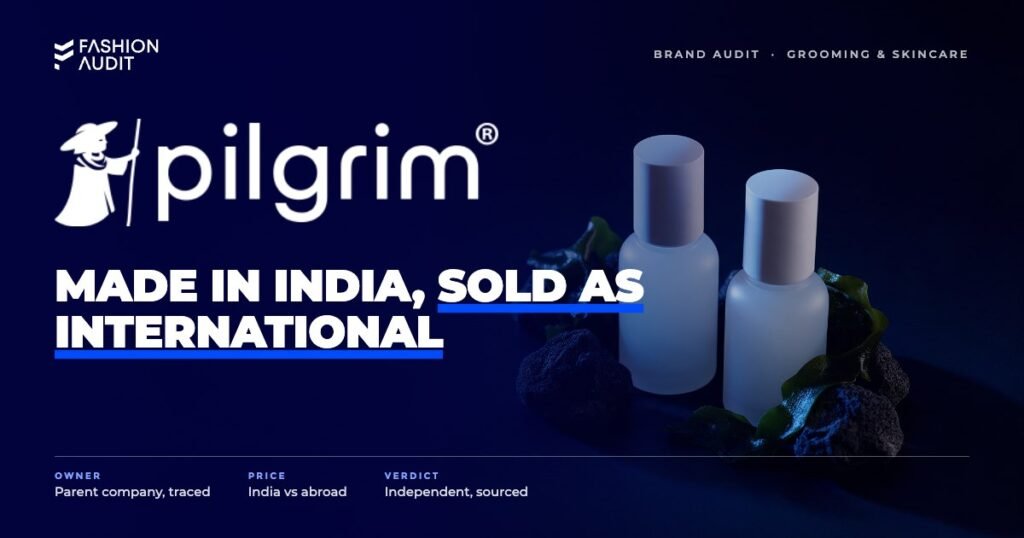
Pilgrim sells a Spanish Squalane moisturiser, a Korean White Lotus sunscreen and a lipstick range called The French Collection. Every one declares Country of Origin: India and names a contract factory in Jammu, Baddi, Parwanoo or Dadra and Nagar Haveli. That is how most Indian skincare is made. But the homepage calls Pilgrim a “Premium International Brand”, so the gap between what the marketing implies and what the pack says is the whole story. Prices checked 1 September 2026.
Pilgrim is a Mumbai company, founded 2019, whose every product examined is made in India by a contractor. Only two products make a real ingredient-origin claim, and neither is backed by a published document. None of its seven sunscreens carries a published SPF report. The MRP is a badge: the brand’s own site sold at a median 28% below it on 1 September 2026.
Snapshot
- Founded
- 2019, Mumbai, by Anurag Kedia and Gagandeep Makker; Heavenly Secrets Private Limited incorporated 28 August 2019
- Current owner
- Founder-controlled and unlisted; Fireside Ventures and Vertex Ventures are investors. Never acquired
- Where it is made
- Contract factories in Jammu, Baddi, Parwanoo and Dadra and Nagar Haveli. Pilgrim owns no plant
- FY25 filed results
- Revenue ₹408.3 crore, net loss ₹68.7 crore, marketing spend ₹234.5 crore
- Price band in India
- Serums ₹361 to ₹499 as charged, sunscreens ₹274 to ₹632; MRPs ₹445 to ₹695
- Per-ml cost
- Serums ₹12 to ₹20 per ml; sunscreens ₹5.48 to ₹9.90 per ml or gram
How it started
Anurag Kedia and Gagandeep Makker, both IIT Bombay alumni, founded Pilgrim in 2019; Heavenly Secrets Private Limited was incorporated in Mumbai on 28 August 2019. A ₹13 crore Series A in June 2021 brought in Fireside Ventures, a $20 million Series B led by Vertex Ventures followed in 2023, and a ₹200 crore primary-and-secondary round announced on 18 March 2025 valued the company at roughly ₹3,000 crore pre-money. Two of the four directors on record are investor nominees, not founders.
- FY21₹5 crore, as stated by the company
- FY23₹72 crore
- FY24₹198.7 crore; net loss ₹26.3 crore
- FY25₹408.3 crore; net loss ₹68.7 crore; marketing ₹234.5 crore
Revenue doubled in a year. The loss grew two and a half times.
Filed annual statements as reported by Inc42 and Startuppedia; FY21 and FY23 as given by the company.
Neither the valuation nor the round is revenue. The filed figure is ₹408.3 crore in FY25 against ₹486.5 crore of expenses, with marketing taking ₹234.5 crore: 57 paise of advertising for every rupee of sales. The About Us page carries no founder story and no word on sourcing; what the founders have said about that lives in press interviews, and it changes.
What they actually make
Pilgrim owns no factory. Every product page examined names a third-party manufacturer and lists Heavenly Secrets only as the marketer, the reverse of what our Campus audit found, where the brand runs its own plants. Across 16 attributions read on 1 September 2026, four contractors do the work.
- Naturis Cosmetics, Jammu9 products, licence JK/21-22/COS-8/334: the serums and moisturisers
- NG Electro Products, Baddi5 products, licence HIM/COS/18/266: five of seven sunscreens
- Kapco International, Parwanoo2 products, licence S-COS/10/19: shampoo, face wash
- Take2 Cosmetics, Dadra and Nagar Haveli1 product: Spanish Collection blush
Kapco International also makes for Mamaearth and Deconstruct, on the same licence.
Manufacturer declarations on discoverpilgrim.com product pages, read 1 September 2026.
The licence numbers on the pack are the factories’ state licences, not Pilgrim’s. Now the provenance claims, against what each page says.
| Product | What the page claims | Made in |
|---|---|---|
| Spanish Squalane moisturiser | “Spanish olive-derived squalane”: a real origin claim, no supplier or certificate published | Jammu |
| Amazonian Patuá shampoo | “Sourced from the heart of the Amazon rainforest”: botanical confirmed in the INCI list, sourcing undocumented | Baddi |
| Korean Rice Water range | “A timeless Korean beauty secret”. Never says the rice water is imported | Jammu, Parwanoo |
| The Spanish Collection makeup | “Inspired by Spanish Flamenco dancers”. The collection page does not mention Spain | Dadra and Nagar Haveli |
Three kinds of claim are mixed together. Two products make a specific ingredient-origin claim that could be checked, and Pilgrim publishes nothing to check it against. Several name a botanical, Kakadu plum or tea tree, that the INCI list confirms, a test the brand passes. The rest use a country as a mood: “Korean” names a tradition, “Spanish” a dance, and The French Collection’s only French word is a shade called “Midnight in Paris”.
A brand can legitimately be inspired by Korea and made in Jammu. The reader just deserves to know which.
The founders have said both things on record. In June 2021 the company described itself as “not merely importing global ingredients”. In 2023 Kedia told Forbes India: “We’re bringing ingredients from the country of origin. That’s the USP of our brand.” The first statement disclaims what the second calls the unique selling point.
Pilgrim publishes no supplier, certificate or origin document for any ingredient, so the Spanish and Amazonian claims can be neither confirmed nor refuted. Look for a supplier name on the carton; if there is none, read the country as a description of the recipe, not the shipment.
The number on the front of the bottle
Twelve Pilgrim products carry a percentage in their name. All twelve publish an ingredient list; none prints the percentage inside it. INCI lists conventionally run in descending order of weight down to 1%, and on seven of the ten products where the full order was captured the active sits where the claim implies, niacinamide second on the 10% serum. That is consistent with the claim, not proof of it.
Two products break the pattern. On the 2% Salicylic Acid serum, salicylic acid is printed 15th of 34 ingredients, behind six botanical extracts and the preservatives, and nothing on the page reconciles that with the 2% on the front. On the 2% Alpha Arbutin serum the list runs “3-O-Ethyl Ascorbic Acid, Alcohol, Allantoin, Alpha Arbutin…” and reaches Purified Water at position 27. That list is alphabetical, so its order says nothing about concentration and the test cannot be run either way.
The sunscreens
Seven sunscreens claim SPF 50 or 50+. Pilgrim publishes no test report, names no laboratory and states no measured UVA value for any of them. The phrase is “clinically tested”, which does not say whether the test was on human skin; in-vivo and in-vitro appear nowhere. Five products from two different factories carry the identical sentence: “Clinically tested to deliver SPF 50+ and PA++++ protection and proven sun defense.”
The 1% Hyaluronic Acid sunscreen has no testing statement at all and substitutes a consumer poll: 96% reported hydration, 97% an invisible finish. A shopper saying a sunscreen felt invisible is not evidence of SPF 50. The 2% Niacinamide Glow Gel Sunscreen is titled PA+++ while its testing line on the same page says PA++++, two different UVA grades. Against Indian brands that publish in-vivo reports with a named lab, Pilgrim sits at the bottom: nothing published on seven of seven.
What Pilgrim costs in India
Every Pilgrim price has two numbers. On 23 products priced on 1 September 2026, the brand’s own site charged a median 28% below MRP, and eight products were 34% to 43% below. A price permanently a third below MRP is the price; the MRP is a reference for the discount badge, the pattern our Sparx audit found in footwear.
| Product, 1 September 2026 | Size and selling price | Per ml or g |
|---|---|---|
| 15% Vitamin C serum | 20 ml, ₹405 (MRP ₹595) | ₹20.25 |
| 10% Vitamin C serum | 30 ml, ₹499 (MRP ₹645) | ₹16.63 |
| 2% Salicylic Acid serum | 30 ml, ₹400 (MRP ₹650) | ₹13.33 |
| Vitamin C Invisible Sunscreen, Kakadu | 45 ml, ₹632 (MRP ₹695) | ₹14.04 |
| 5% Niacinamide gel sunscreen | 50 ml, ₹360 (MRP ₹495) | ₹7.20 |
| 2% Niacinamide gel sunscreen | 50 g, ₹274 (MRP ₹445) | ₹5.48 |
Sunscreen is where Pilgrim is genuinely cheap, at ₹5.48 to ₹9.90 per ml or gram, a third to a half the per-ml cost of the serums; the 45 ml Kakadu Plum sunscreen at ₹14.04 is the exception. Buying “stronger” costs more than the shelf price suggests: the 15% bottle looks cheaper and is the dearest thing per millilitre in the range.
- 10% Vitamin C serum, 30 ml
- ₹499, or ₹16.63 per ml
- 15% Vitamin C serum, 20 ml
- ₹405, or ₹20.25 per ml
- Per-ml premium for the 15%
- +22%
- Checked on
- 1 September 2026
Every page states a 24-month shelf life from manufacture and no period-after-opening figure, the vitamin C serums included.
Who Pilgrim is actually for
Pilgrim suits a buyer who wants a sub-₹500 serum or sunscreen, likes a story with it, and is happy to treat the country on the label as a theme rather than a passport. It suits less well the buyer choosing on the number: Pilgrim prints no percentage you can check against the list, and on two products the order does not help. If you want a sunscreen with a published test, there is none here to read.
Reputation and controversies
The claim that should lead here sits in the homepage’s meta description, the line under the site name in a search result, not in body copy or on any pack. Confirmed twice on 1 September 2026, it reads: “Pilgrim – Premium International Brand | No Animal Testing, No Harmful Chemicals, Natural, Vegan Friendly, FDA Approved.”
The US Food and Drug Administration states that cosmetics, other than colour additives, do not require its approval before sale. There is no such thing as an FDA-approved cosmetic; the category does not exist. And “Premium International Brand” describes a Mumbai company whose every examined product declares Country of Origin: India. The rulings that follow come from the advertising council, a self-regulatory industry body rather than a statutory regulator.
The product pages use “dermatologically tested” and “clinically tested” with no protocol, sample size or laboratory anywhere. The advertising council’s published outcomes include six upheld against Pilgrim, all decided on one day, 20 March 2023, over Facebook advertisements: the White Lotus day cream’s “SPF 50 (PA+++)”, the Red Vine cream that “evens out skin tones in just a few days”, the alpha arbutin serum’s “No Dark Spot Left”, and the hair serum’s “92% observed new hair grow”. Those are findings about what those six advertisements claimed as they then stood. None is a standing bar on a form of words, and nobody has ruled on the product pages as they read on 1 September 2026. The sunscreen claim sits on a range that publishes no test report.
Buying it in India
Pilgrim sells on its own site, Nykaa, Amazon and a growing number of shops. Read the back of the pack before the front, the way our Bata audit asks a reader to separate Bata India, the listed company, from the name on the box.
Find the manufacturer line
The declaration names the factory and its licence number. On Pilgrim it reads Naturis, NG Electro Products, Kapco or Take2; Heavenly Secrets is marketer only.
Find the active in the list
Lists run in descending weight down to 1%. A 2% active behind the preservatives is a question. A list in alphabetical order tells you nothing either way.
Look for a report, not a badge
“Clinically tested” on a sunscreen is a sentence. A published report names a standard, a laboratory and a measured value. Pilgrim’s pages have the sentence.
Do the per-ml sum, then discount the MRP
Divide the selling price by the millilitres: the 20 ml bottle at ₹405 costs more per ml than the 30 ml at ₹499. A shop charging MRP charges a third more than the brand does.
Common questions
Is Pilgrim an Indian brand?
Yes. It is marketed by Heavenly Secrets Private Limited, Mumbai, incorporated 28 August 2019, founder-controlled and never acquired. Every product examined declares Country of Origin: India.
Is Pilgrim FDA approved?
No cosmetic is. The US FDA states that cosmetics, other than colour additives, do not require its approval. The phrase appears in the meta description of Pilgrim’s homepage, not on its packs.
Are Pilgrim sunscreens tested?
Each page says “clinically tested”. Pilgrim publishes no test report, names no laboratory and gives no measured UVA value for any of its seven sunscreens.
Are Pilgrim’s ingredients imported from Spain or Korea?
Two products claim a specific ingredient origin, Spanish squalane and Amazonian Patuá, with no supplier or certificate published for either. The Korean Rice Water pages never claim an import.
How we research and verify brand audits: our methodology.
References
Pilgrim product pages and catalogue below were read on 1 September 2026.
- Pilgrim homepage — meta description “Premium International Brand … FDA Approved”
- QuickCompany, Heavenly Secrets Private Limited — incorporation 28 August 2019, directors
- Inc42, Pilgrim’s growth to ₹400 crore — founders, revenue by year, no owned factory
- Entrepreneur India, 15 June 2021 — Series A; “not merely importing global ingredients”
- Forbes India, 2023 — Series B; “bringing ingredients from the country of origin”
- Entrackr, 18 March 2025 — ₹200 crore round; ₹3,000 crore pre-money valuation
- Inc42, FY25 results — ₹408.3 crore revenue, ₹68.7 crore loss
- Startuppedia, FY25 filings — ₹486.5 crore expenses, ₹234.5 crore marketing
- Pilgrim, 10% Vitamin C Face Serum — Naturis licence JK/21-22/COS-8/334; INCI order
- Pilgrim, 5% Vitamin C Complex Serum Sunscreen — NG Electro licence HIM/COS/18/266; testing sentence
- Pilgrim, The Spanish Collection Blush Duo — “inspired by Spanish Flamenco dancers”; Take2 Cosmetics
- Pilgrim, Spanish Squalane Moisturizer — “Spanish olive-derived squalane”; made in Jammu
- Pilgrim, Amazonian Patuá Shampoo — “sourced from the heart of the Amazon rainforest”; made in Baddi
- Pilgrim, Korean Hydra Glow Gel Face Wash — “Korean beauty secret”; Kapco licence S-COS/10/19
- Pilgrim, The French Collection — “Midnight in Paris” shade
- Pilgrim, 2% Salicylic Acid Serum — salicylic acid 15th of 34
- Pilgrim, 2% Alpha Arbutin Serum — alphabetised ingredient list
- Pilgrim, 1% Hyaluronic Acid Sunscreen Gel — consumer poll in place of a testing statement
- Pilgrim, 2% Niacinamide Glow Gel Sunscreen — PA+++ in the title, PA++++ in the testing line
- Pilgrim full catalogue — MRP and selling prices in the tables
- Pilgrim, 15% Vitamin C Face Serum — 20 ml pack; 24-month shelf life; no after-opening figure
- US FDA, How Cosmetics Are Not FDA-Approved — cosmetics need no FDA approval
- CDSCO, Cosmetics — Cosmetics Rules 2020, state manufacturing licences, Rule 36
- ASCI, complaint outcomes, 2 September 2026 — forty-two entries under Pilgrim’s name; the six upheld on 20 March 2023
Pilgrim’s sunscreens are cheap, at ₹5.48 to ₹9.90 per ml or gram on the brand’s own site, an ingredient list is published on every product we read, and the botanicals it names are the plants it says they are. At the real price, around 28% below MRP, the gel sunscreens are among the least expensive SPF 50 claims on an Indian shelf.
What you pay extra for is the country on the label, and nothing published tells you what that buys. Two ingredient-origin claims, no document behind either. Seven sunscreens, no report behind any. A “2%” serum with the active printed 15th, another whose list is alphabetised, and a meta description that says “FDA Approved” for a category the FDA does not approve.
Buy the ₹274 gel sunscreen if you are buying on price; do not pay ₹20 a millilitre for a country name.